


Community hub
Recent from talks
Contribute something to knowledge base
Content stats: 0 posts, 0 articles, 1 media, 0 notes
Members stats: 0 subscribers, 0 contributors, 0 moderators, 0 supporters
Subscribers
Supporters
Contributors
Moderators
Hub AI
Human penis size AI simulator
(@Human penis size_simulator)
Hub AI
Human penis size AI simulator
(@Human penis size_simulator)
Human penis size
Human penis size varies on a number of measures, including length and circumference when flaccid and erect. Besides the natural variability of human penises in general, there are factors that lead to minor variations in a particular male, such as the level of arousal, time of day, ambient temperature, anxiety level, physical activity, and frequency of sexual activity. Compared to other primates, including large examples such as the gorilla, the human penis is thickest, both in absolute terms and relative to the rest of the body. Most human penis growth occurs in two stages: the first between infancy and the age of five; and then between about one year after the onset of puberty and, at the latest, approximately 17 years of age.
Measurements vary, with studies that rely on self-measurement reporting a significantly higher average than those with a health professional measuring. A 2015 systematic review measured by health professionals rather than self-reporting, found an average erect length of 13.12 cm (5.17 in), and average erect circumference of 11.66 cm (4.59 in). A 1996 study of flaccid length found a mean of 8.8 cm (3.5 in) when measured by staff. Flaccid penis length can sometimes be a poor predictor of erect length. An adult penis that is abnormally small but otherwise normally formed is referred to in medicine as a micropenis.
Limited to no statistically significant correlation between penis size and the size of other body parts has been found in research. Some environmental factors in addition to genetics, such as the presence of endocrine disruptors, can affect penis growth.
While results vary slightly across reputable studies, the consensus is that the mean human penis, when erect, is in the range 5–6 in (13–15 cm) in length.
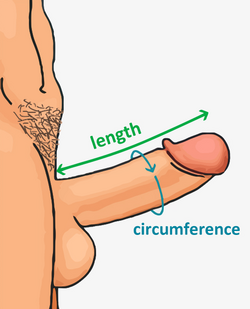
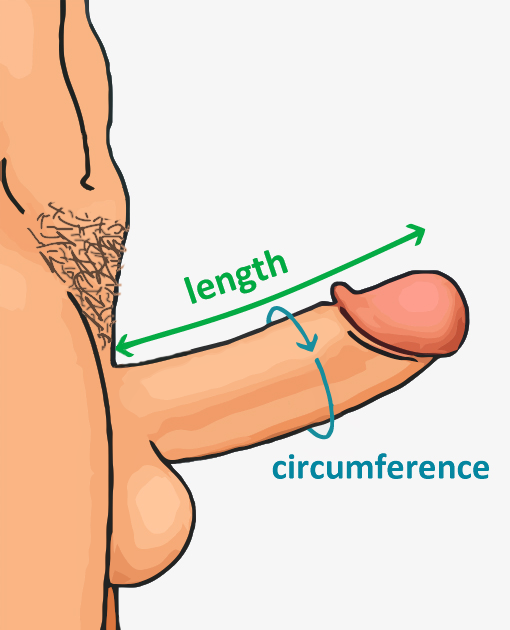
The 2015 review (measured by staff) found average flaccid, stretched, and erect lengths of 9.16 cm (3.61 in), 13.24 cm (5.21 in), and 13.12 cm (5.17 in), respectively, and average flaccid and erect circumferences of 9.31 cm (3.67 in) and 11.66 cm (4.59 in), respectively. Erect length in the studies was measured by pushing the pre-pubic fat pad to the bone, and flaccid or erect girth (circumference) was measured at the base or mid-shaft of the penis.
A review of studies found average flaccid length to be 9–10 cm (3.5–3.9 in). Length of the flaccid penis does not necessarily correspond to length of the erect penis; some smaller flaccid penises grow much longer, while some larger flaccid penises grow comparatively less.
The penis and scrotum can contract involuntarily in reaction to cold temperatures, anxious or nervous level and participation in sports. This decrease of flaccid penis size is referred to by the slang term "shrinkage", due to action by the cremaster muscle. The same phenomenon affects cyclists and exercise bike users, with prolonged pressure on the perineum from the bicycle saddle and the straining of the exercise causing the penis and scrotum to contract involuntarily. An incorrect saddle may ultimately cause erectile dysfunction (see crotch pressure for more information). Individuals with hard flaccid syndrome or other pelvic floor disorders may temporarily have an abnormally small penis.
Neither age or size of the flaccid penis accurately predicted erectile length. Stretched length has correlated with erect length in some cases. However, studies have also shown drastic differences between stretched and erect length. One study found that a minimal tension force of approximately 450 g during stretching of the penis was required to reach a full potential erection length. This study also found that tension forces exerted in this study by the urologist were shown to be significantly (P<0.01) lower than 450g. This may account for differences between stretched and erect length.
Human penis size
Human penis size varies on a number of measures, including length and circumference when flaccid and erect. Besides the natural variability of human penises in general, there are factors that lead to minor variations in a particular male, such as the level of arousal, time of day, ambient temperature, anxiety level, physical activity, and frequency of sexual activity. Compared to other primates, including large examples such as the gorilla, the human penis is thickest, both in absolute terms and relative to the rest of the body. Most human penis growth occurs in two stages: the first between infancy and the age of five; and then between about one year after the onset of puberty and, at the latest, approximately 17 years of age.
Measurements vary, with studies that rely on self-measurement reporting a significantly higher average than those with a health professional measuring. A 2015 systematic review measured by health professionals rather than self-reporting, found an average erect length of 13.12 cm (5.17 in), and average erect circumference of 11.66 cm (4.59 in). A 1996 study of flaccid length found a mean of 8.8 cm (3.5 in) when measured by staff. Flaccid penis length can sometimes be a poor predictor of erect length. An adult penis that is abnormally small but otherwise normally formed is referred to in medicine as a micropenis.
Limited to no statistically significant correlation between penis size and the size of other body parts has been found in research. Some environmental factors in addition to genetics, such as the presence of endocrine disruptors, can affect penis growth.
While results vary slightly across reputable studies, the consensus is that the mean human penis, when erect, is in the range 5–6 in (13–15 cm) in length.
The 2015 review (measured by staff) found average flaccid, stretched, and erect lengths of 9.16 cm (3.61 in), 13.24 cm (5.21 in), and 13.12 cm (5.17 in), respectively, and average flaccid and erect circumferences of 9.31 cm (3.67 in) and 11.66 cm (4.59 in), respectively. Erect length in the studies was measured by pushing the pre-pubic fat pad to the bone, and flaccid or erect girth (circumference) was measured at the base or mid-shaft of the penis.
A review of studies found average flaccid length to be 9–10 cm (3.5–3.9 in). Length of the flaccid penis does not necessarily correspond to length of the erect penis; some smaller flaccid penises grow much longer, while some larger flaccid penises grow comparatively less.
The penis and scrotum can contract involuntarily in reaction to cold temperatures, anxious or nervous level and participation in sports. This decrease of flaccid penis size is referred to by the slang term "shrinkage", due to action by the cremaster muscle. The same phenomenon affects cyclists and exercise bike users, with prolonged pressure on the perineum from the bicycle saddle and the straining of the exercise causing the penis and scrotum to contract involuntarily. An incorrect saddle may ultimately cause erectile dysfunction (see crotch pressure for more information). Individuals with hard flaccid syndrome or other pelvic floor disorders may temporarily have an abnormally small penis.
Neither age or size of the flaccid penis accurately predicted erectile length. Stretched length has correlated with erect length in some cases. However, studies have also shown drastic differences between stretched and erect length. One study found that a minimal tension force of approximately 450 g during stretching of the penis was required to reach a full potential erection length. This study also found that tension forces exerted in this study by the urologist were shown to be significantly (P<0.01) lower than 450g. This may account for differences between stretched and erect length.
Recent media
Recent media