


Community hub
Recent from talks
Contribute something to knowledge base
Content stats: 0 posts, 0 articles, 1 media, 0 notes
Members stats: 0 subscribers, 0 contributors, 0 moderators, 0 supporters
Subscribers
Supporters
Contributors
Moderators
Hub AI
Hydrogen bond AI simulator
(@Hydrogen bond_simulator)
Hub AI
Hydrogen bond AI simulator
(@Hydrogen bond_simulator)
Hydrogen bond
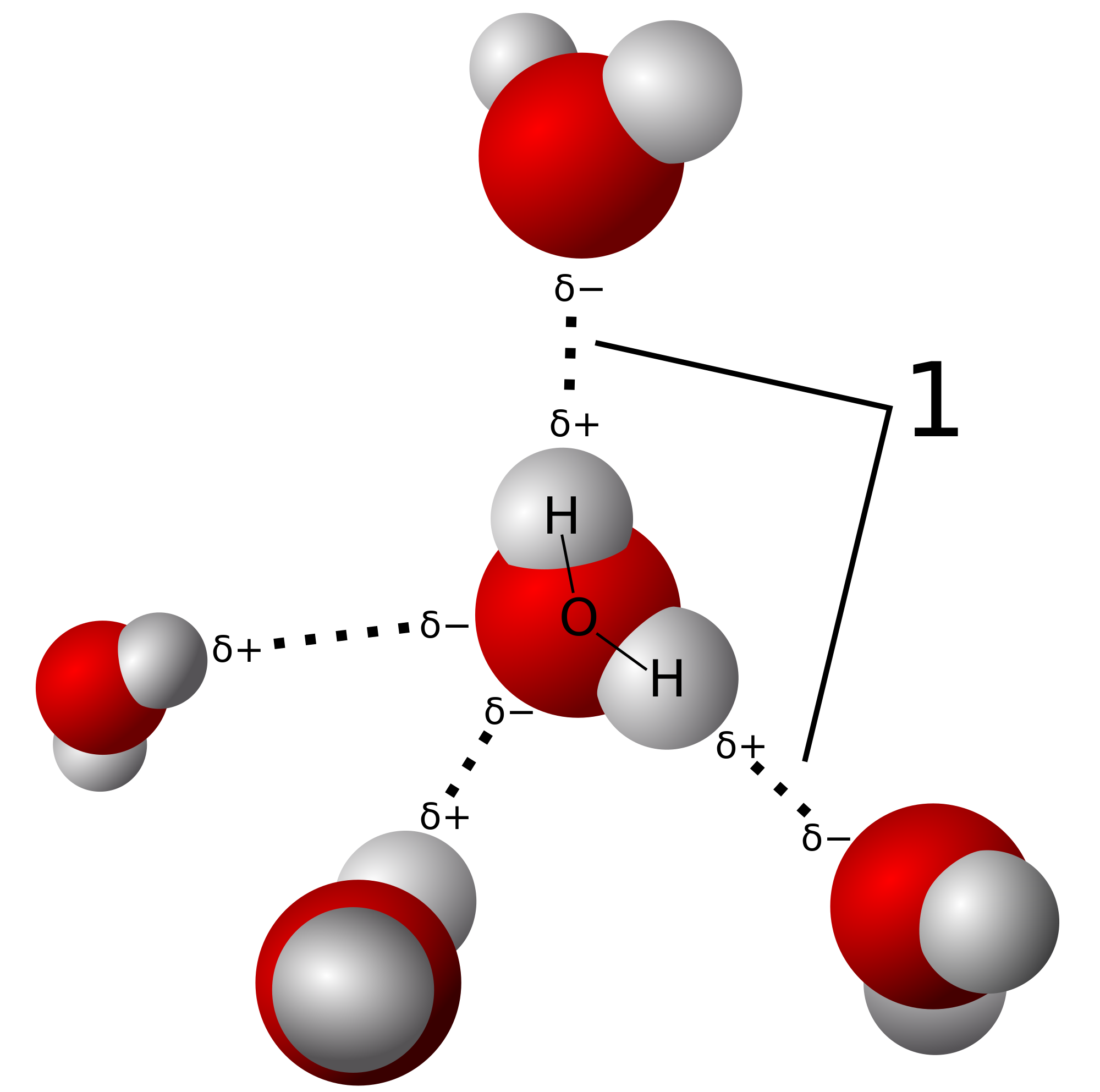
In chemistry, a hydrogen bond (H-bond) is a specific type of molecular interaction that exhibits partial covalent character and cannot be described as a purely electrostatic force. It occurs when a hydrogen (H) atom, covalently bonded to a more electronegative donor atom or group (Dn), interacts with another electronegative atom bearing a lone pair of electrons—the hydrogen bond acceptor (Ac). Unlike simple dipole–dipole interactions, hydrogen bonding arises from charge transfer (nB → σ*AH), orbital interactions, and quantum mechanical delocalization, making it a resonance-assisted interaction rather than a mere electrostatic attraction.
The general notation for hydrogen bonding is Dn−H···Ac, where the solid line represents a polar covalent bond, and the dotted or dashed line indicates the hydrogen bond. The most frequent donor and acceptor atoms are nitrogen (N), oxygen (O), and fluorine (F), due to their high electronegativity and ability to engage in stronger hydrogen bonding.
The term "hydrogen bond" is generally used for well-defined, localized interactions with significant charge transfer and orbital overlap, such as those in DNA base pairing or ice. In contrast, "hydrogen-bonding interactions" is a broader term used when the interaction is weaker, more dynamic, or delocalized, such as in liquid water, supramolecular assemblies (e.g.: lipid membranes, protein-protein interactions), or weak C-H···O interactions. This distinction is particularly relevant in structural biology, materials science, and computational chemistry, where hydrogen bonding spans a continuum from weak van der Waals-like interactions to nearly covalent bonding.
Hydrogen bonding can occur between separate molecules (intermolecular) or within different parts of the same molecule (intramolecular). Its strength varies considerably, depending on geometry, environment, and the donor-acceptor pair, typically ranging from 1 to 40 kcal/mol. This places hydrogen bonds stronger than van der Waals interactions but generally weaker than covalent or ionic bonds.
Hydrogen bonding plays a fundamental role in chemistry, biology, and materials science. It is responsible for the anomalously high boiling point of water, the stabilization of protein and nucleic acid structures, and key properties of materials like paper, wool, and hydrogels. In biological systems, hydrogen bonds mediate molecular recognition, enzyme catalysis, and DNA replication, while in materials science, they contribute to self-assembly, adhesion, and supramolecular organization.
In a hydrogen bond, the electronegative atom not covalently attached to the hydrogen is named the proton acceptor, whereas the one covalently bound to the hydrogen is named the proton donor. This nomenclature is recommended by the IUPAC. The hydrogen of the donor is protic and therefore can act as a Lewis acid and the acceptor is the Lewis base. Hydrogen bonds are represented as H···Y system, where the dots represent the hydrogen bond. Liquids that display hydrogen bonding (such as water) are called associated liquids.[citation needed]
Hydrogen bonds arise from a combination of electrostatics (multipole-multipole and multipole-induced multipole interactions), covalency (charge transfer by orbital overlap), and dispersion (London forces).
In weaker hydrogen bonds, hydrogen atoms tend to bond to elements such as sulfur (S) or chlorine (Cl); even carbon (C) can serve as a donor, particularly when the carbon or one of its neighbors is electronegative (e.g., in chloroform, aldehydes and terminal acetylenes). Gradually, it was recognized that there are many examples of weaker hydrogen bonding involving donor other than N, O, or F and/or acceptor Ac with electronegativity approaching that of hydrogen (rather than being much more electronegative). Although weak (≈1 kcal/mol), "non-traditional" hydrogen bonding interactions are ubiquitous and influence structures of many kinds of materials.[citation needed]
Hydrogen bond
In chemistry, a hydrogen bond (H-bond) is a specific type of molecular interaction that exhibits partial covalent character and cannot be described as a purely electrostatic force. It occurs when a hydrogen (H) atom, covalently bonded to a more electronegative donor atom or group (Dn), interacts with another electronegative atom bearing a lone pair of electrons—the hydrogen bond acceptor (Ac). Unlike simple dipole–dipole interactions, hydrogen bonding arises from charge transfer (nB → σ*AH), orbital interactions, and quantum mechanical delocalization, making it a resonance-assisted interaction rather than a mere electrostatic attraction.
The general notation for hydrogen bonding is Dn−H···Ac, where the solid line represents a polar covalent bond, and the dotted or dashed line indicates the hydrogen bond. The most frequent donor and acceptor atoms are nitrogen (N), oxygen (O), and fluorine (F), due to their high electronegativity and ability to engage in stronger hydrogen bonding.
The term "hydrogen bond" is generally used for well-defined, localized interactions with significant charge transfer and orbital overlap, such as those in DNA base pairing or ice. In contrast, "hydrogen-bonding interactions" is a broader term used when the interaction is weaker, more dynamic, or delocalized, such as in liquid water, supramolecular assemblies (e.g.: lipid membranes, protein-protein interactions), or weak C-H···O interactions. This distinction is particularly relevant in structural biology, materials science, and computational chemistry, where hydrogen bonding spans a continuum from weak van der Waals-like interactions to nearly covalent bonding.
Hydrogen bonding can occur between separate molecules (intermolecular) or within different parts of the same molecule (intramolecular). Its strength varies considerably, depending on geometry, environment, and the donor-acceptor pair, typically ranging from 1 to 40 kcal/mol. This places hydrogen bonds stronger than van der Waals interactions but generally weaker than covalent or ionic bonds.
Hydrogen bonding plays a fundamental role in chemistry, biology, and materials science. It is responsible for the anomalously high boiling point of water, the stabilization of protein and nucleic acid structures, and key properties of materials like paper, wool, and hydrogels. In biological systems, hydrogen bonds mediate molecular recognition, enzyme catalysis, and DNA replication, while in materials science, they contribute to self-assembly, adhesion, and supramolecular organization.
In a hydrogen bond, the electronegative atom not covalently attached to the hydrogen is named the proton acceptor, whereas the one covalently bound to the hydrogen is named the proton donor. This nomenclature is recommended by the IUPAC. The hydrogen of the donor is protic and therefore can act as a Lewis acid and the acceptor is the Lewis base. Hydrogen bonds are represented as H···Y system, where the dots represent the hydrogen bond. Liquids that display hydrogen bonding (such as water) are called associated liquids.[citation needed]
Hydrogen bonds arise from a combination of electrostatics (multipole-multipole and multipole-induced multipole interactions), covalency (charge transfer by orbital overlap), and dispersion (London forces).
In weaker hydrogen bonds, hydrogen atoms tend to bond to elements such as sulfur (S) or chlorine (Cl); even carbon (C) can serve as a donor, particularly when the carbon or one of its neighbors is electronegative (e.g., in chloroform, aldehydes and terminal acetylenes). Gradually, it was recognized that there are many examples of weaker hydrogen bonding involving donor other than N, O, or F and/or acceptor Ac with electronegativity approaching that of hydrogen (rather than being much more electronegative). Although weak (≈1 kcal/mol), "non-traditional" hydrogen bonding interactions are ubiquitous and influence structures of many kinds of materials.[citation needed]
Recent media
Recent media