

Recent from talks
Hyperelastic material
Knowledge base stats:
Talk channels stats:
Members stats:
Hyperelastic material
A hyperelastic or Green elastic material is a type of constitutive model for ideally elastic material for which the stress–strain relationship derives from a strain energy density function. The hyperelastic material is a special case of a Cauchy elastic material.
For many materials, linear elastic models do not accurately describe the observed material behaviour. The most common example of this kind of material is rubber, whose stress-strain relationship can be defined as non-linearly elastic, isotropic and incompressible. Hyperelasticity provides a means of modeling the stress–strain behavior of such materials. The behavior of unfilled, vulcanized elastomers often conforms closely to the hyperelastic ideal. Filled elastomers and biological tissues are also often modeled via the hyperelastic idealization. In addition to being used to model physical materials, hyperelastic materials are also used as fictitious media, e.g. in the third medium contact method.
Ronald Rivlin and Melvin Mooney developed the first hyperelastic models, the Neo-Hookean and Mooney–Rivlin solids. Many other hyperelastic models have since been developed. Other widely used hyperelastic material models include the Ogden model and the Arruda–Boyce model.
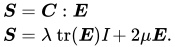
The simplest hyperelastic material model is the Saint Venant–Kirchhoff model which is just an extension of the geometrically linear elastic material model to the geometrically nonlinear regime. This model has the general form and the isotropic form respectively where is tensor contraction, is the second Piola–Kirchhoff stress, is a fourth order stiffness tensor and is the Lagrangian Green strain given by and are the Lamé constants, and is the second order unit tensor.


![{\displaystyle \mathbf {E} ={\frac {1}{2}}\left[(\nabla _{\mathbf {X} }\mathbf {u} )^{\textsf {T}}+\nabla _{\mathbf {X} }\mathbf {u} +(\nabla _{\mathbf {X} }\mathbf {u} )^{\textsf {T}}\cdot \nabla _{\mathbf {X} }\mathbf {u} \right]\,\!}](https://wikimedia.org/api/rest_v1/media/math/render/svg/8c8b59fed4fc1f45e08b5f6ae13fe5e5f2586951)


The strain-energy density function for the Saint Venant–Kirchhoff model is
![{\displaystyle W({\boldsymbol {E}})={\frac {\lambda }{2}}[{\text{tr}}({\boldsymbol {E}})]^{2}+\mu {\text{tr}}{\mathord {\left({\boldsymbol {E}}^{2}\right)}}}](https://wikimedia.org/api/rest_v1/media/math/render/svg/de41de18a428e0920a40050db04bdf7653ef0c5f)
and the second Piola–Kirchhoff stress can be derived from the relation

Hyperelastic material models can be classified as:
Generally, a hyperelastic model should satisfy the Drucker stability criterion. Some hyperelastic models satisfy the Valanis-Landel hypothesis which states that the strain energy function can be separated into the sum of separate functions of the principal stretches :


Hub AI
Hyperelastic material AI simulator
(@Hyperelastic material_simulator)
Hyperelastic material
A hyperelastic or Green elastic material is a type of constitutive model for ideally elastic material for which the stress–strain relationship derives from a strain energy density function. The hyperelastic material is a special case of a Cauchy elastic material.
For many materials, linear elastic models do not accurately describe the observed material behaviour. The most common example of this kind of material is rubber, whose stress-strain relationship can be defined as non-linearly elastic, isotropic and incompressible. Hyperelasticity provides a means of modeling the stress–strain behavior of such materials. The behavior of unfilled, vulcanized elastomers often conforms closely to the hyperelastic ideal. Filled elastomers and biological tissues are also often modeled via the hyperelastic idealization. In addition to being used to model physical materials, hyperelastic materials are also used as fictitious media, e.g. in the third medium contact method.
Ronald Rivlin and Melvin Mooney developed the first hyperelastic models, the Neo-Hookean and Mooney–Rivlin solids. Many other hyperelastic models have since been developed. Other widely used hyperelastic material models include the Ogden model and the Arruda–Boyce model.
The simplest hyperelastic material model is the Saint Venant–Kirchhoff model which is just an extension of the geometrically linear elastic material model to the geometrically nonlinear regime. This model has the general form and the isotropic form respectively where is tensor contraction, is the second Piola–Kirchhoff stress, is a fourth order stiffness tensor and is the Lagrangian Green strain given by and are the Lamé constants, and is the second order unit tensor.
The strain-energy density function for the Saint Venant–Kirchhoff model is
and the second Piola–Kirchhoff stress can be derived from the relation
Hyperelastic material models can be classified as:
Generally, a hyperelastic model should satisfy the Drucker stability criterion. Some hyperelastic models satisfy the Valanis-Landel hypothesis which states that the strain energy function can be separated into the sum of separate functions of the principal stretches :
Recent media