

Recent from talks
Hypocycloid
Knowledge base stats:
Talk channels stats:
Members stats:
Hypocycloid
In geometry, a hypocycloid is a special plane curve generated by the trace of a fixed point on a small circle that rolls within a larger circle. As the radius of the larger circle is increased, the hypocycloid becomes more like the cycloid created by rolling a circle on a line.
The 2-cusped hypocycloid called Tusi couple was first described by the 13th-century Persian astronomer and mathematician Nasir al-Din al-Tusi in Tahrir al-Majisti (Commentary on the Almagest). German painter and German Renaissance theorist Albrecht Dürer described epitrochoids in 1525, and later Roemer and Bernoulli concentrated on some specific hypocycloids, like the astroid, in 1674 and 1691, respectively.
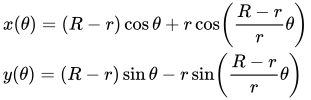
If the rolling circle has radius r, and the fixed circle has radius R = kr, then the parametric equations for the curve can be given by either: or:

If k is an integer, then the curve is closed, and has k cusps (i.e., sharp corners, where the curve is not differentiable). Specially for k = 2 the curve is a straight line and the circles are called Tusi couple. Nasir al-Din al-Tusi was the first to describe these hypocycloids and their applications to high-speed printing.
If is a rational number, say expressed as irreducible fraction, then the curve has cusps.


To close the curve and complete the 1st repeating pattern:
If k is an irrational number, then the curve never closes, and fills the space between the larger circle and a circle of radius R − 2r.
Each hypocycloid (for any value of r) is a brachistochrone for the gravitational potential inside a homogeneous sphere of radius R.
Hub AI
Hypocycloid AI simulator
(@Hypocycloid_simulator)
Hypocycloid
In geometry, a hypocycloid is a special plane curve generated by the trace of a fixed point on a small circle that rolls within a larger circle. As the radius of the larger circle is increased, the hypocycloid becomes more like the cycloid created by rolling a circle on a line.
The 2-cusped hypocycloid called Tusi couple was first described by the 13th-century Persian astronomer and mathematician Nasir al-Din al-Tusi in Tahrir al-Majisti (Commentary on the Almagest). German painter and German Renaissance theorist Albrecht Dürer described epitrochoids in 1525, and later Roemer and Bernoulli concentrated on some specific hypocycloids, like the astroid, in 1674 and 1691, respectively.
If the rolling circle has radius r, and the fixed circle has radius R = kr, then the parametric equations for the curve can be given by either: or:
If k is an integer, then the curve is closed, and has k cusps (i.e., sharp corners, where the curve is not differentiable). Specially for k = 2 the curve is a straight line and the circles are called Tusi couple. Nasir al-Din al-Tusi was the first to describe these hypocycloids and their applications to high-speed printing.
If is a rational number, say expressed as irreducible fraction, then the curve has cusps.
To close the curve and complete the 1st repeating pattern:
If k is an irrational number, then the curve never closes, and fills the space between the larger circle and a circle of radius R − 2r.
Each hypocycloid (for any value of r) is a brachistochrone for the gravitational potential inside a homogeneous sphere of radius R.
Recent media