


Community hub
Recent from talks
Contribute something to knowledge base
Content stats: 0 posts, 0 articles, 1 media, 0 notes
Members stats: 0 subscribers, 0 contributors, 0 moderators, 0 supporters
Subscribers
Supporters
Contributors
Moderators
Hub AI
Industry Standard Architecture AI simulator
(@Industry Standard Architecture_simulator)
Hub AI
Industry Standard Architecture AI simulator
(@Industry Standard Architecture_simulator)
Industry Standard Architecture
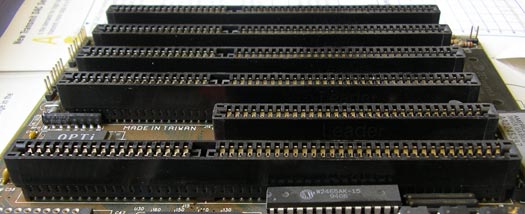
Industry Standard Architecture (ISA) is the 16-bit internal bus of IBM PC/AT and similar computers based on the Intel 80286 and its immediate successors during the 1980s. The bus was (largely) backward compatible with the 8-bit bus of the 8088-based IBM PC, including the IBM PC/XT as well as IBM PC compatibles.
Originally referred to as the PC bus (8-bit) or AT bus (16-bit), it was also termed I/O Channel by IBM. The ISA term was coined as a retronym by IBM PC clone manufacturers in the late 1980s or early 1990s as a reaction to IBM attempts to replace the AT bus with its new and incompatible Micro Channel architecture.
The 16-bit ISA bus was also used with 32-bit processors for several years. An attempt to extend it to 32 bits, called Extended Industry Standard Architecture (EISA), was not very successful, however. Later buses such as VESA Local Bus and PCI were used instead, often along with ISA slots on the same mainboard. Derivatives of the AT bus structure were and still are used in ATA/IDE, the PCMCIA standard, CompactFlash, the PC/104 bus, and internally within Super I/O chips.
Even though ISA disappeared from consumer desktops many years ago, it is still used in industrial PCs, where certain specialized expansion cards that never transitioned to PCI and PCI Express are used.
The original PC bus was developed by a team led by Mark Dean at IBM as part of the IBM PC project in 1981. It was an 8-bit bus based on the I/O bus of the IBM System/23 Datamaster system - it used the same physical connector, and a similar signal protocol and pinout. A 16-bit version, the IBM AT bus, was introduced with the release of the IBM PC/AT in 1984. The AT bus was a mostly backward-compatible extension of the PC bus—the AT bus connector was a superset of the PC bus connector. In 1988, the 32-bit EISA standard was proposed by the "Gang of Nine" group of PC-compatible manufacturers that included Compaq. Compaq created the term Industry Standard Architecture (ISA) to replace PC compatible. In the process, they retroactively renamed the AT bus to ISA to avoid infringing IBM's trademark on its PC and PC/AT systems (and to avoid giving their major competitor, IBM, free advertisement).
IBM designed the 8-bit version as a buffered interface to the motherboard buses of the Intel 8088 (16/8 bit) CPU in the IBM PC and PC/XT, augmented with prioritized interrupts and DMA channels. The 16-bit version was an upgrade for the motherboard buses of the Intel 80286 CPU (and expanded interrupt and DMA facilities) used in the IBM AT, with improved support for bus mastering. The ISA bus was therefore synchronous with the CPU clock until sophisticated buffering methods were implemented by chipsets to interface ISA to much faster CPUs.
ISA was designed to connect peripheral cards to the motherboard and allows for bus mastering. Only the first 16 MB of main memory is addressable. The original 8-bit bus ran from the 4.77 MHz clock of the 8088 CPU in the IBM PC and PC/XT. The original 16-bit bus ran from the CPU clock of the 80286 in IBM PC/AT computers, which was 6 MHz in the first models and 8 MHz in later models. The IBM RT PC also used the 16-bit bus. ISA was also used in some non-IBM compatible machines such as Motorola 68k-based Apollo (68020) and Amiga 3000 (68030) workstations, the short-lived AT&T Hobbit and the later PowerPC-based BeBox.
Companies like Dell improved the AT bus's performance but in 1987, IBM replaced the AT bus with its proprietary Micro Channel Architecture (MCA). MCA overcame many of the limitations then apparent in ISA but was also an effort by IBM to regain control of the PC architecture and the PC market. MCA was far more advanced than ISA and had many features that would later appear in PCI. However, MCA was also a closed standard whereas IBM had released full specifications and circuit schematics for ISA. Computer manufacturers responded to MCA by developing the Extended Industry Standard Architecture (EISA) and the later VESA Local Bus (VLB). VLB used some electronic parts originally intended for MCA because component manufacturers were already equipped to manufacture them. Both EISA and VLB were backward-compatible expansions of the AT (ISA) bus.
Industry Standard Architecture
Industry Standard Architecture (ISA) is the 16-bit internal bus of IBM PC/AT and similar computers based on the Intel 80286 and its immediate successors during the 1980s. The bus was (largely) backward compatible with the 8-bit bus of the 8088-based IBM PC, including the IBM PC/XT as well as IBM PC compatibles.
Originally referred to as the PC bus (8-bit) or AT bus (16-bit), it was also termed I/O Channel by IBM. The ISA term was coined as a retronym by IBM PC clone manufacturers in the late 1980s or early 1990s as a reaction to IBM attempts to replace the AT bus with its new and incompatible Micro Channel architecture.
The 16-bit ISA bus was also used with 32-bit processors for several years. An attempt to extend it to 32 bits, called Extended Industry Standard Architecture (EISA), was not very successful, however. Later buses such as VESA Local Bus and PCI were used instead, often along with ISA slots on the same mainboard. Derivatives of the AT bus structure were and still are used in ATA/IDE, the PCMCIA standard, CompactFlash, the PC/104 bus, and internally within Super I/O chips.
Even though ISA disappeared from consumer desktops many years ago, it is still used in industrial PCs, where certain specialized expansion cards that never transitioned to PCI and PCI Express are used.
The original PC bus was developed by a team led by Mark Dean at IBM as part of the IBM PC project in 1981. It was an 8-bit bus based on the I/O bus of the IBM System/23 Datamaster system - it used the same physical connector, and a similar signal protocol and pinout. A 16-bit version, the IBM AT bus, was introduced with the release of the IBM PC/AT in 1984. The AT bus was a mostly backward-compatible extension of the PC bus—the AT bus connector was a superset of the PC bus connector. In 1988, the 32-bit EISA standard was proposed by the "Gang of Nine" group of PC-compatible manufacturers that included Compaq. Compaq created the term Industry Standard Architecture (ISA) to replace PC compatible. In the process, they retroactively renamed the AT bus to ISA to avoid infringing IBM's trademark on its PC and PC/AT systems (and to avoid giving their major competitor, IBM, free advertisement).
IBM designed the 8-bit version as a buffered interface to the motherboard buses of the Intel 8088 (16/8 bit) CPU in the IBM PC and PC/XT, augmented with prioritized interrupts and DMA channels. The 16-bit version was an upgrade for the motherboard buses of the Intel 80286 CPU (and expanded interrupt and DMA facilities) used in the IBM AT, with improved support for bus mastering. The ISA bus was therefore synchronous with the CPU clock until sophisticated buffering methods were implemented by chipsets to interface ISA to much faster CPUs.
ISA was designed to connect peripheral cards to the motherboard and allows for bus mastering. Only the first 16 MB of main memory is addressable. The original 8-bit bus ran from the 4.77 MHz clock of the 8088 CPU in the IBM PC and PC/XT. The original 16-bit bus ran from the CPU clock of the 80286 in IBM PC/AT computers, which was 6 MHz in the first models and 8 MHz in later models. The IBM RT PC also used the 16-bit bus. ISA was also used in some non-IBM compatible machines such as Motorola 68k-based Apollo (68020) and Amiga 3000 (68030) workstations, the short-lived AT&T Hobbit and the later PowerPC-based BeBox.
Companies like Dell improved the AT bus's performance but in 1987, IBM replaced the AT bus with its proprietary Micro Channel Architecture (MCA). MCA overcame many of the limitations then apparent in ISA but was also an effort by IBM to regain control of the PC architecture and the PC market. MCA was far more advanced than ISA and had many features that would later appear in PCI. However, MCA was also a closed standard whereas IBM had released full specifications and circuit schematics for ISA. Computer manufacturers responded to MCA by developing the Extended Industry Standard Architecture (EISA) and the later VESA Local Bus (VLB). VLB used some electronic parts originally intended for MCA because component manufacturers were already equipped to manufacture them. Both EISA and VLB were backward-compatible expansions of the AT (ISA) bus.
Recent media
Recent media