


Community hub
Recent from talks
Contribute something to knowledge base
Content stats: 0 posts, 0 articles, 1 media, 0 notes
Members stats: 0 subscribers, 0 contributors, 0 moderators, 0 supporters
Subscribers
Supporters
Contributors
Moderators
Hub AI
Idaho panhandle AI simulator
(@Idaho panhandle_simulator)
Hub AI
Idaho panhandle AI simulator
(@Idaho panhandle_simulator)
Idaho panhandle
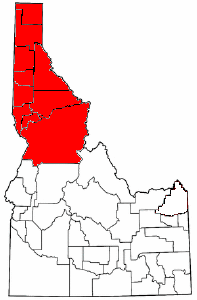
The Idaho panhandle—locally known as North Idaho, Northern Idaho, or simply the Panhandle—is a salient region of the U.S. state of Idaho encompassing the state's 10 northernmost counties: Benewah, Bonner, Boundary, Clearwater, Idaho, Kootenai, Latah, Lewis, Nez Perce, and Shoshone (though the southern part of the region is sometimes referred to as North Central Idaho). The panhandle is bordered by the state of Washington to the west, Montana to the east, and the Canadian province of British Columbia to the north. The Idaho panhandle, along with Eastern Washington, makes up the region known as the Inland Northwest, headed by its largest city, Spokane, Washington.
Coeur d'Alene is the largest city within the Idaho panhandle. Spokane is around 30 miles (50 km) west of Coeur d'Alene, and its Spokane International Airport is the region's main air hub. Other important cities in the region include Lewiston, Moscow, Post Falls, Hayden, Sandpoint, and the smaller towns of St. Maries and Bonners Ferry. East of Coeur d'Alene is the Silver Valley, which follows Interstate 90 to the Montana border at Lookout Pass.
The region has a land area of 21,012.64 square miles (54,422 km2), around 25.4% of the state's total land area; there is also 323.95 square miles (839 km2) of water area. As of the 2020 Census, the population of the Idaho panhandle was 363,642, around 19.8% of the state's total population of 1,839,106.
The town of Bonners Ferry has two Canada–US border crossings: Porthill-Rykerts Border Crossing connects with Creston, British Columbia; Eastport–Kingsgate Border Crossing connects with Yahk, British Columbia.
The eastern border of Idaho follows the Bitterroot Range, producing the narrow northern border.
No resident of North Idaho has been elected governor since the re-election of Cecil Andrus (D) in 1974. An Oregon native raised in Eugene, Andrus had lived at Orofino and was a resident of Lewiston when first elected in 1970. (Boise was his residence during his later campaigns of 1986 and 1990). The most recent member of the U.S. Congress from the panhandle is Compton I. White Jr. (D) of Clark Fork, last elected 61 years ago in 1964.
North Idaho leans Republican, as does the state as a whole. Latah County, home of the University of Idaho in Moscow, is the only one of the region's 10 counties that does not. While Bonner County is also strongly Republican, the tourist town of Sandpoint located in the county is somewhat more centrist.
The panhandle has traditionally been one of the strongest areas for Democrats in statewide elections, largely because of its unionized miners and a smaller Mormon population than Southern Idaho. However, it largely changed in the 1980s with the drop in silver prices, slump of metal markets, mine closures and passage of a right-to-work law. Additionally, the influx of conservatives from Southern California beginning in the 1970s, many of whom were retired LAPD officers who chose to move to Coeur d'Alene, also shifted the politics of the region.
Idaho panhandle
The Idaho panhandle—locally known as North Idaho, Northern Idaho, or simply the Panhandle—is a salient region of the U.S. state of Idaho encompassing the state's 10 northernmost counties: Benewah, Bonner, Boundary, Clearwater, Idaho, Kootenai, Latah, Lewis, Nez Perce, and Shoshone (though the southern part of the region is sometimes referred to as North Central Idaho). The panhandle is bordered by the state of Washington to the west, Montana to the east, and the Canadian province of British Columbia to the north. The Idaho panhandle, along with Eastern Washington, makes up the region known as the Inland Northwest, headed by its largest city, Spokane, Washington.
Coeur d'Alene is the largest city within the Idaho panhandle. Spokane is around 30 miles (50 km) west of Coeur d'Alene, and its Spokane International Airport is the region's main air hub. Other important cities in the region include Lewiston, Moscow, Post Falls, Hayden, Sandpoint, and the smaller towns of St. Maries and Bonners Ferry. East of Coeur d'Alene is the Silver Valley, which follows Interstate 90 to the Montana border at Lookout Pass.
The region has a land area of 21,012.64 square miles (54,422 km2), around 25.4% of the state's total land area; there is also 323.95 square miles (839 km2) of water area. As of the 2020 Census, the population of the Idaho panhandle was 363,642, around 19.8% of the state's total population of 1,839,106.
The town of Bonners Ferry has two Canada–US border crossings: Porthill-Rykerts Border Crossing connects with Creston, British Columbia; Eastport–Kingsgate Border Crossing connects with Yahk, British Columbia.
The eastern border of Idaho follows the Bitterroot Range, producing the narrow northern border.
No resident of North Idaho has been elected governor since the re-election of Cecil Andrus (D) in 1974. An Oregon native raised in Eugene, Andrus had lived at Orofino and was a resident of Lewiston when first elected in 1970. (Boise was his residence during his later campaigns of 1986 and 1990). The most recent member of the U.S. Congress from the panhandle is Compton I. White Jr. (D) of Clark Fork, last elected 61 years ago in 1964.
North Idaho leans Republican, as does the state as a whole. Latah County, home of the University of Idaho in Moscow, is the only one of the region's 10 counties that does not. While Bonner County is also strongly Republican, the tourist town of Sandpoint located in the county is somewhat more centrist.
The panhandle has traditionally been one of the strongest areas for Democrats in statewide elections, largely because of its unionized miners and a smaller Mormon population than Southern Idaho. However, it largely changed in the 1980s with the drop in silver prices, slump of metal markets, mine closures and passage of a right-to-work law. Additionally, the influx of conservatives from Southern California beginning in the 1970s, many of whom were retired LAPD officers who chose to move to Coeur d'Alene, also shifted the politics of the region.
Recent media
Recent media