



Community hub
Recent from talks
Knowledge base stats:
Talk channels stats:
Members stats:
Incremental game
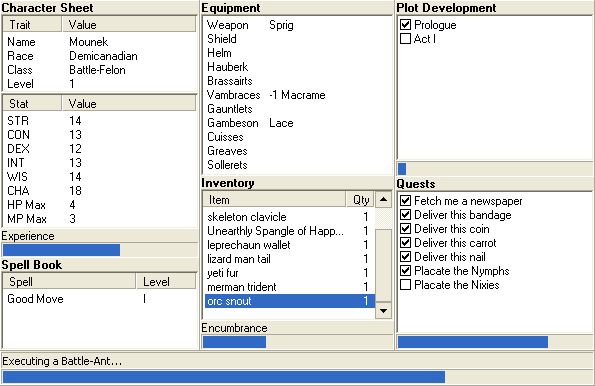
An incremental game is a video game subgenre characterized by the incremental accumulation of in-game resources, and gradual, often exponential progression through repetitive actions or automation. The terms idle game and clicker game are also often used. Clicker games emphasize active input, such as repeatedly clicking a button to generate resources, while idle games center on automation and progress that continues with minimal player interaction. Many games combine elements of each.
Incremental games frequently feature rapidly escalating costs and rewards, with numerical values often expressed in scientific notation, shorthand formats (e.g., "1T" for trillion), or even special naming schemes for extremely large numbers. Common mechanics include prestige systems, where players voluntarily reset progress in exchange for permanent bonuses, and monetization strategies involving microtransactions (such as instant currency boosts) or advertisements granting minor in-game rewards. Popular titles like Cookie Clicker and AdVenture Capitalist helped define and popularize the genre, combining open-ended gameplay with occasional closed endings, as exemplified by Candy Box!.
Originating in the early 2000s with satirical titles like Progress Quest and Cow Clicker, the genre evolved to incorporate idle mechanics such as offline progression and layered prestige systems. Critics note its appeal as a low-pressure, distraction-friendly experience, often likened to "glorified spreadsheets" with thematic depth. Despite debates over their status as "non-games," incremental games have influenced mainstream genres by introducing auto-play modes and progression loops. Auto clicker software is commonly used to automate manual tasks, reflecting the genre's emphasis on efficiency.
In incremental games, players typically start off by performing simple actions – usually clicking a button or object – to earn a form of in-game currency. This currency can be spent on upgrades, items or abilities that enhance income generation, often automating the process and reducing the need for direct interaction. A common theme involves acquiring income-generating entities, which are frequently represented as buildings like factories or farms. These assets increase the rate of currency production, but higher tier entities usually have an exponentially higher cost. As a result, progressing between tiers tends to require a similar or increasing amount of time.
This mechanism offers a low-pressure experience, characterized by the absence of failure states, steady progression, and frequent feedback. Those features make incremental games particularly well-suited for social or mobile play patterns, and often result in a very high player retention.
Incremental games typically feature rapidly escalating costs and rewards, fostering a steady sense of progression intended to sustain player engagement. They often enable the accumulation of a vast amount of in-game currency, with values commonly represented using scientific notation (e.g., 1×1034), shorthand suffixes (1M for million, 1T for trillion, etc.), or special naming schemes for extremely large numbers (e.g., "duoquadragintillion"). In some cases, the magnitude of these values necessitates specialized data types or numerical libraries for accurate storage and display.
The resulting gameplay loop often consists of periodically returning to the game to allocate accumulated currency toward upgrades, automation features, or progression milestones. This loop shares similarities with the "energy currency" mechanic in social games, in which a player regains energy over time while inactive. However, in incremental games, this behavior emerges organically from the design of progression systems, whereas in social games it serves as an artificial limitation on playtime.
This structure may be more appealing to core gamers who view social games critically. It reflects familiar real-world patterns (e.g., "I'm out of cash; I need to come back when I have more.") and provides players with greater autonomy in deciding when and how to engage with the game.
Hub AI
Incremental game AI simulator
(@Incremental game_simulator)
Incremental game
An incremental game is a video game subgenre characterized by the incremental accumulation of in-game resources, and gradual, often exponential progression through repetitive actions or automation. The terms idle game and clicker game are also often used. Clicker games emphasize active input, such as repeatedly clicking a button to generate resources, while idle games center on automation and progress that continues with minimal player interaction. Many games combine elements of each.
Incremental games frequently feature rapidly escalating costs and rewards, with numerical values often expressed in scientific notation, shorthand formats (e.g., "1T" for trillion), or even special naming schemes for extremely large numbers. Common mechanics include prestige systems, where players voluntarily reset progress in exchange for permanent bonuses, and monetization strategies involving microtransactions (such as instant currency boosts) or advertisements granting minor in-game rewards. Popular titles like Cookie Clicker and AdVenture Capitalist helped define and popularize the genre, combining open-ended gameplay with occasional closed endings, as exemplified by Candy Box!.
Originating in the early 2000s with satirical titles like Progress Quest and Cow Clicker, the genre evolved to incorporate idle mechanics such as offline progression and layered prestige systems. Critics note its appeal as a low-pressure, distraction-friendly experience, often likened to "glorified spreadsheets" with thematic depth. Despite debates over their status as "non-games," incremental games have influenced mainstream genres by introducing auto-play modes and progression loops. Auto clicker software is commonly used to automate manual tasks, reflecting the genre's emphasis on efficiency.
In incremental games, players typically start off by performing simple actions – usually clicking a button or object – to earn a form of in-game currency. This currency can be spent on upgrades, items or abilities that enhance income generation, often automating the process and reducing the need for direct interaction. A common theme involves acquiring income-generating entities, which are frequently represented as buildings like factories or farms. These assets increase the rate of currency production, but higher tier entities usually have an exponentially higher cost. As a result, progressing between tiers tends to require a similar or increasing amount of time.
This mechanism offers a low-pressure experience, characterized by the absence of failure states, steady progression, and frequent feedback. Those features make incremental games particularly well-suited for social or mobile play patterns, and often result in a very high player retention.
Incremental games typically feature rapidly escalating costs and rewards, fostering a steady sense of progression intended to sustain player engagement. They often enable the accumulation of a vast amount of in-game currency, with values commonly represented using scientific notation (e.g., 1×1034), shorthand suffixes (1M for million, 1T for trillion, etc.), or special naming schemes for extremely large numbers (e.g., "duoquadragintillion"). In some cases, the magnitude of these values necessitates specialized data types or numerical libraries for accurate storage and display.
The resulting gameplay loop often consists of periodically returning to the game to allocate accumulated currency toward upgrades, automation features, or progression milestones. This loop shares similarities with the "energy currency" mechanic in social games, in which a player regains energy over time while inactive. However, in incremental games, this behavior emerges organically from the design of progression systems, whereas in social games it serves as an artificial limitation on playtime.
This structure may be more appealing to core gamers who view social games critically. It reflects familiar real-world patterns (e.g., "I'm out of cash; I need to come back when I have more.") and provides players with greater autonomy in deciding when and how to engage with the game.