



Community hub
Recent from talks
Contribute something
Nothing was collected or created yet.
Large numbers
View on WikipediaLarge numbers are numbers far larger than those encountered in everyday life, such as simple counting or financial transactions. These quantities appear prominently in mathematics, cosmology, cryptography, and statistical mechanics. Googology studies the naming conventions and properties of these immense numbers.[1][2]
Since the customary decimal format of large numbers can be lengthy, other systems have been devised that allows for shorter representation. For example, a billion is represented as 13 characters (1,000,000,000) in decimal format, but is only 3 characters (109) when expressed in exponential format. A trillion is 17 characters in decimal, but only 4 (1012) in exponential. Values that vary dramatically can be represented and compared graphically via logarithmic scale.
Natural language numbering
[edit]A natural language numbering system represents large numbers using names rather than a series of digits. For example "billion" may be easier to comprehend for some readers than "1,000,000,000". Sometimes it is shortened by using a suffix, for example 2,340,000,000 = 2.34 B (B = billion). A numeric value can be lengthy when expressed in words, for example, "2,345,789" is "two million, three hundred forty five thousand, seven hundred and eighty nine".
Scientific notation
[edit]Scientific notation was devised to represent the vast range of values encountered in scientific research in a format that is more compact than traditional formats yet allows for high precision when called for. A value is represented as a decimal fraction times a multiple power of 10. The factor is intended to make reading comprehension easier than a lengthy series of zeros. For example, 1.0×10⁹ expresses one billion – 1 followed by nine zeros. The reciprocal, one billionth, is 1.0×10⁻⁹. Sometimes the letter e replaces the exponent, for example 1 billion may be expressed as 1e9 instead of 1.0×10⁹.
Examples
[edit]- googol =
- centillion = or , depending on number naming system
- millinillion = or , depending on number naming system
- The largest known Smith number = (101031−1) × (104594 + 3×102297 + 1)1476 ×103913210
- The largest known Mersenne prime = [3]
- googolplex =
- Skewes's numbers: the first is approximately , the second
- Graham's number, larger than what can be represented even using power towers (tetration). However, it can be represented using layers of Knuth's up-arrow notation.
- Kruskal's tree theorem is a sequence relating to graphs. TREE(3) is larger than Graham's number.
- Rayo's number is a large number named after Agustín Rayo which has been claimed to be the largest named number. It was originally defined in a "big number duel" at MIT on 26 January 2007.





Examples of large numbers describing real-world things:
- The number of cells in the human body (estimated at 3.72×10¹³), or 37.2 trillion[4]
- The number of bits on a computer hard disk (as of 2024[update], typically about 1013, 1–2 TB), or 10 trillion
- The number of neuronal connections in the human brain (estimated at 1014), or 100 trillion
- The Avogadro constant is the number of "elementary entities" (usually atoms or molecules) in one mole; the number of atoms in 12 grams of carbon-12 – approximately 6.022×10²³, or 602.2 sextillion.
- The total number of DNA base pairs within the entire biomass on Earth, as a possible approximation of global biodiversity, is estimated at (5.3±3.6)×1037, or 53±36 undecillion[5][6]
- The mass of Earth consists of about 4 × 1051, or 4 sexdecillion, nucleons
- The estimated number of atoms in the observable universe (1080), or 100 quinvigintillion
- The lower bound on the game-tree complexity of chess, also known as the "Shannon number" (estimated at around 10120), or 1 novemtrigintillion.[7] Note that this value of the Shannon number is for Standard Chess. It has even larger values for larger-board chess variants such as Grant Acedrex, Tai Shogi, and Taikyoku Shogi.
Astronomical
[edit]In astronomy and cosmology large numbers for measures of length and time are encountered. For instance, according to the prevailing Big Bang model, the universe is approximately 13.8 billion years old (equivalent to 4.355×10¹⁷ seconds). The observable universe spans 93 billion light years (approximately 8.8×1026 meters) and hosts around 5×10²² stars, organized into roughly 125 billion galaxies (as observed by the Hubble Space Telescope). As a rough estimate, there are about 1080 atoms within the observable universe.[8]
According to Don Page, physicist at the University of Alberta, Canada, the longest finite time that has so far been explicitly calculated by any physicist is
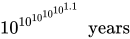
(which corresponds to the scale of an estimated Poincaré recurrence time for the quantum state of a hypothetical box containing a black hole with the estimated mass of the entire universe, observable or not, assuming a certain inflationary model with an inflaton whose mass is 10−6 Planck masses), roughly 10^10^1.288*10^3.884 T [9][10] This time assumes a statistical model subject to Poincaré recurrence. A much simplified way of thinking about this time is in a model where the universe's history repeats itself arbitrarily many times due to properties of statistical mechanics; this is the time scale when it will first be somewhat similar (for a reasonable choice of "similar") to its current state again.
Combinatorial processes give rise to astonishingly large numbers. The factorial function, which quantifies permutations of a fixed set of objects, grows superexponentially as the number of objects increases. Stirling's formula provides a precise asymptotic expression for this rapid growth.
In statistical mechanics, combinatorial numbers reach such immense magnitudes that they are often expressed using logarithms.
Gödel numbers, along with similar representations of bit-strings in algorithmic information theory, are vast—even for mathematical statements of moderate length. Remarkably, certain pathological numbers surpass even the Gödel numbers associated with typical mathematical propositions.
Logician Harvey Friedman has made significant contributions to the study of very large numbers, including work related to Kruskal's tree theorem and the Robertson–Seymour theorem.
"Billions and billions"
[edit]To help viewers of Cosmos distinguish between "millions" and "billions", astronomer Carl Sagan stressed the "b". Sagan never did, however, say "billions and billions". The public's association of the phrase and Sagan came from a Tonight Show skit. Parodying Sagan's effect, Johnny Carson quipped "billions and billions".[11] The phrase has, however, now become a humorous fictitious number—the Sagan. Cf., Sagan Unit.
Standardized system of writing
[edit] |
A standardized way of writing very large numbers allows them to be easily sorted in increasing order, and one can get a good idea of how much larger a number is than another one.
To compare numbers in scientific notation, say 5×10⁴ and 2×10⁵, compare the exponents first, in this case 5 > 4, so 2×10⁵ > 5×10⁴. If the exponents are equal, the mantissa (or coefficient) should be compared, thus 5×10⁴ > 2×10⁴ because 5 > 2.
Tetration with base 10 gives the sequence , the power towers of numbers 10, where denotes a functional power of the function (the function also expressed by the suffix "-plex" as in googolplex, see the googol family).



These are very round numbers, each representing an order of magnitude in a generalized sense. A crude way of specifying how large a number is, is specifying between which two numbers in this sequence it is.
More precisely, numbers in between can be expressed in the form , i.e., with a power tower of 10s, and a number at the top, possibly in scientific notation, e.g. , a number between and (note that if ). (See also extension of tetration to real heights.)






Thus googolplex is .

Another example:
- (between and )



Thus the "order of magnitude" of a number (on a larger scale than usually meant), can be characterized by the number of times (n) one has to take the to get a number between 1 and 10. Thus, the number is between and . As explained, a more precise description of a number also specifies the value of this number between 1 and 10, or the previous number (taking the logarithm one time less) between 10 and 1010, or the next, between 0 and 1.


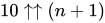
Note that

I.e., if a number x is too large for a representation the power tower can be made one higher, replacing x by log10x, or find x from the lower-tower representation of the log10 of the whole number. If the power tower would contain one or more numbers different from 10, the two approaches would lead to different results, corresponding to the fact that extending the power tower with a 10 at the bottom is then not the same as extending it with a 10 at the top (but, of course, similar remarks apply if the whole power tower consists of copies of the same number, different from 10).

If the height of the tower is large, the various representations for large numbers can be applied to the height itself. If the height is given only approximately, giving a value at the top does not make sense, so the double-arrow notation (e.g. ) can be used. If the value after the double arrow is a very large number itself, the above can recursively be applied to that value.

Examples:
- (between and )
- (between and )
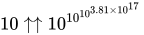





Similarly to the above, if the exponent of is not exactly given then giving a value at the right does not make sense, and instead of using the power notation of , it is possible to add to the exponent of , to obtain e.g. .



If the exponent of is large, the various representations for large numbers can be applied to this exponent itself. If this exponent is not exactly given then, again, giving a value at the right does not make sense, and instead of using the power notation of it is possible use the triple arrow operator, e.g. .

If the right-hand argument of the triple arrow operator is large the above applies to it, obtaining e.g. (between and ). This can be done recursively, so it is possible to have a power of the triple arrow operator.



Then it is possible to proceed with operators with higher numbers of arrows, written .

Compare this notation with the hyper operator and the Conway chained arrow notation:
- = ( a → b → n ) = hyper(a, n + 2, b)

An advantage of the first is that when considered as function of b, there is a natural notation for powers of this function (just like when writing out the n arrows): . For example:

- = ( 10 → ( 10 → ( 10 → b → 2 ) → 2 ) → 2 )

and only in special cases the long nested chain notation is reduced; for obtains:

- = ( 10 → 3 → 3 )

Since the b can also be very large, in general it can be written instead a number with a sequence of powers with decreasing values of n (with exactly given integer exponents ) with at the end a number in ordinary scientific notation. Whenever a is too large to be given exactly, the value of is increased by 1 and everything to the right of is rewritten.


For describing numbers approximately, deviations from the decreasing order of values of n are not needed. For example, , and . Thus is obtained the somewhat counterintuitive result that a number x can be so large that, in a way, x and 10x are "almost equal" (for arithmetic of large numbers see also below).


If the superscript of the upward arrow is large, the various representations for large numbers can be applied to this superscript itself. If this superscript is not exactly given then there is no point in raising the operator to a particular power or to adjust the value on which it act, instead it is possible to simply use a standard value at the right, say 10, and the expression reduces to with an approximate n. For such numbers the advantage of using the upward arrow notation no longer applies, so the chain notation can be used instead.

The above can be applied recursively for this n, so the notation is obtained in the superscript of the first arrow, etc., or a nested chain notation, e.g.:
- (10 → 10 → (10 → 10 → ) ) =

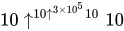
If the number of levels gets too large to be convenient, a notation is used where this number of levels is written down as a number (like using the superscript of the arrow instead of writing many arrows). Introducing a function = (10 → 10 → n), these levels become functional powers of f, allowing us to write a number in the form where m is given exactly and n is an integer which may or may not be given exactly (for example: ). If n is large, any of the above can be used for expressing it. The "roundest" of these numbers are those of the form fm(1) = (10→10→m→2). For example,




Compare the definition of Graham's number: it uses numbers 3 instead of 10 and has 64 arrow levels and the number 4 at the top; thus , but also .


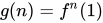
If m in is too large to give exactly, it is possible to use a fixed n, e.g. n = 1, and apply the above recursively to m, i.e., the number of levels of upward arrows is itself represented in the superscripted upward-arrow notation, etc. Using the functional power notation of f this gives multiple levels of f. Introducing a function these levels become functional powers of g, allowing us to write a number in the form where m is given exactly and n is an integer which may or may not be given exactly. For example, if (10→10→m→3) = gm(1). If n is large any of the above can be used for expressing it. Similarly a function h, etc. can be introduced. If many such functions are required, they can be numbered instead of using a new letter every time, e.g. as a subscript, such that there are numbers of the form where k and m are given exactly and n is an integer which may or may not be given exactly. Using k=1 for the f above, k=2 for g, etc., obtains (10→10→n→k) = . If n is large any of the above can be used to express it. Thus is obtained a nesting of forms where going inward the k decreases, and with as inner argument a sequence of powers with decreasing values of n (where all these numbers are exactly given integers) with at the end a number in ordinary scientific notation.





When k is too large to be given exactly, the number concerned can be expressed as =(10→10→10→n) with an approximate n. Note that the process of going from the sequence =(10→n) to the sequence =(10→10→n) is very similar to going from the latter to the sequence =(10→10→10→n): it is the general process of adding an element 10 to the chain in the chain notation; this process can be repeated again (see also the previous section). Numbering the subsequent versions of this function a number can be described using functions , nested in lexicographical order with q the most significant number, but with decreasing order for q and for k; as inner argument yields a sequence of powers with decreasing values of n (where all these numbers are exactly given integers) with at the end a number in ordinary scientific notation.


For a number too large to write down in the Conway chained arrow notation it size can be described by the length of that chain, for example only using elements 10 in the chain; in other words, one could specify its position in the sequence 10, 10→10, 10→10→10, .. If even the position in the sequence is a large number same techniques can be applied again.
Examples
[edit]Numbers expressible in decimal notation:
- 22 = 4
- 222 = 2 ↑↑ 3 = 16
- 33 = 27
- 44 = 256
- 55 = 3,125
- 66 = 46,656
- = 2 ↑↑ 4 = 2↑↑↑3 = 65,536
- 77 = 823,543
- 106 = 1,000,000 = 1 million
- 88 = 16,777,216
- 99 = 387,420,489
- 109 = 1,000,000,000 = 1 billion
- 1010 = 10,000,000,000
- 1012 = 1,000,000,000,000 = 1 trillion
- 333 = 3 ↑↑ 3 = 7,625,597,484,987 ≈ 7.63 × 10¹²
- 1015 = 1,000,000,000,000,000 = 1 million billion = 1 quadrillion
- 1018 = 1,000,000,000,000,000,000 = 1 billion billion = 1 quintilion

Numbers expressible in scientific notation:
- Approximate number of atoms in the observable universe = 1080 = 100,000,000,000,000,000,000,000,000,000,000,000,000,000,000,000,000,000,000,000,000,000,000,000,000,000,000
- googol = 10100 = 10,000,000,000,000,000,000,000,000,000,000,000,000,000,000,000,000,000,000,000,000,000,000,000,000,000,000,000,000,000,000,000,000,000[12]
- 444 = 4 ↑↑ 3 = 2512 ≈ 1.34 × 10154 ≈ (10 ↑)2 2.2
- Approximate number of Planck volumes composing the volume of the observable universe = 8.5 × 10184
- 555 = 5 ↑↑ 3 = 53125 ≈ 1.91 × 102184 ≈ (10 ↑)2 3.3
- 666 = 6 ↑↑ 3 ≈ 2.66 × 1036,305 ≈ (10 ↑)2 4.6
- 777 = 7 ↑↑ 3 ≈ 3.76 × 10695,974 ≈ (10 ↑)2 5.8
- 888 = 8 ↑↑ 3 ≈ 6.01 × 1015,151,335 ≈ (10 ↑)2 7.2
- , the 52nd and as of October 2024[update] the largest known Mersenne prime.[3]
- 999 = 9 ↑↑ 3 ≈ 4.28 × 10369,693,099 ≈ (10 ↑)2 8.6
- 101010 =10 ↑↑ 3 = 1010,000,000,000 = (10 ↑)3 1



Numbers expressible in (10 ↑)n k notation:
- googolplex =
- 10 ↑↑ 5 = (10 ↑)5 1
- 3 ↑↑ 6 ≈ (10 ↑)5 1.10
- 2 ↑↑ 8 ≈ (10 ↑)5 4.3
- 10 ↑↑ 6 = (10 ↑)6 1
- 10 ↑↑↑ 2 = 10 ↑↑ 10 = (10 ↑)10 1
- 2 ↑↑↑↑ 3 = 2 ↑↑↑ 4 = 2 ↑↑ 65,536 ≈ (10 ↑)65,533 4.3 is between 10 ↑↑ 65,533 and 10 ↑↑ 65,534





Bigger numbers:
- 3 ↑↑↑ 3 = 3 ↑↑ (3 ↑↑ 3) ≈ 3 ↑↑ 7.6 × 10¹² ≈ 10 ↑↑ 7.6 × 10¹² is between (10 ↑↑)2 2 and (10 ↑↑)2 3
- = ( 10 → 3 → 3 )
- = ( 10 → 4 → 3 )
- = ( 10 → 5 → 3 )
- = ( 10 → 6 → 3 )
- = ( 10 → 7 → 3 )
- = ( 10 → 8 → 3 )
- = ( 10 → 9 → 3 )
- = ( 10 → 2 → 4 ) = ( 10 → 10 → 3 )
- The first term in the definition of Graham's number, g1 = 3 ↑↑↑↑ 3 = 3 ↑↑↑ (3 ↑↑↑ 3) ≈ 3 ↑↑↑ (10 ↑↑ 7.6 × 10¹²) ≈ 10 ↑↑↑ (10 ↑↑ 7.6 × 10¹²) is between (10 ↑↑↑)2 2 and (10 ↑↑↑)2 3 (See Graham's number#Magnitude)
- = (10 → 3 → 4)
- = ( 4 → 4 → 4 )
- = ( 10 → 4 → 4 )
- = ( 10 → 5 → 4 )
- = ( 10 → 6 → 4 )
- = ( 10 → 7 → 4 )
- = ( 10 → 8 → 4 )
- = ( 10 → 9 → 4 )
- = ( 10 → 2 → 5 ) = ( 10 → 10 → 4 )
- ( 2 → 3 → 2 → 2 ) = ( 2 → 3 → 8 )
- ( 3 → 2 → 2 → 2 ) = ( 3 → 2 → 9 ) = ( 3 → 3 → 8 )
- ( 10 → 10 → 10 ) = ( 10 → 2 → 11 )
- ( 10 → 2 → 2 → 2 ) = ( 10 → 2 → 100 )
- ( 10 → 10 → 2 → 2 ) = ( 10 → 2 → ) =
- The second term in the definition of Graham's number, g2 = 3 ↑g1 3 > 10 ↑g1 – 1 10.
- ( 10 → 10 → 3 → 2 ) = (10 → 10 → (10 → 10 → ) ) =
- g3 = (3 → 3 → g2) > (10 → 10 → g2 – 1) > (10 → 10 → 3 → 2)
- g4 = (3 → 3 → g3) > (10 → 10 → g3 – 1) > (10 → 10 → 4 → 2)
- ...
- g9 = (3 → 3 → g8) is between (10 → 10 → 9 → 2) and (10 → 10 → 10 → 2)
- ( 10 → 10 → 10 → 2 )
- g10 = (3 → 3 → g9) is between (10 → 10 → 10 → 2) and (10 → 10 → 11 → 2)
- ...
- g63 = (3 → 3 → g62) is between (10 → 10 → 63 → 2) and (10 → 10 → 64 → 2)
- ( 10 → 10 → 64 → 2 )
- Graham's number, g64[13]
- ( 10 → 10 → 65 → 2 )
- ( 10 → 10 → 10 → 3 )
- ( 10 → 10 → 10 → 4 )
- ( 10 → 10 → 10 → 10 )
- ( 10 → 10 → 10 → 10 → 10 )
- ( 10 → 10 → 10 → 10 → 10 → 10 )
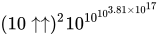
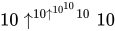
- ( 10 → 10 → 10 → 10 → 10 → 10 → 10 → ... → 10 → 10 → 10 → 10 → 10 → 10 → 10 → 10 ) where there are ( 10 → 10 → 10 ) "10"s






















Other notations
[edit]Some notations for extremely large numbers:
- Knuth's up-arrow notation, hyperoperators, Ackermann function, including tetration
- Conway chained arrow notation
- Steinhaus-Moser notation; apart from the method of construction of large numbers, this also involves a graphical notation with polygons. Alternative notations, like a more conventional function notation, can also be used with the same functions.
- Fast-growing hierarchy
These notations are essentially functions of integer variables, which increase very rapidly with those integers. Ever-faster-increasing functions can easily be constructed recursively by applying these functions with large integers as argument.
A function with a vertical asymptote is not helpful in defining a very large number, although the function increases very rapidly: one has to define an argument very close to the asymptote, i.e. use a very small number, and constructing that is equivalent to constructing a very large number, e.g. the reciprocal.
Comparison of base values
[edit]The following illustrates the effect of a base different from 10, base 100. It also illustrates representations of numbers and the arithmetic.
, with base 10 the exponent is doubled.
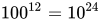
, ditto.

, the highest exponent is very little more than doubled (increased by log102).

- (thus if n is large it seems fair to say that is "approximately equal to" )
- (compare ; thus if n is large it seems fair to say that is "approximately equal to" )
- (compare )
- (compare )
- (compare ; if n is large this is "approximately" equal)

















Accuracy
[edit]For a number , one unit change in n changes the result by a factor 10. In a number like , with the 6.2 the result of proper rounding using significant figures, the true value of the exponent may be 50 less or 50 more. Hence the result may be a factor too large or too small. This seems like extremely poor accuracy, but for such a large number it may be considered fair (a large error in a large number may be "relatively small" and therefore acceptable).


For very large numbers
[edit]In the case of an approximation of an extremely large number, the relative error may be large, yet there may still be a sense in which one wants to consider the numbers as "close in magnitude". For example, consider
- and

The relative error is

a large relative error. However, one can also consider the relative error in the logarithms; in this case, the logarithms (to base 10) are 10 and 9, so the relative error in the logarithms is only 10%.
The point is that exponential functions magnify relative errors greatly – if a and b have a small relative error,
- and


the relative error is larger, and
- and


will have an even larger relative error. The question then becomes: on which level of iterated logarithms to compare two numbers? There is a sense in which one may want to consider
- and


to be "close in magnitude". The relative error between these two numbers is large, and the relative error between their logarithms is still large; however, the relative error in their second-iterated logarithms is small:
- and


Such comparisons of iterated logarithms are common, e.g., in analytic number theory.
Classes
[edit]One solution to the problem of comparing large numbers is to define classes of numbers, such as the system devised by Robert Munafo,[14] which is based on different "levels" of perception of an average person. Class 0 – numbers between zero and six – is defined to contain numbers that are easily subitized, that is, numbers that show up very frequently in daily life and are almost instantly comparable. Class 1 – numbers between six and 1,000,000=106 – is defined to contain numbers whose decimal expressions are easily subitized, that is, numbers who are easily comparable not by cardinality, but "at a glance" given the decimal expansion.
Each class after these are defined in terms of iterating this base-10 exponentiation, to simulate the effect of another "iteration" of human indistinguishability. For example, class 5 is defined to include numbers between 101010106 and 10101010106, which are numbers where X becomes humanly indistinguishable from X2 [15] (taking iterated logarithms of such X yields indistinguishibility firstly between log(X) and 2log(X), secondly between log(log(X)) and 1+log(log(X)), and finally an extremely long decimal expansion whose length can't be subitized).
Approximate arithmetic
[edit]There are some general rules relating to the usual arithmetic operations performed on very large numbers:
- The sum and the product of two very large numbers are both "approximately" equal to the larger one.

Hence:
- A very large number raised to a very large power is "approximately" equal to the larger of the following two values: the first value and 10 to the power the second. For example, for very large there is (see e.g. the computation of mega) and also . Thus , see table.



Systematically creating ever-faster-increasing sequences
[edit]Given a strictly increasing integer sequence/function (n≥1), it is possible to produce a faster-growing sequence (where the superscript n denotes the nth functional power). This can be repeated any number of times by letting , each sequence growing much faster than the one before it. Thus it is possible to define , which grows much faster than any for finite k (here ω is the first infinite ordinal number, representing the limit of all finite numbers k). This is the basis for the fast-growing hierarchy of functions, in which the indexing subscript is extended to ever-larger ordinals.

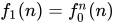

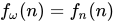

For example, starting with f0(n) = n + 1:
- f1(n) = f0n(n) = n + n = 2n
- f2(n) = f1n(n) = 2nn > (2 ↑) n for n ≥ 2 (using Knuth up-arrow notation)
- f3(n) = f2n(n) > (2 ↑)n n ≥ 2 ↑2 n for n ≥ 2
- fk+1(n) > 2 ↑k n for n ≥ 2, k < ω
- fω(n) = fn(n) > 2 ↑n – 1 n > 2 ↑n − 2 (n + 3) − 3 = A(n, n) for n ≥ 2, where A is the Ackermann function (of which fω is a unary version)
- fω+1(64) > fω64(6) > Graham's number (= g64 in the sequence defined by g0 = 4, gk+1 = 3 ↑gk 3)
- This follows by noting fω(n) > 2 ↑n – 1 n > 3 ↑n – 2 3 + 2, and hence fω(gk + 2) > gk+1 + 2
- fω(n) > 2 ↑n – 1 n = (2 → n → n-1) = (2 → n → n-1 → 1) (using Conway chained arrow notation)
- fω+1(n) = fωn(n) > (2 → n → n-1 → 2) (because if gk(n) = X → n → k then X → n → k+1 = gkn(1))
- fω+k(n) > (2 → n → n-1 → k+1) > (n → n → k)
- fω2(n) = fω+n(n) > (n → n → n) = (n → n → n→ 1)
- fω2+k(n) > (n → n → n → k)
- fω3(n) > (n → n → n → n)
- fωk(n) > (n → n → ... → n → n) (Chain of k+1 n's)
- fω2(n) = fωn(n) > (n → n → ... → n → n) (Chain of n+1 n's)
In some noncomputable sequences
[edit]The busy beaver function Σ is an example of a function which grows faster than any computable function. Its value for even relatively small input is huge. The values of Σ(n) for n = 1, 2, 3, 4, 5 are 1, 4, 6, 13, 4098[16] (sequence A028444 in the OEIS). Σ(6) is not known but is at least 10↑↑15.
Infinite numbers
[edit]Although all the numbers discussed above are very large, they are all still finite. Certain fields of mathematics define infinite and transfinite numbers. For example, aleph-null is the cardinality of the infinite set of natural numbers, and aleph-one is the next greatest cardinal number. is the cardinality of the reals. The proposition that is known as the continuum hypothesis.


See also
[edit]- Arbitrary-precision arithmetic – Calculations where numbers' precision is only limited by computer memory
- Dirac large numbers hypothesis – Hypothesis relating age of the universe to physical constants
- Exponential growth – Growth of quantities at rate proportional to the current amount
- History of large numbers
- Human scale – Concept that takes people as the primary measure of development
- Indefinite and fictitious numbers
- Indian numbering system – Indian convention of naming large numbers
- Infinity – Mathematical concept
- Law of large numbers – Averages of repeated trials converge to the expected value
- List of arbitrary-precision arithmetic software
- Long and short scales – Two meanings of "billion" and "trillion"
- Myriad – Order of magnitude name for 10,000
- Names of large numbers
- Orders of magnitude – Scale of numbers with a fixed ratio
- Power of 10 – Ten raised to an integer power
- Power of two – Two raised to an integer power
- Tetration – Arithmetic operation
References
[edit]- ^ Darling, David; Banerjee, Agnijo (2018-01-01). Weird Maths: At the Edge of Infinity and Beyond. Harper Collins. ISBN 978-93-5277-990-1.
- ^ Nowlan, Robert A. (2017-04-09). "Chapter 14: Large and Small" (PDF). Masters of Mathematics: The Problems They Solved, Why These Are Important, and What You Should Know about Them. Brill Publishers (published 2019). p. 220. ISBN 978-94-6300-892-1.
- ^ a b "Mersenne Prime Discovery - 2^136279841 is Prime!". Great Internet Mersenne Prime Search.
- ^ Bianconi, Eva; Piovesan, Allison; Facchin, Federica; Beraudi, Alina; Casadei, Raffaella; Frabetti, Flavia; Vitale, Lorenza; Pelleri, Maria Chiara; Tassani, Simone (Nov–Dec 2013). "An estimation of the number of cells in the human body". Annals of Human Biology. 40 (6): 463–471. doi:10.3109/03014460.2013.807878. hdl:11585/152451. ISSN 1464-5033. PMID 23829164. S2CID 16247166.
- ^ Landenmark HK, Forgan DH, Cockell CS (June 2015). "An Estimate of the Total DNA in the Biosphere". PLOS Biology. 13 (6) e1002168. doi:10.1371/journal.pbio.1002168. PMC 4466264. PMID 26066900.
- ^ Nuwer R (18 July 2015). "Counting All the DNA on Earth". The New York Times. New York. ISSN 0362-4331. Retrieved 2015-07-18.
- ^ Shannon, Claude (March 1950). "XXII. Programming a Computer for Playing Chess" (PDF). Philosophical Magazine. Series 7. 41 (314). Archived from the original (PDF) on 2010-07-06. Retrieved 2019-01-25.
- ^ Atoms in the Universe. Universe Today. 30-07-2009. Retrieved 02-03-13.
- ^ Information Loss in Black Holes and/or Conscious Beings?, Don N. Page, Heat Kernel Techniques and Quantum Gravity (1995), S. A. Fulling (ed), p. 461. Discourses in Mathematics and its Applications, No. 4, Texas A&M University Department of Mathematics. arXiv:hep-th/9411193. ISBN 0-9630728-3-8.
- ^ How to Get A Googolplex
- ^ Carl Sagan takes questions more from his 'Wonder and Skepticism' CSICOP 1994 keynote, Skeptical Inquirer Archived December 21, 2016, at the Wayback Machine
- ^ Journal Online, Carl BialikThe Wall Street (2004-06-14). "There Could Be No Google Without Edward Kasner". Wall Street Journal. ISSN 0099-9660. Retrieved 2025-06-18.
- ^ Regarding the comparison with the previous value: , so starting the 64 steps with 1 instead of 4 more than compensates for replacing the numbers 3 by 10
- ^ "Large Numbers at MROB". www.mrob.com. Retrieved 2021-05-13.
- ^ "Large Numbers (page 2) at MROB". www.mrob.com. Retrieved 2021-05-13.
- ^ "[July 2nd 2024] We have proved "BB(5) = 47,176,870"". The Busy Beaver Challenge. 2024-07-02. Retrieved 2024-07-04.

Large numbers
View on GrokipediaBasic Notations and Representations
Natural Language Numbering
Natural language numbering systems for large numbers vary across cultures and have evolved historically to name powers of ten, often reflecting linguistic and mathematical traditions. In English, the modern system traces its roots to the 15th century, when French mathematician Nicolas Chuquet introduced terms like byllion for and tryllion for in his manuscript Triparty en la science des nombres, establishing the foundation for the "illion" naming convention based on Latin prefixes for successive powers of a million.[1] This long scale system, where each new term multiplies the previous by , became prevalent in continental Europe, with million denoting , billion , trillion , quadrillion , and quintillion .[9] A parallel short scale system, multiplying by instead, emerged in the 16th century through French writer Jacques Peletier du Mans and gained traction in the English-speaking world, particularly in the United States, where it redefined billion as , trillion as , quadrillion , quintillion , sextillion , septillion , octillion , and nonillion .[9] The discrepancy arose from differing interpretations of the original Latin-derived terms, leading to confusion in international contexts; for instance, a British billion () was a thousand times larger than an American one until the United Kingdom officially adopted the short scale in 1974 to align with global scientific and financial standards.[10] In French, the traditional long scale persists with modifications for clarity: million for , milliard for (to avoid ambiguity), billion for , billiard , trillion , trilliard , quadrillion , quandrilliard , and quintillion .[11] This system, influenced by Chuquet's work, emphasizes grouping digits in sets of six, reflecting historical European practices in commerce and science. Chinese numbering, rooted in ancient traditions dating back to the Warring States period (475–221 BCE), uses a distinct base-10,000 structure for large values, avoiding the million-based illions of European languages. Key units include wàn (万) for , yì (亿) for , zhào (兆) for , jīng (京) for , gāi (垓) for , jí (秭) for , and zī (穰) for , allowing compact expression of vast quantities like national populations or economic figures.[12] For example, one trillion () is simply yī zhào (一兆), combining the unit with the numeral one. This system's efficiency stems from classical texts like the Zhoubi Suanjing (circa 100 BCE), which grouped numbers in myriad-based cycles to handle astronomical and administrative scales.[13] These linguistic variations highlight cultural adaptations to conceptualizing scale, with the short scale's dominance in American English from the early 20th century influencing global media and finance, while non-Western systems like Chinese prioritize brevity for everyday large-scale discourse.[9] Beyond natural language limits, such verbal naming often transitions to mathematical notations for greater precision in scientific applications.Standard Decimal Notation
Standard decimal notation represents large finite numbers using the base-10 positional numeral system, where each digit from 0 to 9 indicates a power of 10, starting from the rightmost digit as 10^0. This system allows for the straightforward expansion of numbers by appending digits, such as writing one million as 1000000 or, more readably, with grouping separators.[14] To enhance readability, digits in large numbers are typically grouped in sets of three, counting from the units place to the left. In English-speaking countries like the United States and United Kingdom, a comma serves as the thousands separator, as in 1,000,000 for one million or 1,000,000,000 for one billion. This convention follows guidelines from style authorities such as the Associated Press, which recommend commas for numbers of four or more digits to separate thousands. Internationally, particularly in scientific contexts, the International System of Units (SI) recommends using a thin space instead of a comma or dot to avoid confusion with decimal markers, as stated in the SI Brochure: "Numbers may be divided in groups of three in order to facilitate reading; neither dots nor commas are ever inserted in the spaces between groups of three digits." For example, the number 1234567 might appear as 1,234,567 in American English or 1 234 567 under SI guidelines.[15][14] For numbers exceeding practical limits for full expansion—such as those with dozens or hundreds of digits—abbreviations are employed to denote multiples of powers of 10, particularly in economic or summary contexts. Common abbreviations include million for 1,000,000 (or 10^6) and billion for 1,000,000,000 (or 10^9), often written as $5 million or 2.5 billion to condense information without losing precision. The Associated Press style guide specifies using such word-number combinations for amounts of $1 million or more, spelling out "million" and "billion" while using numerals for the coefficient.[15] Examples illustrate the progression: a thousand is 1,000; a million is 1,000,000; and Avogadro's number, the constant representing the number of particles in one mole, is exactly 602,214,076,000,000,000,000,000 when partially written out in decimal form (full expansion impractical beyond this). This value, defined exactly since the 2019 SI redefinition, demonstrates how grouping aids comprehension even for numbers spanning 24 digits. For even larger scales, such as estimates of the observable universe's atoms (around 10^80), full decimal notation becomes infeasible due to length, prompting a shift to more compact representations like scientific notation for brevity.[16]Scientific Notation
Scientific notation is a mathematical convention for expressing either very large or very small numbers in a compact form, particularly useful for numbers that would otherwise require many digits in standard decimal notation. It represents a number as the product of a coefficient and a power of ten, enabling easier manipulation in calculations and clearer communication of scale. This method is widely adopted in scientific and technical fields to handle quantities ranging from subatomic scales to cosmic distances.[17] The canonical form of scientific notation for a number is , where is the coefficient satisfying and is an integer exponent. For positive numbers, is between 1 and 10 (exclusive of 10), and the sign of indicates whether the original number is greater than or less than 1. Negative exponents are used for fractions less than 1, such as . This structure ensures the coefficient carries the significant digits while the exponential term conveys the magnitude.[18] To convert a number from standard decimal notation to scientific notation, first identify the position of the decimal point and shift it to place the first non-zero digit immediately before it, counting the number of places moved to determine the exponent. For example, consider 1230000: the decimal point is after the last zero, so move it six places to the left to get 1.230000, which simplifies to (assuming three significant figures). Similarly, for 0.000567, move the decimal four places to the right to obtain . This process aligns the number with the required coefficient range and adjusts the exponent accordingly.[19] In physics and engineering, scientific notation is essential for performing operations on extreme values, such as the speed of light ( m/s) or electron charge ( C), where direct decimal representation would be unwieldy. It integrates with the concept of significant figures, as the coefficient's digits reflect the measurement's precision; for instance, implies three significant figures, indicating higher accuracy than . This preserves reliability in computations involving propagation of uncertainties.[20][21] Astronomers extend this notation to vast scales, such as expressing the observable universe's diameter as approximately meters.[22]Practical Examples Across Fields
Everyday and Economic Scales
In everyday contexts, large numbers manifest in population sizes that shape global resource demands and social systems. As of November 2025, the world's population stands at approximately 8.26 × 10^9 people, a figure that underscores the scale of human activity and the logistical challenges of providing food, housing, and infrastructure for billions.[23] This total has grown from about 8.09 × 10^9 on January 1, 2025, reflecting ongoing demographic trends driven by birth rates and migration.[24] Economic scales amplify these numbers through aggregated financial metrics that influence policy and markets. The global gross domestic product (GDP) in 2025 is estimated at 1.17 × 10^14 USD, representing the total value of goods and services produced worldwide and highlighting the immense economic output of interconnected nations.[25] National debts further illustrate fiscal magnitudes; for instance, the United States' public debt exceeds 3.8 × 10^13 USD as of late 2025, equivalent to over 100% of its GDP and reflecting cumulative borrowing for public spending and crises.[26] Such figures demonstrate how large numbers quantify the balance between growth and sustainability in modern economies. Technological advancements introduce large numbers in data management and connectivity, essential to daily digital interactions. Global data creation is projected to reach 181 zettabytes (1.81 × 10^23 bytes) by the end of 2025, with much of this volume stored in cloud computing infrastructures supporting services like streaming and AI applications.[27] Internet traffic, a key driver of this data explosion, is forecasted to average 522 exabytes (5.22 × 10^20 bytes) per month in 2025, fueled by video consumption and remote work.[28] Historical milestones provide perspective on the evolution of economic scales. In 1870, the founding of Standard Oil with an initial capital of 10^6 USD marked an early instance of a million-dollar corporate venture, setting the stage for industrial consolidation and vast wealth accumulation in the late 19th century.[29] Scientific notation aids in handling these figures efficiently, allowing quick comparisons and calculations without cumbersome digit strings.Astronomical and Physical Scales
In astronomy and cosmology, large numbers quantify the enormous spatial and temporal scales of the universe. The observable universe, defined as the region from which light has had time to reach us since the Big Bang, spans a diameter of approximately meters, equivalent to about 93 billion light-years. This measurement derives from integrating the expansion history of the universe using parameters like the Hubble constant and matter density from cosmic microwave background observations. Within this volume, estimates place the total number of stars at around , accounting for roughly 2 trillion galaxies each containing about 100 billion stars on average. These figures highlight the challenge of conceptualizing cosmic vastness, where distances exceed practical human experience by orders of magnitude. Physical phenomena also invoke comparably immense numbers. The inverse of the Planck time, the smallest meaningful interval in quantum gravity at seconds, yields a frequency of approximately hertz, representing a theoretical upper limit for oscillatory processes in the universe. Similarly, supermassive black holes embody extreme mass concentrations; for instance, the black hole at the center of the quasar TON 618 has a mass of 66 billion solar masses, or roughly kilograms, making it one of the most massive known objects and dwarfing the Sun's mass by a factor of . Such scales underscore the role of large numbers in describing gravitational collapse and energy densities near event horizons. The rhetorical power of these quantities was popularized by astronomer Carl Sagan in his 1980 television series Cosmos: A Personal Voyage, where the phrase "billions and billions" evocatively conveyed magnitudes of or greater, such as the estimated 100–400 billion stars in the Milky Way or the even larger stellar populations across the cosmos. Though often misattributed as a direct quote, Sagan's usage in the series and subsequent writings emphasized the awe-inspiring abundance of celestial bodies, bridging scientific precision with public wonder.Formal Systems and Notations
Knuth's Up-Arrow Notation
Knuth's up-arrow notation provides a concise method for denoting extremely large integers through successive levels of hyperoperations, beginning with exponentiation and extending to higher-order iterations. Introduced by Donald Knuth in 1976 as part of his seminal work The Art of Computer Programming, Volume 2: Seminumerical Algorithms, the notation uses a base a, a non-negative integer b, and a sequence of up-arrows (↑) to represent iterated operations, with evaluation always proceeding from right to left for consistency in power towers.[30] The notation starts with a single up-arrow, where , equivalent to standard exponentiation. Adding arrows increases the operation's level: double up-arrows denote tetration, so is a power tower of b copies of a, defined recursively as and for . For example, , and . Triple up-arrows represent pentation, , and further arrows continue this pattern, each level vastly amplifying the result beyond the previous.[30] This system enables the expression of numbers far exceeding practical computation, such as in theoretical mathematics and combinatorics. A prominent application appears in the definition of Graham's number, where the initial value (four up-arrows) denotes a tetrational tower of three 3's: , yielding an immense integer that serves as the starting point for iterated operations up to . This notation's power lies in its ability to compactly capture hyperoperations that grow faster than any primitive recursive function, making it essential for discussing bounds in Ramsey theory and beyond.[30][31]Other Specialized Notations
The Ackermann function serves as a foundational example of a notation for hyperoperations, providing a recursive definition that encapsulates increasingly rapid growth rates beyond primitive recursion. Defined for non-negative integers and , it is given by , for , and for . This function corresponds to hyperoperations where (successor-like), (multiplication-like), (exponentiation-like), and (tetration-like iterated exponentiation). For instance, , illustrating its capacity to generate numbers vastly exceeding exponential scales with modest inputs.[32] Conway's chained arrow notation extends the expression of hyperoperations through a sequence of positive integers connected by right-pointing arrows, enabling concise representation of supertetrational growth. Introduced by mathematicians John H. Conway and Richard K. Guy in their 1996 book The Book of Numbers, the notation evaluates from right to left with specific recursive rules that build nested hyperoperations. A simple example is , but extensions like yield numbers far surpassing tetration towers, such as those in Ramsey theory bounds. This system allows for the compact notation of immense values, with chains of length greater than three producing hyper-iterated structures.[33][34] In googology, the study of large numbers, specialized notations like tetration provide essential tools for denoting iterated exponentiation, often symbolized as to represent a power tower of height with base . Tetration, the fourth hyperoperation, is defined recursively as and for integer , yielding rapid growth such as and . This notation underpins many advanced systems, including extensions to non-integer heights via the super-logarithm or Schroeder function for convergence analysis. Other googological frameworks, such as Bowers' Exploding Array Function (BEAF), build on tetration using multi-dimensional arrays in curly braces to encode even faster-growing hierarchies, like , facilitating the description of numbers at ordinal levels beyond standard recursion. Jonathan Bowers, regarded as the founding father of modern googology, invented BEAF.[35] Other notable googologists and their inventions include Chris Bird, who created Bird's array notation and helped develop BEAF;[36] Hyp cos, who invented strong array notation, arguably the fastest-growing computable function in googology;[37] Lawrence Hollom, who developed hyperfactorial array notation in April 2013;[38] Sbiis Saibian, who devised the Extensible-E System;[39] and Aarex Tiaokhiao, who created various extensions to other notations.[40] These notations collectively enable the formal exploration of growth rates unattainable by basic arithmetic, often referencing hyperoperation sequences for scalability.[41]Comparison of Notation Bases
The choice of numerical base significantly influences how large numbers are represented, affecting both the length of the notation and the ease of perceiving their magnitude. In base 10 (decimal), which is the standard for everyday use, numbers are expressed using digits 0-9, leading to a balanced representation for human cognition. In contrast, base 2 (binary), prevalent in computing, uses only 0 and 1, resulting in much longer strings for the same value. For example, in binary is a 1 followed by 100 zeros, requiring 101 digits, whereas in decimal it is 1,267,650,600,228,229,401,496,703,205,376, which spans just 31 digits.[42] This demonstrates how higher bases like 10 compress representations of large numbers, reducing digit count and aiding quick magnitude assessment, as the general formula for the number of digits needed to represent a number in base is .[43] Historical systems further illustrate base variations. The Babylonian sexagesimal system (base 60) used cuneiform symbols for values 1 to 59, enabling compact notation for astronomical calculations involving vast scales, such as planetary positions over millennia. For instance, a number like 1,000,000 in decimal requires 4 digits in base 60 compared to 7 in base 10, owing to the larger base allowing each position to hold more value.[44] Similarly, base 12 (duodecimal) has been advocated for its efficiency in fractions and divisions due to 12's divisors (1, 2, 3, 4, 6, 12), potentially shortening representations of large quantities in trade or measurement; a number around might use approximately 12 digits in base 12 versus 13 in base 10.[45] These systems highlight how bases with many factors facilitate handling large numbers in specific contexts, though they demand learning more symbols (e.g., 59 for base 60).[46] In modern computing, base 2 dominates hardware for its simplicity in electronic circuits, but representations are often converted to higher bases like hexadecimal (base 16) for human readability, cutting digit length dramatically— in hex is 1 followed by 25 zeros, requiring 26 digits.[42] Overall, higher bases enhance notation efficiency by minimizing digits for large numbers, improving perception of scale, but they increase the cognitive load of memorizing symbols and performing arithmetic, as operations like multiplication become more complex without familiar patterns.[43] Specialized notations, such as Knuth's up-arrow, typically assume base 10 for accessibility but can adapt to other bases.Challenges in Computation and Accuracy
Precision Limits for Very Large Numbers
In computer systems, floating-point arithmetic is governed by standards such as IEEE 754, which defines the double-precision format (binary64) with a 53-bit significand and an 11-bit exponent field, allowing representation of positive numbers up to approximately . Beyond this range, numbers overflow to infinity, and values exceeding the significand's precision lose accuracy in the lower-order digits.[47] This limitation arises from the fixed 64-bit allocation, where the exponent bias of 1023 enables the specified range but imposes hard boundaries on magnitude. For integer representations, programming languages impose varying constraints based on their design. In C++, standard integer types likeunsigned long long are typically 64 bits wide, accommodating values up to , as mandated by the C++ standard for fixed-size types. Exceeding this triggers undefined behavior or wraparound overflow, depending on the operation. In contrast, Python's int type supports arbitrary precision, dynamically allocating memory to handle integers of unlimited size without inherent overflow, though computational time and memory increase with magnitude.[48]
A practical example of these limits is computing , which equals approximately and fits within IEEE 754 double precision's range but not its exact integer representation due to mantissa truncation. However, in C++ using 64-bit integers, vastly exceeds the maximum value, causing immediate overflow during calculation. Python can compute and store it precisely, demonstrating how language choices affect handling of very large finite numbers. These precision bounds can be partially mitigated through approximations in specialized libraries, but they fundamentally constrain exact computation for extremely large values.