

Image response
View on Wikipedia


Image response (or more correctly, image response rejection ratio, or IMRR) is a measure of performance of a radio receiver that operates on the superheterodyne principle. [1]
In such a radio receiver, a local oscillator (LO) is used to heterodyne or "beat" against the incoming radio frequency (RF), generating sum and difference frequencies. One of these will be at the intermediate frequency (IF), and will be selected and amplified. The radio receiver is responsive to any signal at its designed IF frequency, including unwanted signals. For example, with a LO tuned to 110 MHz, there are two incoming signal frequencies that can generate a 10 MHz IF frequency. A signal broadcast at 100 MHz (the wanted signal), and mixed with the 110 MHz LO will create the sum frequency of 210 MHz (ignored by the receiver), and the difference frequency at the desired 10 MHz. However, a signal broadcast at 120 MHz (the unwanted signal), and mixed with the 110 MHz LO will create a sum frequency of 230 MHz (ignored by the receiver), and the difference frequency also at 10 MHz. The signal at 120 MHz is called the image of the wanted signal at 100 MHz. The ability of the receiver to reject this image gives the image rejection ratio (IMRR) of the system.
Image rejection ratio
[edit]The image rejection ratio, or image frequency rejection ratio, is the ratio of the intermediate-frequency (IF) signal level produced by the desired input frequency to that produced by the image frequency. The image rejection ratio is usually expressed in dB. When the image rejection ratio is measured, the input signal levels of the desired and image frequencies must be equal for the measurement to be meaningful.
IMRR is measured in dB, giving the ratio of the wanted to the unwanted signal to yield the same output from the receiver. In a good design, ratios of >60 dB are achievable. Note that IMRR is not a measurement of the performance of the IF stages or IF filtering (selectivity); the signal yields a perfectly valid IF frequency. Rather, it is the measure of the bandpass characteristics of the stages preceding the IF amplifier, which will consist of RF bandpass filters and usually an RF amplifier stage or two.
Image rejection formulas
[edit]The Image Frequency Rejection Ratio (IRR) is characterized by its RF filter which can be determined on the basis of its relative response of a parallel tuned circuit.[2]
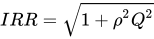
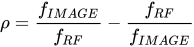
where,
and Q is the quality factor.
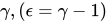
The Image Rejection Ratio for a given value of gain imbalance and phase imbalance is determined by,[3]


See also
[edit]References
[edit]- ^ C-W and A-M Radio Transmitters and Receivers, United States Department of the Army, 1952 page 229
- ^ Sekhar, T. G. Thomas S. Chandra (2005-08-01). Communication Theory. Tata McGraw-Hill Education. ISBN 9780070590915.
- ^ "Image Rejection Ratio (IMRR) with transmit IQ gain/phase imbalance". www.dsplog.com. 31 January 2013. Retrieved 2018-09-14.
 This article incorporates public domain material from Federal Standard 1037C. General Services Administration. Archived from the original on 2022-01-22. (in support of MIL-STD-188).
Image response
View on GrokipediaPrinciples of Operation
Superheterodyne Receiver Context
The superheterodyne receiver functions by converting the desired radio frequency (RF) signal to a fixed intermediate frequency (IF) through mixing with a tunable local oscillator (LO) signal, enabling more effective amplification and filtering at the lower IF rather than the original high RF.[5] This frequency conversion process shifts the signal spectrum while preserving its modulation content, allowing subsequent stages to operate with components optimized for a constant frequency band.[6] Essential components of the architecture include the RF amplifier to boost the incoming weak signal, the mixer to combine the RF input with the LO output and generate the IF, the local oscillator to enable tuning across the desired RF range, the IF amplifier to provide high-gain amplification at the fixed IF, and the detector to demodulate the IF signal into the original audio or data.[5] Invented by Edwin Howard Armstrong in 1918 during World War I as an improvement over tuned radio frequency (TRF) receivers, the superheterodyne design was patented shortly thereafter and rapidly commercialized, with RCA introducing production models by 1924 for AM radio applications.[7] It quickly became the dominant architecture in broadcast receivers from the 1920s onward, extending to television, communications, and other systems due to its enhanced performance.[5] Among its primary advantages are fixed IF filters that deliver superior selectivity and adjacent channel rejection through sharp, stable tuning characteristics, along with the feasibility of high gain at the lower IF frequency, which improves overall sensitivity and permits the use of more cost-effective, lower-frequency components compared to direct RF processing in TRF designs.[5][8] This mixing approach, while beneficial, can result in unwanted signals from an image frequency being downconverted to the IF as a byproduct.[6]Image Frequency Derivation
In superheterodyne receivers, the downconversion process involves mixing the incoming radio frequency (RF) signal with a local oscillator (LO) signal to produce an intermediate frequency (IF) output. For low-side injection, where the LO frequency $ f_{\text{LO}} $ is below the desired RF frequency $ f_{\text{RF}} $, the mixer generates the difference frequency such that $ f_{\text{RF}} - f_{\text{LO}} = f_{\text{IF}} $, or equivalently, $ f_{\text{RF}} = f_{\text{LO}} + f_{\text{IF}} $. This mixing operation, based on the nonlinear interaction in the mixer, produces both sum and difference components from the input signals, but the receiver's IF filter selects the desired difference term at $ f_{\text{IF}} $.[9] However, the same mixer nonlinearity allows another input frequency, known as the image frequency $ f_{\text{image}} $, to produce an identical IF output through the sum or difference process. Specifically, for low-side injection, an undesired signal at $ f_{\text{image}} = f_{\text{LO}} - f_{\text{IF}} $ will mix to yield $ f_{\text{LO}} - f_{\text{image}} = f_{\text{IF}} $, mimicking the desired signal and passing through the IF filter. Substituting the relation for the desired signal gives the explicit formula $ f_{\text{image}} = f_{\text{RF}} - 2 f_{\text{IF}} $, derived directly from the mixer products: the image is separated from the desired RF by twice the IF frequency. For high-side injection, where $ f_{\text{LO}} = f_{\text{RF}} + f_{\text{IF}} $, the image occurs at $ f_{\text{image}} = f_{\text{LO}} + f_{\text{IF}} $, leading to $ f_{\text{image}} = f_{\text{RF}} + 2 f_{\text{IF}} $. In both cases, the image arises because the mixer's second-order terms $ |f_{\text{signal}} \pm f_{\text{LO}}| $ can yield $ f_{\text{IF}} $ from two distinct input frequencies symmetric around $ f_{\text{LO}} $.[9][2] To illustrate, consider a frequency diagram for low-side injection with $ f_{\text{RF}} = 100 $ MHz, $ f_{\text{LO}} = 90 $ MHz, and $ f_{\text{IF}} = 10 $ MHz. The desired RF at 100 MHz mixes to the difference at 10 MHz. The image at 80 MHz ($ 90 - 10 90 - 80 $), causing overlap in the IF band:Frequency Spectrum:
Desired RF (100 MHz) [Image](/page/Image) (80 MHz)
| |
-----|----- LO (90 MHz) -----|-----
IF (10 MHz) output