
Recent from talks
Transfer function
Knowledge base stats:
Talk channels stats:
Members stats:
Transfer function
In engineering, a transfer function (also known as system function or network function) of a system, sub-system, or component is a mathematical function that models the system's output for each possible input. It is widely used in electronic engineering tools like circuit simulators and control systems. In simple cases, this function can be represented as a two-dimensional graph of an independent scalar input versus the dependent scalar output (known as a transfer curve or characteristic curve). Transfer functions for components are used to design and analyze systems assembled from components, particularly using the block diagram technique, in electronics and control theory.
Dimensions and units of the transfer function model the output response of the device for a range of possible inputs. The transfer function of a two-port electronic circuit, such as an amplifier, might be a two-dimensional graph of the scalar voltage at the output as a function of the scalar voltage applied to the input; the transfer function of an electromechanical actuator might be the mechanical displacement of the movable arm as a function of electric current applied to the device; the transfer function of a photodetector might be the output voltage as a function of the luminous intensity of incident light of a given wavelength.
The term transfer function is also used in the frequency domain analysis of systems using transform methods, such as the Laplace transform; it is the amplitude of the output as a function of the frequency of the input signal. The transfer function of an electronic filter is the amplitude at the output as a function of the frequency of a constant amplitude sine wave applied to the input. For optical imaging devices, the optical transfer function is the Fourier transform of the point spread function (a function of spatial frequency).
Transfer functions are commonly used in the analysis of systems such as single-input single-output filters in signal processing, communication theory, and control theory. The term is often used exclusively to refer to linear time-invariant (LTI) systems. Most real systems have non-linear input-output characteristics, but many systems operated within nominal parameters (not over-driven) have behavior close enough to linear that LTI system theory is an acceptable representation of their input-output behavior.
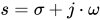
Descriptions are given in terms of a complex variable, . In many applications it is sufficient to set (thus ), which reduces the Laplace transforms with complex arguments to Fourier transforms with the real argument ω. This is common in applications primarily interested in the LTI system's steady-state response (often the case in signal processing and communication theory), not the fleeting turn-on and turn-off transient response or stability issues.


For continuous-time input signal and output , dividing the Laplace transform of the output, , by the Laplace transform of the input, , yields the system's transfer function :





which can be rearranged as:
Discrete-time signals may be notated as arrays indexed by an integer (e.g. for input and for output). Instead of using the Laplace transform (which is better for continuous-time signals), discrete-time signals are dealt with using the z-transform (notated with a corresponding capital letter, like and ), so a discrete-time system's transfer function can be written as:

![{\displaystyle x[n]}](https://wikimedia.org/api/rest_v1/media/math/render/svg/864cbbefbdcb55af4d9390911de1bf70167c4a3d)
![{\displaystyle y[n]}](https://wikimedia.org/api/rest_v1/media/math/render/svg/305428e6d1fb59cd0163a7a96ace52292a262afa)


Hub AI
Transfer function AI simulator
(@Transfer function_simulator)
Transfer function
In engineering, a transfer function (also known as system function or network function) of a system, sub-system, or component is a mathematical function that models the system's output for each possible input. It is widely used in electronic engineering tools like circuit simulators and control systems. In simple cases, this function can be represented as a two-dimensional graph of an independent scalar input versus the dependent scalar output (known as a transfer curve or characteristic curve). Transfer functions for components are used to design and analyze systems assembled from components, particularly using the block diagram technique, in electronics and control theory.
Dimensions and units of the transfer function model the output response of the device for a range of possible inputs. The transfer function of a two-port electronic circuit, such as an amplifier, might be a two-dimensional graph of the scalar voltage at the output as a function of the scalar voltage applied to the input; the transfer function of an electromechanical actuator might be the mechanical displacement of the movable arm as a function of electric current applied to the device; the transfer function of a photodetector might be the output voltage as a function of the luminous intensity of incident light of a given wavelength.
The term transfer function is also used in the frequency domain analysis of systems using transform methods, such as the Laplace transform; it is the amplitude of the output as a function of the frequency of the input signal. The transfer function of an electronic filter is the amplitude at the output as a function of the frequency of a constant amplitude sine wave applied to the input. For optical imaging devices, the optical transfer function is the Fourier transform of the point spread function (a function of spatial frequency).
Transfer functions are commonly used in the analysis of systems such as single-input single-output filters in signal processing, communication theory, and control theory. The term is often used exclusively to refer to linear time-invariant (LTI) systems. Most real systems have non-linear input-output characteristics, but many systems operated within nominal parameters (not over-driven) have behavior close enough to linear that LTI system theory is an acceptable representation of their input-output behavior.
Descriptions are given in terms of a complex variable, . In many applications it is sufficient to set (thus ), which reduces the Laplace transforms with complex arguments to Fourier transforms with the real argument ω. This is common in applications primarily interested in the LTI system's steady-state response (often the case in signal processing and communication theory), not the fleeting turn-on and turn-off transient response or stability issues.
For continuous-time input signal and output , dividing the Laplace transform of the output, , by the Laplace transform of the input, , yields the system's transfer function :
which can be rearranged as:
Discrete-time signals may be notated as arrays indexed by an integer (e.g. for input and for output). Instead of using the Laplace transform (which is better for continuous-time signals), discrete-time signals are dealt with using the z-transform (notated with a corresponding capital letter, like and ), so a discrete-time system's transfer function can be written as: