Hubbry Logo
Immelmann turnImmelmann turnMain
Open search
Immelmann turn
Community hub
Immelmann turn
logo
8 pages, 0 posts
0 subscribers
Be the first to start a discussion here.
Immelmann turn
Immelmann turn
from Wikipedia

Modern Immelmann

The term Immelmann turn, named after German World War I Eindecker fighter ace Leutnant Max Immelmann, refers to two different aircraft maneuvers. In World War I aerial combat, an Immelmann turn was a maneuver used after an attack on another aircraft to reposition the attacking aircraft for another attack. In modern aerobatics, an Immelmann turn (also known as a roll-off-the-top, or simply an Immelmann) is an aerobatic maneuver that results in level flight in the opposite direction at a higher altitude.

Historical combat maneuver

[edit]
Illustration of the historical maneuver from a 1918 flight manual

In World War I aerial combat,[1] an Immelmann turn was a maneuver used after an attack on another aircraft to reposition the attacking aircraft for another attack.

After making a high-speed diving attack on an enemy, the attacker would then climb back up past the enemy aircraft, and just short of the stall, apply full rudder to yaw his aircraft around.[2] This put his aircraft facing down at the enemy aircraft, making another high-speed diving pass possible. This is a difficult maneuver to perform properly, as it involves precise control of the aircraft at low speed. With practice and proper use of all of the fighter's controls, the maneuver could be used to reposition the attacking aircraft to dive back down in any direction desired.

Max Immelmann's Fokker Eindecker relied on relatively ineffectual wing warping for rolling, but had a large moveable vertical stabiliser, meaning turns were initiated and mostly controlled with the rudder. His innovation was in realising that this limitation in his aircraft could be turned to his advantage, whipping it over at the top of a zoom climb rather than attempting to make a conventional banked turn, which would have been too slow and cumbersome to provide an advantage in air combat.

In modern aerobatics, this maneuver, if executed pre-stall with a non-zero turning radius at the top of the climb, is known as a wingover. If the rudder turn is executed right at the initiation of the stall, the resulting yaw occurs around a point within the aircraft's wingspan and the maneuver is known as a stall turn or hammerhead.

Aerobatic maneuver

[edit]
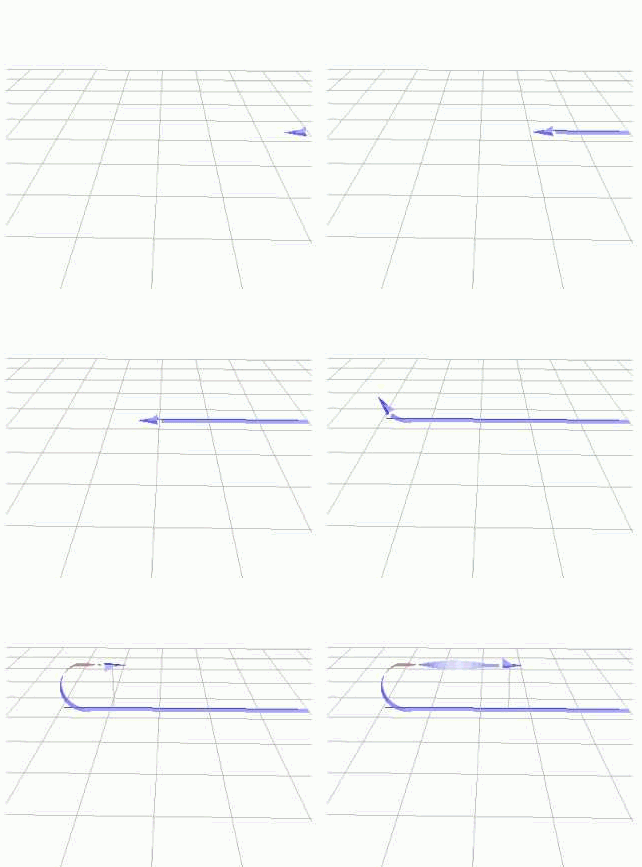
Schematic view of an Immelmann turn:
  1. Level flight
  2. Half inside loop
  3. Half roll to bring aircraft back level

The aerobatic Immelmann turn derives its name from the dogfighting tactic, but is a different maneuver than the original, now known as a "wingover" or "hammerhead".[citation needed]

In modern aerobatics, an Immelmann turn (also known as a roll-off-the-top, or simply an Immelmann) is an aerobatic maneuver. Essentially, it comprises an ascending half-loop followed by a half-roll, resulting in level flight in the opposite direction at a higher altitude. It is the opposite of a Split S, which involves a half-roll followed by a half-loop, resulting in level flight in the opposite direction at a lower altitude.[citation needed]

To successfully execute a roll-off-the-top turn, the pilot accelerates to sufficient airspeed to perform a loop in the aircraft. The pilot then pulls the aircraft into a climb, and continues to pull back on the controls as the aircraft climbs. Rudder and ailerons must be used to keep the half-loop straight when viewed from the ground. As the aircraft passes over the point at which the climb was commenced, it should be inverted and a half loop will have been executed. Sufficient airspeed must be maintained to recover without losing altitude, and at the top of the loop the pilot then executes a half-roll to regain normal upright aircraft orientation. As a result, the aircraft is now at a higher altitude and has changed course 180 degrees.[citation needed]

Not all aircraft are capable of (or certified for) this maneuver, due to insufficient engine power, or engine design that precludes inverted flying. (This usually applies to piston engines that have an open-oil pan. However, when properly flown, the aircraft will maintain positive G throughout the maneuver, eliminating the requirement for an inverted oil system.) In fact, a few early aircraft had sufficiently precise roll control to have performed this maneuver properly.[3]

See also

[edit]

Citations

[edit]
  1. ^ Wood & Sutton 2016, p. 10.
  2. ^ McMinnies & Anderson 1997, p. 194.
  3. ^ Wheeler 1963, pp. 68–71.

General bibliography

[edit]
[edit]
Revisions and contributorsEdit on WikipediaRead on Wikipedia
from Grokipedia
The Immelmann turn is an aerial maneuver in which an aircraft performs a climbing half-loop to gain altitude, followed immediately by a half-roll to reverse direction and return to level flight, allowing the pilot to reposition for another attack or evade pursuit. Named after the German fighter ace , who is credited with its development, the turn became a foundational tactic in early during the "" period of 1915–1916. Immelmann, known as the "Eagle of Lille," pioneered the maneuver while flying Fokker Eindecker monoplanes, using it to maintain a superior altitude advantage over opponents and execute repeated diving attacks. In practice, after firing on an enemy from above and behind, he would pull into the half-loop to climb vertically, then roll inverted at the top to face the opposite direction, often descending to re-engage. This technique contributed to his tally of 15 confirmed aerial victories before his death in combat on June 18, 1916, when British pilots downed his aircraft after a prolonged involving the turn. In modern , the Immelmann turn has evolved into a staple of and fighter tactics, defined precisely as a vertical half-loop upward followed seamlessly by a half slow-roll to wings-level, without pausing between elements. Although the original WWI version—limited by the low-powered engines and structural constraints of early fighters like the Eindecker—likely resembled a or more than the full aerobatic form, the name persists for its repositioning utility in both training and combat scenarios. Its enduring legacy underscores the shift from rudimentary to structured dogfighting in history.

History

Origins in World War I

During the early stages of in 1915, aerial combat transitioned from reconnaissance to aggressive dogfighting, but aircraft like the German Fokker Eindecker faced significant limitations, including sluggish climb rates after high-speed dives and vulnerability to counterattacks from slower but more maneuverable Allied two-seaters. These constraints necessitated innovative tactics for pilots to reposition quickly after an attack, reversing direction while regaining altitude to maintain superiority over opponents with inferior climbing performance. Max Immelmann, a pioneering German serving with Feldflieger-Abteilung 62, played a central role in developing such a response after receiving one of the first Fokker Eindecker E.I monoplanes in June 1915, equipped with a synchronized that allowed firing through the propeller arc. His first documented application of the maneuver occurred during engagements that summer, refining it through repeated sorties against French and British aircraft; a notable early instance involved evading and pursuing a French Morane-Saulnier parasol monoplane on September 9, 1915, contributing to his second confirmed victory. Immelmann, who amassed 17 aerial victories before his death in 1916, credited the tactic with enabling his success in outmaneuvering slower-climbing foes. The Immelmann turn's primary tactical purpose was to allow a pilot to execute a diving attack, then rapidly reverse course by climbing steeply to reposition above the enemy, exploiting the Eindecker's dive speed while compensating for its weak post-dive recovery. Immelmann employed it in many of his 17 victories, including his debut confirmed kill on August 1, 1915, against a British Royal Aircraft Factory B.E.2c reconnaissance plane near Douai, where he dove, fired, and used the turn to evade return fire while climbing for a follow-up pass. This approach forced many opponents to retreat toward German lines, disrupting Allied reconnaissance and bombing missions. Historical accounts, including Immelmann's personal logs and British pilot reports, describe the maneuver as a steep zoom climb—essentially a half-loop—followed by a wingover or snap roll to reverse heading, distinguishing it from pre-war French techniques like the renversement, which relied on a banking sideslip without significant altitude gain. Debates persist among aviation historians over its exact form, with some evidence from contemporary observer notes suggesting Immelmann adapted existing zoom recoveries rather than inventing from scratch, though his consistent wartime application elevated it to a named staple of single-seat fighter tactics.

Naming and Legacy

The Immelmann turn derives its name from , the pioneering German fighter pilot and ace who was posthumously honored for his innovative aerial tactics. Immelmann was on June 18, 1916, during a near , , where he had earned the nickname "Eagle of Lille" for his dominant patrols defending the sector. His death at age 25, after scoring 17 confirmed victories, elevated him to national hero status in , with the maneuver—initially a simple and directional reversal used to reposition after an attack—quickly associated with his combat style by contemporaries. Following , the term "Immelmann turn" entered lexicon in 1918, appearing in English-language publications and manuals as German tactics became studied by Allied forces through captured documents and debriefings of former enemies. By the , it was recognized in instructional texts on fighter maneuvers, reflecting its rapid dissemination beyond German squadrons to international circles. The maneuver influenced subsequent aces, notably , who adapted zoom-and-reverse elements in his own dogfighting strategies while leading Jasta 11 after Immelmann's death. Culturally, it featured in World War I-themed literature and early films, such as the 1927 silent epic Wings, which dramatized aerial combat and won the for its realistic depictions of tactics like the turn. Twentieth-century analyses have questioned the precision of attributing the modern half-loop-and-roll version to Immelmann, noting that the Fokker E.I's limited and likely restricted him to a less aerobatic variant—a steep zoom followed by a skid or for reversal. By the , however, the term had evolved into standardized terminology across dictionaries and manuals, enduring as a foundational concept in both combat and aerobatic training.

Description

Historical Combat Execution

In aerial combat, the Immelmann turn was executed as a tactical reversal maneuver following a firing pass on an enemy , allowing the pilot to quickly reverse direction while gaining altitude for a subsequent attack. The process began with a zoom climb initiated immediately after the dive, converting the 's into . The pilot then initiated a zoom climb after the dive, pulling up to near-vertical attitude, followed by a input to kick over the top into a sideslip, and then to roll out facing the opposite direction while descending to regain speed. This enabled the pilot to dive back toward the target from a superior position. Aircraft like the Fokker Eindecker, a tail-heavy powered by a , presented specific constraints during execution. The engine's necessitated continuous input to counteract leftward yaw, particularly during the climb and reversal phases, while the aircraft's design required precise and coordination to avoid sideslipping. The entire maneuver generally took 10-15 seconds to complete, demanding smooth control inputs to maintain structural integrity under the generated loads. Tactically, the Immelmann turn was integrated after a head-on or diving attack to loop back onto the enemy's position, capitalizing on the Eindecker's tighter turn radius compared to larger Allied reconnaissance planes like the BE.2c. This allowed German pilots to exploit momentary overshoots, repositioning for a high-side guns pass while the opponent struggled to turn. However, the maneuver carried risks, including a potential at the top if entry speed was insufficient, which could lead to a spin or loss of control in the low-power monoplanes of the era. Enemies often countered with a —a climbing to maintain and follow—or a split-S, a half-roll into a dive to evade and reverse below the attacker. A notable early example occurred in Immelmann's June 1915 engagement over , where, piloting an unarmed LVG , he employed an evasive zoom and reversal—precursor to the formalized turn—to evade pursuing British aircraft and attempt a re-attack before being forced down. This incident highlighted the maneuver's defensive potential even in unarmed machines, earning him recognition for innovative tactics.

Aerobatic Execution

In modern , the Immelmann turn emphasizes precision, symmetry, and showmanship, serving as a fundamental turnaround maneuver in competition sequences. The execution begins with straight-and-level entry flight, where the pilot pulls smoothly into a half-loop using full deflection to reach a 90-degree nose-up pitch attitude, followed by continuation to inverted flight at the 180-degree point atop the loop. Immediately upon reaching the apex, a half-roll—often a snap roll for crispness—is initiated to return the to upright while reversing the flight direction, exiting on a parallel horizontal line opposite the entry heading; this process trades for altitude, typically gaining 300-600 feet depending on the and entry conditions. Suitable aircraft for this maneuver include high-performance aerobatic types such as the Extra 300 or , which possess the structural integrity (+10/-10 G limits) and responsive controls to handle the full and deflections required for tight radii and rapid attitude changes without exceeding design limits. Performance is evaluated under (FAI) judging criteria, where the Immelmann corresponds to figure A-8 (or equivalent in Family 7.2 for basic half-loops with rolls), demanding a zero-radius apex with perfectly round, symmetric loop geometry, centered rolls, and horizontal entry/exit lines to achieve full scoring (base K-factor of 10 points). Deviations, such as inconsistent loop radius, off-center rolls, or visible segmentation between elements, result in deductions of 0.5-2 points per fault, with wind corrections required to maintain heading alignment. Training for the Immelmann progresses methodically to build pilot confidence and precision: initial ground briefings cover entry speeds (typically 120-150 knots for positive-G loops) and risk factors like G-loading, followed by simulator sessions to practice the half-loop-to-roll transition without real-world hazards. In-air demonstrations then occur at altitudes exceeding 3,000 feet above ground level (AGL), starting with gentle entries and advancing to full-deflection snaps under instructor supervision. For visual appeal in airshows, the maneuver often incorporates smoke trails to highlight the flight path and apex symmetry, aiding judges and spectators; this is evident in routines by teams like the Breitling Jet Team, where synchronized Immelmann turns in their L-39 Albatros jets create dramatic, trailing smoke patterns during opposition passes and solo displays.

Principles

Aerodynamic Mechanics

The Immelmann turn's half-loop phase relies on a deliberate increase in the aircraft's angle of attack (AoA) to generate the centripetal force required for the upward pitch, typically reaching values up to 17 degrees in high-AoA executions to approach stall limits without exceeding them. This elevated AoA produces the necessary vertical lift component for the curved trajectory, with the lift coefficient CLC_L peaking at 1.5–2.0 depending on the airfoil and configuration. The fundamental lift equation governing this process is L=12ρv2SCLL = \frac{1}{2} \rho v^2 S C_L, where LL is lift, ρ\rho is air density, vv is true airspeed, SS is wing reference area, and CLC_L varies with AoA; during the loop, dynamic pressure (12ρv2\frac{1}{2} \rho v^2) must be sufficient to sustain the load factor without structural overload. To counteract deceleration, engine thrust is augmented to offset the induced drag, which rises quadratically with AoA due to the proportional increase in CL2C_L^2 in the drag polar equation CD=CD0+CL2πAReC_D = C_{D_0} + \frac{C_L^2}{\pi AR e}, where CD0C_{D_0} is profile drag coefficient, ARAR is aspect ratio, and ee is Oswald efficiency factor. At the apex of the half-loop, the aircraft enters inverted flight, where the roll phase commences with a half-roll executed using aileron deflection at approximately zero to light positive G-loads (0–1 g) to maintain structural integrity and control authority. The roll rate ω\omega is approximated by the simplified equation ω=δaqSc2Ix\omega = \frac{\delta_a q S c}{2 I_x}, where δa\delta_a is aileron deflection angle, qq is dynamic pressure, SS is wing area, cc is mean aerodynamic chord, and IxI_x is the roll moment of inertia; this rate builds rapidly in low-inertia aerobatic aircraft to complete the 180-degree roll efficiently. Adverse yaw, arising from differential drag on the downward-deflected aileron wing, is countered by coordinated rudder input to prevent sideslip and ensure a clean roll axis. Aircraft stability during the maneuver is influenced by transient shifts in effective center of gravity due to varying load factors and fuel slosh, requiring precise control inputs to avoid departure. The wing's dihedral angle contributes to lateral stability by inducing a rolling moment that opposes sideslip, aiding recovery to level flight post-roll, though this effect reverses in inverted attitudes and must be managed. Limitations arise from aerodynamic buffet onset at high AoA exceeding 20 degrees in subsonic regimes, caused by flow separation over the wing and tail, which vibrates the airframe and reduces control effectiveness if not mitigated by reducing AoA.

Energy and Altitude Considerations

The Immelmann turn manages energy states by converting from initial airspeed into for altitude gain during the of the half-loop phase. This trade-off allows the to reverse direction while ascending, preserving overall for subsequent maneuvers provided entry conditions are adequate. In historical WWI executions with low-powered like the Fokker Eindecker, energy trades were more limited, resulting in shallower climbs compared to modern aerobatic or jet applications. The total energy E_total comprises E_k = \frac{1}{2} m v^2, where m is the mass and v is velocity, and E_p = m g h, with g as and h as altitude; efficient execution minimizes dissipative losses to drag and induced effects. Minimum entry speed must typically exceed 1.5–1.8 times the V_s, depending on and load factors, to initiate the pull-up without risking a power-off at the apex, ensuring sufficient margin for load factor application throughout the loop segment. In representative training scenarios for jet trainers like the T-38, entry occurs at 500 knots (KCAS) under military power to maintain positive energy state. Altitude gain mechanics in the half-loop typically trade a significant portion of entry for several hundred feet of , scaled by initial E_k; for instance, higher entry speeds yield greater vertical displacement before the half-roll exit. Load factor n = L/W peaks at 4-5 g during the pull-up to sustain the radius, demanding precise control to avoid exceeding structural limits while optimizing retention. Power requirements emphasize exceeding drag in the vertical segment; military power suffices for most trainers, but in high-performance jets, engagement can significantly augment energy to counteract deceleration and support aggressive climbs. Post-maneuver drawbacks include noticeable loss from the energy conversion, reducing kinetic reserves and exposing the to faster pursuers during recovery.

Applications

In Military Tactics

During , the Immelmann turn evolved as a key disengagement and repositioning maneuver for the Luftwaffe's fighters, enabling pilots to execute quick 180-degree reversals after a diving pass to regain altitude and re-attack from above. This tactic leveraged the Bf 109's superior climb rate but became less dominant as Allied forces developed countermeasures, such as the —a paired formation maneuver where aircraft crisscrossed paths to disrupt attackers' aim and force them into predictable turns, thereby diminishing the Immelmann's surprise element. In the , the maneuver adapted to higher speeds during the , where U.S. Air Force F-86 pilots used a modified "Immelmann zoom" version, entering at approximately Mach 0.9 to convert into altitude for evading or repositioning against MiG-15s. By the 1960s, U.S. Air Force manuals incorporated the Immelmann for interceptors like the , emphasizing its role in rapid vector changes during air defense missions. In modern fighter tactics, the Immelmann integrates into energy-maneuvering frameworks, as outlined in performance charts (EM diagrams), for aircraft such as the F-16 Fighting Falcon and , allowing pilots to trade speed for altitude while maintaining offensive options against high-angle-of-attack threats. During 1980s Red Flag exercises at , U.S. pilots practiced abbreviated Immelmann pull-ups to simulate counters in beyond-visual-range transitions to close-quarters combat. However, supersonic regimes introduce limitations, with increased drag during the loop phase rendering full executions inefficient; contemporary applications often limit it to 90-degree pull-ups for energy preservation. The maneuver saw continued use in the Vietnam War, where U.S. pilots in F-4 Phantoms employed Immelmann-like climbs to evade surface-to-air missiles and reposition in dogfights, adapting to higher energy states than in earlier eras. As of 2025, it remains relevant in virtual training simulators for fourth- and fifth-generation fighters, teaching energy management in beyond-visual-range engagements transitioning to within-visual-range. A notable case illustrating the maneuver's adaptability occurred in the 1970s when USAF F-102 pilot Pete Seitz, operating from , performed a gear-down Immelmann—lowering and deploying speed brakes to decelerate—while intercepting a suspected drug-running near , successfully repositioning without overshooting the slower target.

In Aerobatics and Training

The Immelmann turn has been a staple in aerobatic competition sequences organized by the (FAI) since the inception of the World Aerobatic Championships in 1960, where pilots perform prescribed figures judged on criteria such as axis precision, line accuracy, and control throughout the maneuver. In modern events, such as the 2024 Sportsman Power Sequence under FAI guidelines, the Immelmann appears as a key turnaround element, requiring entrants to execute a half-loop followed by a half-roll while maintaining vertical and horizontal lines to maximize scoring from judges. These competitions emphasize the maneuver's role in demonstrating pilot precision, with deductions applied for deviations in the 180-degree heading change or altitude control, as outlined in the FAI Aresti Aerobatic Catalogue. In pilot training programs, the Immelmann turn serves as a foundational exercise for building G-tolerance and handling skills, particularly in civilian aerobatic curricula. Schools affiliated with events like commonly instruct the maneuver in , starting from a minimum altitude of 1,500 feet above ground level to ensure safe recovery margins during the pull-up and roll phases. This training exposes pilots to positive G-forces typically up to 4-5g at the loop's apex, helping develop tolerance without exceeding the 's certified limits of +6g/-3g in the aerobatic category. Safety protocols mandate pre-maneuver briefings on G-induced loss of consciousness risks, with instructors monitoring for sustained loads beyond 4g and requiring immediate power reduction if needed; post-maneuver spin recovery drills, following FAA 61-67C procedures, are standard to address any unintended stalls during the half-roll. The educational value of the Immelmann lies in its enhancement of , precise stick-rudder coordination, and , making it integral to aerobatic endorsements for private pilot license (PPL) holders seeking advanced ratings. Since the , when FAA training syllabi expanded to include aerobatic elements in response to increasing spin accidents, the maneuver has been incorporated into curricula for aircraft like the Citabria and to teach under varying attitudes. Notable performers, such as seven-time U.S. National Aerobatic Champion , adapted the Immelmann for low-level airshow routines in the 1990s, integrating it into her Extra 260 sequences flown as low as 50 feet above ground to captivate audiences while adhering to safety margins.

References

Add your contribution
Related Hubs
User Avatar
No comments yet.