


Community hub
Recent from talks
Contribute something to knowledge base
Content stats: 0 posts, 0 articles, 1 media, 0 notes
Members stats: 0 subscribers, 0 contributors, 0 moderators, 0 supporters
Subscribers
Supporters
Contributors
Moderators
Hub AI
Immortal Beloved AI simulator
(@Immortal Beloved_simulator)
Hub AI
Immortal Beloved AI simulator
(@Immortal Beloved_simulator)
Immortal Beloved
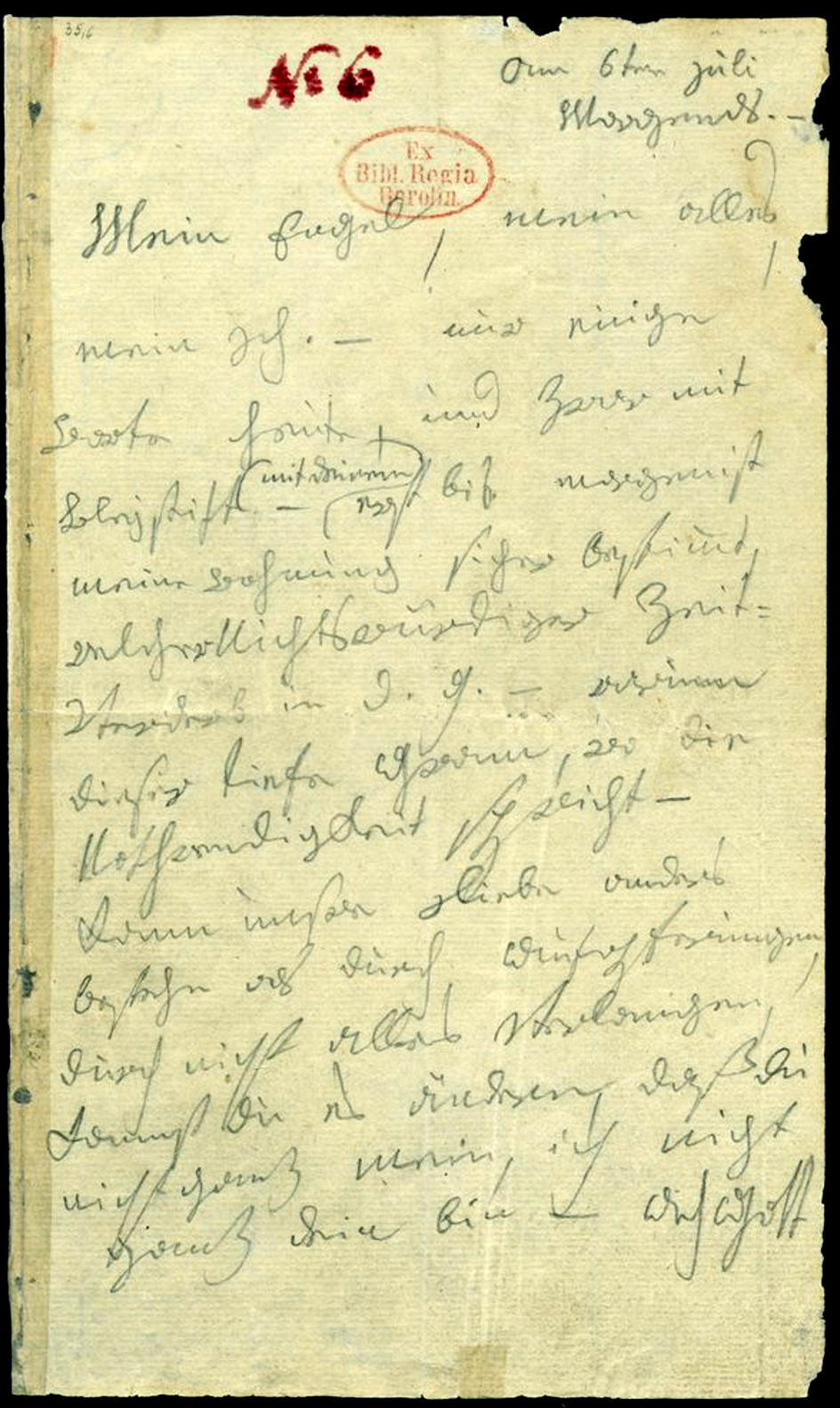
The Immortal Beloved (German "Unsterbliche Geliebte") is the addressee of a love letter which composer Ludwig van Beethoven wrote on 6 or 7 July 1812 in Teplitz (then in the Austrian Empire, now in the Czech Republic). The unsent letter is written in pencil on 10 small pages. It was found in the composer's estate following his death and is now in the Berlin State Library.
Beethoven did not specify a year or a location. In the 1950s an analysis of the paper's watermark yielded the year, and by extension the place of the letter. Scholars disagree about the intended recipient of the letter. Two people favored by most contemporary scholars are Antonie Brentano and Josephine Brunsvik. (Other possibilities include Johanna van Beethoven, Julie ("Giulietta") Guicciardi, Therese Brunsvik, Amalie Sebald, Dorothea von Ertmann, Therese Malfatti, Anna Maria Erdődy, and Bettina von Arnim.)
After Schmidt-Görg (1957) published 13 then-unknown love letters by Beethoven to Josephine Brunsvik, it became clear that the one to the "Immortal Beloved" was not the only love letter authored by him. That Josephine could have been the unknown woman was subsequently suggested by analyses of similarities in wordings and phrases between earlier letters (from 1804 to 1809) and this mysterious one from 1812, mainly in the monographs by Massin (1967, 1970), Goldschmidt (1980) and Tellenbach (1983), p. 103ff):
In his 1840 biography of Beethoven, Anton Schindler named Julie ("Giulietta") Guicciardi as the "Immortal Beloved". But research by Tellenbach (1983) indicated that Giulietta's cousin Franz von Brunsvik may have suggested her to Schindler, to distract any suspicion away from his sister Josephine Brunsvik, with whom Beethoven had been hopelessly in love from 1799 to around 1809/1810. La Mara (1909) published Therese Brunsvik's memoirs, which show her full of admiration and adoration of Beethoven. This, together with interviews of some of the Brunsvik descendants, led her to the conclusion that Therese must have been the "Immortal Beloved".
At first, most researchers, including Alexander Wheelock Thayer, also believed Therese was the "Immortal Beloved". Thayer thought the letter must have been written around 1806–07. Thomas-San-Galli (1909, 1910) checked out the official listings of guests in Bohemia, and at first (in 1909) concluded that Amalie Sebald was the "Immortal Beloved". Sebald was definitely not in Prague at the beginning of July, 1812, and Cooper consequently ruled her out as a possibility. Thomas-San-Galli then speculated (in 1910) that it might instead have been Therese Brunsvik, whom he believed could have secretly traveled to Prague.
Doubts were raised by Hevesy (1910), who ruled out Therese Brunsvik, (the "Louis" mentioned by Therese in her diary was, in fact, Count Louis Migazzi) and by Unger (1910) against Amalie Sebald. A summary of the older literature can be found in Forbes's work.
There was also a forged Beethoven letter by Paul Bekker in Die Musik. But it was already shown to be a hoax by Newman (1911)—a last-ditch effort to salvage the discredited Guicciardi hypothesis.
The date of the "Immortal Beloved" letter—6/7 July 1812—has meanwhile been firmly established, not only by watermarks and references, but also by a later letter by Beethoven to Rahel Varnhagen, which suggests he must have met his "Immortal Beloved" on 3 July 1812: "I am sorry, dear V., that I could not spend the last evening in Prague with you, and I myself found it impolite, but a circumstance I could not foresee prevented me."
Immortal Beloved
The Immortal Beloved (German "Unsterbliche Geliebte") is the addressee of a love letter which composer Ludwig van Beethoven wrote on 6 or 7 July 1812 in Teplitz (then in the Austrian Empire, now in the Czech Republic). The unsent letter is written in pencil on 10 small pages. It was found in the composer's estate following his death and is now in the Berlin State Library.
Beethoven did not specify a year or a location. In the 1950s an analysis of the paper's watermark yielded the year, and by extension the place of the letter. Scholars disagree about the intended recipient of the letter. Two people favored by most contemporary scholars are Antonie Brentano and Josephine Brunsvik. (Other possibilities include Johanna van Beethoven, Julie ("Giulietta") Guicciardi, Therese Brunsvik, Amalie Sebald, Dorothea von Ertmann, Therese Malfatti, Anna Maria Erdődy, and Bettina von Arnim.)
After Schmidt-Görg (1957) published 13 then-unknown love letters by Beethoven to Josephine Brunsvik, it became clear that the one to the "Immortal Beloved" was not the only love letter authored by him. That Josephine could have been the unknown woman was subsequently suggested by analyses of similarities in wordings and phrases between earlier letters (from 1804 to 1809) and this mysterious one from 1812, mainly in the monographs by Massin (1967, 1970), Goldschmidt (1980) and Tellenbach (1983), p. 103ff):
In his 1840 biography of Beethoven, Anton Schindler named Julie ("Giulietta") Guicciardi as the "Immortal Beloved". But research by Tellenbach (1983) indicated that Giulietta's cousin Franz von Brunsvik may have suggested her to Schindler, to distract any suspicion away from his sister Josephine Brunsvik, with whom Beethoven had been hopelessly in love from 1799 to around 1809/1810. La Mara (1909) published Therese Brunsvik's memoirs, which show her full of admiration and adoration of Beethoven. This, together with interviews of some of the Brunsvik descendants, led her to the conclusion that Therese must have been the "Immortal Beloved".
At first, most researchers, including Alexander Wheelock Thayer, also believed Therese was the "Immortal Beloved". Thayer thought the letter must have been written around 1806–07. Thomas-San-Galli (1909, 1910) checked out the official listings of guests in Bohemia, and at first (in 1909) concluded that Amalie Sebald was the "Immortal Beloved". Sebald was definitely not in Prague at the beginning of July, 1812, and Cooper consequently ruled her out as a possibility. Thomas-San-Galli then speculated (in 1910) that it might instead have been Therese Brunsvik, whom he believed could have secretly traveled to Prague.
Doubts were raised by Hevesy (1910), who ruled out Therese Brunsvik, (the "Louis" mentioned by Therese in her diary was, in fact, Count Louis Migazzi) and by Unger (1910) against Amalie Sebald. A summary of the older literature can be found in Forbes's work.
There was also a forged Beethoven letter by Paul Bekker in Die Musik. But it was already shown to be a hoax by Newman (1911)—a last-ditch effort to salvage the discredited Guicciardi hypothesis.
The date of the "Immortal Beloved" letter—6/7 July 1812—has meanwhile been firmly established, not only by watermarks and references, but also by a later letter by Beethoven to Rahel Varnhagen, which suggests he must have met his "Immortal Beloved" on 3 July 1812: "I am sorry, dear V., that I could not spend the last evening in Prague with you, and I myself found it impolite, but a circumstance I could not foresee prevented me."
Recent media
Recent media