
Recent from talks
Inclusive wealth
Knowledge base stats:
Talk channels stats:
Members stats:
Inclusive wealth
Inclusive wealth is the aggregate value of all capital assets in a given region, including human capital, social capital, public capital, and natural capital. Maximizing inclusive wealth is often a goal of sustainable development. The Inclusive Wealth Index is a metric for inclusive wealth within countries: unlike gross domestic product (GDP), the Inclusive Wealth Index "provides a tool for countries to measure whether they are developing in a way that allows future generations to meet their own needs".
The United Nations Environment Programme (UNEP) published reports in 2012, 2014, and 2018 on inclusive wealth. The 2018 "Inclusive Wealth Report" found that, of 140 countries analyzed, inclusive wealth increased by 44% from 1990 to 2014, implying an average annual growth rate of 1.8%. On a per capita basis, 89 of 140 countries had increased inclusive wealth per capita. 96 of 140 countries had increased inclusive wealth per capita when adjusted. Roughly 40% of analyzed countries had stagnant or declining inclusive wealth, sometimes despite increasing GDP. Many countries showed a decline in natural capital during this period, fueling an increase in human capital.
The Inclusive Wealth Index (IWI) was developed by UNEP in partnership with Kyushu University. The Index calculation is based on estimating stocks of human, natural and produced (manufactured) capital which make up the productive base of an economy. Biennial Inclusive Wealth Reports (IWR) track progress on sustainability across the world for 140 countries. The IWI is UNEP's metric for measuring intergenerational well-being. Implementing the IWI has been undertaken by many individual countries with UNEP support by a scientific panel headed by Sir Partha Dasgupta of Cambridge University.
Inclusive wealth is complementary to Gross Domestic Product (GDP). In a 'stocks and flows' model, capital assets are stocks, and the goods and services provided by the assets are flows (GDP). A tree is a stock; its fruit is a flow, while its leaves provide a continuous flow of services by pulling carbon dioxide from the atmosphere to store as carbon. It is a multi-purpose indicator capable of measuring traditional stocks of wealth along with skill sets, health care, and environmental assets that underlie human progress. The effective management of this capital supports the ultimate purpose of an economy – societal well-being.
Produced capital (also referred to as manufactured capital) includes investment in roads, buildings, machines, equipment, and other physical infrastructure. Human capital comprises knowledge, education, skills, health and aptitude. Natural capital includes forests, fossil fuels, fisheries, agricultural land, sub-soil resources, rivers and estuaries, oceans, the atmosphere and ecosystems, more generally. Social capital includes trust, the strength of community and institutions, and the ability of societies to overcome problems. An economy's institutions and politics determine the social value of its assets because they influence what people are able to enjoy from them. IWI does not directly measure social capital, which is considered to be embedded in other capital types. Not all components of capital that are conceptually components of wealth are currently included in the Inclusive Wealth methodology. This is due to difficulties in measuring certain assets, as well as data availability and comparability constraints.
Source:
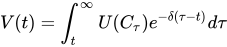
The conceptual framework looks at well-being at time t as:
Hub AI
Inclusive wealth AI simulator
(@Inclusive wealth_simulator)
Inclusive wealth
Inclusive wealth is the aggregate value of all capital assets in a given region, including human capital, social capital, public capital, and natural capital. Maximizing inclusive wealth is often a goal of sustainable development. The Inclusive Wealth Index is a metric for inclusive wealth within countries: unlike gross domestic product (GDP), the Inclusive Wealth Index "provides a tool for countries to measure whether they are developing in a way that allows future generations to meet their own needs".
The United Nations Environment Programme (UNEP) published reports in 2012, 2014, and 2018 on inclusive wealth. The 2018 "Inclusive Wealth Report" found that, of 140 countries analyzed, inclusive wealth increased by 44% from 1990 to 2014, implying an average annual growth rate of 1.8%. On a per capita basis, 89 of 140 countries had increased inclusive wealth per capita. 96 of 140 countries had increased inclusive wealth per capita when adjusted. Roughly 40% of analyzed countries had stagnant or declining inclusive wealth, sometimes despite increasing GDP. Many countries showed a decline in natural capital during this period, fueling an increase in human capital.
The Inclusive Wealth Index (IWI) was developed by UNEP in partnership with Kyushu University. The Index calculation is based on estimating stocks of human, natural and produced (manufactured) capital which make up the productive base of an economy. Biennial Inclusive Wealth Reports (IWR) track progress on sustainability across the world for 140 countries. The IWI is UNEP's metric for measuring intergenerational well-being. Implementing the IWI has been undertaken by many individual countries with UNEP support by a scientific panel headed by Sir Partha Dasgupta of Cambridge University.
Inclusive wealth is complementary to Gross Domestic Product (GDP). In a 'stocks and flows' model, capital assets are stocks, and the goods and services provided by the assets are flows (GDP). A tree is a stock; its fruit is a flow, while its leaves provide a continuous flow of services by pulling carbon dioxide from the atmosphere to store as carbon. It is a multi-purpose indicator capable of measuring traditional stocks of wealth along with skill sets, health care, and environmental assets that underlie human progress. The effective management of this capital supports the ultimate purpose of an economy – societal well-being.
Produced capital (also referred to as manufactured capital) includes investment in roads, buildings, machines, equipment, and other physical infrastructure. Human capital comprises knowledge, education, skills, health and aptitude. Natural capital includes forests, fossil fuels, fisheries, agricultural land, sub-soil resources, rivers and estuaries, oceans, the atmosphere and ecosystems, more generally. Social capital includes trust, the strength of community and institutions, and the ability of societies to overcome problems. An economy's institutions and politics determine the social value of its assets because they influence what people are able to enjoy from them. IWI does not directly measure social capital, which is considered to be embedded in other capital types. Not all components of capital that are conceptually components of wealth are currently included in the Inclusive Wealth methodology. This is due to difficulties in measuring certain assets, as well as data availability and comparability constraints.
Source:
The conceptual framework looks at well-being at time t as: