


Community hub
Recent from talks
Contribute something to knowledge base
Content stats: 0 posts, 0 articles, 1 media, 0 notes
Members stats: 0 subscribers, 0 contributors, 0 moderators, 0 supporters
Subscribers
Supporters
Contributors
Moderators
My Number Card
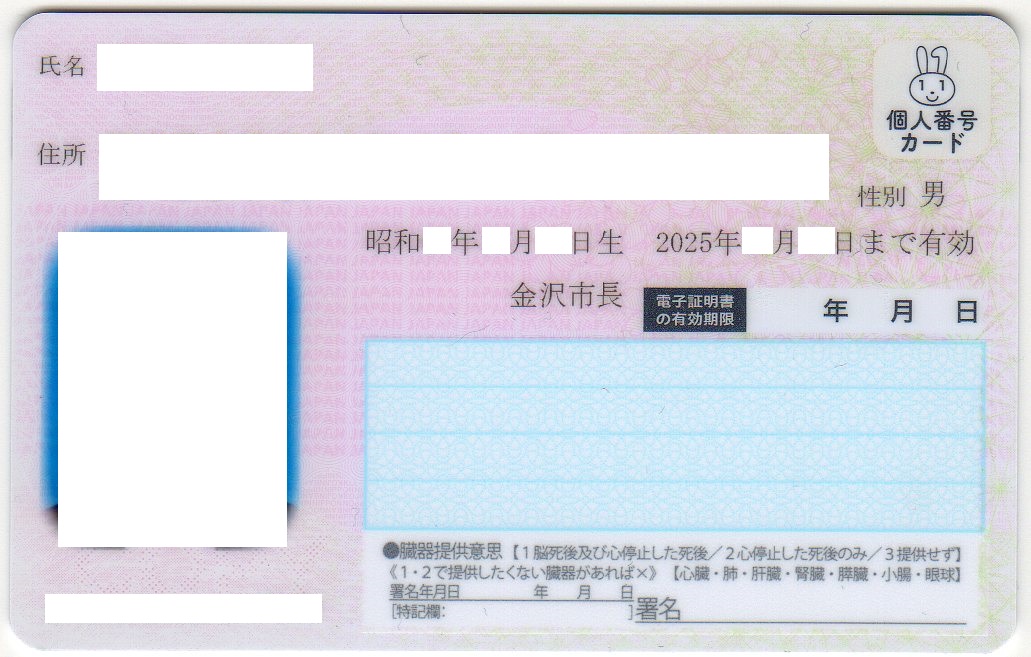
The My Number Card (Japanese: マイナンバーカード, Hepburn: mai nanbā kādo), officially called the Individual Number Card in English, is an identity document issued to citizens of Japan and foreign residents which contains a unique 12-digit Individual Number (Japanese: 個人番号, Hepburn: kojin bangō) that serves as a national identification number in Japan. Unlike similar-looking identity cards in Europe, the My Number Card can be issued to both Japanese citizens and foreign residents, and is not proof of nationality. The My Number Card is used in Japan to streamline administrative purposes like filing taxes and social security, and it is also utilized to provide disaster response to those in need. It is the de facto Japanese equivalent to a U.S. Social Security Number.
The My Number Card stores information such as personal name, photo, address, birthday, and sex. Residents who wish to obtain the card can request an application form from the municipality (via a ward office or city hall) where they reside.
Many countries around the world, including Japan, require residents and citizens to disclose and register their address with the government for various bureaucratic purposes. Many countries obligate that their residents and citizens provide up to date information regarding where they reside, by visiting a registration office or the police within a few days after establishing a new residence. However some countries, like the United States or Canada, do not require their residents or citizens to provide this information to the government, unless they are applying for a passport or drivers license.
Both Japanese citizens and foreign residents are obligated to report their domicile to their nearest municipal government office.
In 2002, the Japanese government created the Basic Resident Registers Network and started to issue unique 11-digits identity codes at request to people who did not possess a drivers license, but wanted a identity card to prove legitimacy when applying for a Japanese passport, obtaining copies of their family registry, or any other activities that require ID. These identity codes provided information regarding the bearer's name, date of birth, gender, address, and the identity code itself.
By 2003, the Japanese government started to issue a Resident registration card (住基カード, Jūki kādo), which are physical cards with IC chips linked to these identity numbers. Both the Basic Resident Registers Network and the Jūki kādo were negatively received and had widespread opposition from people, political parties, and prefectures. Despite this, in 2008, the Supreme Court of Japan ruled the Basic Resident Registers Network and subsequent affiliations constitutional.
Beginning in 2015 the Japanese government started to make significant steps in overseeing Japan's transformation to a digital economy, and established a new government office titled the Minister for Digital Transformation. Under this new cabinet, the Japanese government started to phase out the Basic Resident Registers Network system's 11-digits identity codes, in order to establish a new modern system of unique 12-digits codes, called the Individual Number (Japanese: 個人番号, Hepburn: kojin bangō). These codes were issued to all Japanese citizens and foreign residents in a unsolicited manner. To advertise the system's introduction, the Government of Japan hired actress Aya Ueto and created a mascot character named "Maina-chan".
Beginning in March 2021, the Japanese government began to issue My Number Cards embedded with IC chips that can double as health insurance cards. These cards can be read by card readers, and in conjunction with facial recognition, give facial medical care providers instant access to patients' past health checkup results and prescription drug history. They are accepted at all medical institutions, and separate health insurance cards will no longer be issued as of December 2024.
My Number Card
The My Number Card (Japanese: マイナンバーカード, Hepburn: mai nanbā kādo), officially called the Individual Number Card in English, is an identity document issued to citizens of Japan and foreign residents which contains a unique 12-digit Individual Number (Japanese: 個人番号, Hepburn: kojin bangō) that serves as a national identification number in Japan. Unlike similar-looking identity cards in Europe, the My Number Card can be issued to both Japanese citizens and foreign residents, and is not proof of nationality. The My Number Card is used in Japan to streamline administrative purposes like filing taxes and social security, and it is also utilized to provide disaster response to those in need. It is the de facto Japanese equivalent to a U.S. Social Security Number.
The My Number Card stores information such as personal name, photo, address, birthday, and sex. Residents who wish to obtain the card can request an application form from the municipality (via a ward office or city hall) where they reside.
Many countries around the world, including Japan, require residents and citizens to disclose and register their address with the government for various bureaucratic purposes. Many countries obligate that their residents and citizens provide up to date information regarding where they reside, by visiting a registration office or the police within a few days after establishing a new residence. However some countries, like the United States or Canada, do not require their residents or citizens to provide this information to the government, unless they are applying for a passport or drivers license.
Both Japanese citizens and foreign residents are obligated to report their domicile to their nearest municipal government office.
In 2002, the Japanese government created the Basic Resident Registers Network and started to issue unique 11-digits identity codes at request to people who did not possess a drivers license, but wanted a identity card to prove legitimacy when applying for a Japanese passport, obtaining copies of their family registry, or any other activities that require ID. These identity codes provided information regarding the bearer's name, date of birth, gender, address, and the identity code itself.
By 2003, the Japanese government started to issue a Resident registration card (住基カード, Jūki kādo), which are physical cards with IC chips linked to these identity numbers. Both the Basic Resident Registers Network and the Jūki kādo were negatively received and had widespread opposition from people, political parties, and prefectures. Despite this, in 2008, the Supreme Court of Japan ruled the Basic Resident Registers Network and subsequent affiliations constitutional.
Beginning in 2015 the Japanese government started to make significant steps in overseeing Japan's transformation to a digital economy, and established a new government office titled the Minister for Digital Transformation. Under this new cabinet, the Japanese government started to phase out the Basic Resident Registers Network system's 11-digits identity codes, in order to establish a new modern system of unique 12-digits codes, called the Individual Number (Japanese: 個人番号, Hepburn: kojin bangō). These codes were issued to all Japanese citizens and foreign residents in a unsolicited manner. To advertise the system's introduction, the Government of Japan hired actress Aya Ueto and created a mascot character named "Maina-chan".
Beginning in March 2021, the Japanese government began to issue My Number Cards embedded with IC chips that can double as health insurance cards. These cards can be read by card readers, and in conjunction with facial recognition, give facial medical care providers instant access to patients' past health checkup results and prescription drug history. They are accepted at all medical institutions, and separate health insurance cards will no longer be issued as of December 2024.
Recent media
Recent media