


Community hub
Recent from talks
Knowledge base stats:
Talk channels stats:
Members stats:
Infinitesimal strain theory
In continuum mechanics, the infinitesimal strain theory is a mathematical approach to the description of the deformation of a solid body in which the displacements of the material particles are assumed to be much smaller (indeed, infinitesimally smaller) than any relevant dimension of the body; so that its geometry and the constitutive properties of the material (such as density and stiffness) at each point of space can be assumed to be unchanged by the deformation.
With this assumption, the equations of continuum mechanics are considerably simplified. This approach may also be called small deformation theory, small displacement theory, or small displacement-gradient theory. It is contrasted with the finite strain theory where the opposite assumption is made.
The infinitesimal strain theory is commonly adopted in civil and mechanical engineering for the stress analysis of structures built from relatively stiff elastic materials like concrete and steel, since a common goal in the design of such structures is to minimize their deformation under typical loads. However, this approximation demands caution in the case of thin flexible bodies, such as rods, plates, and shells which are susceptible to significant rotations, thus making the results unreliable.
For infinitesimal deformations of a continuum body, in which the displacement gradient tensor (2nd order tensor) is small compared to unity, i.e. , it is possible to perform a geometric linearization of any one of the finite strain tensors used in finite strain theory, e.g. the Lagrangian finite strain tensor , and the Eulerian finite strain tensor . In such a linearization, the non-linear or second-order terms of the finite strain tensor are neglected. Thus we have


or and or




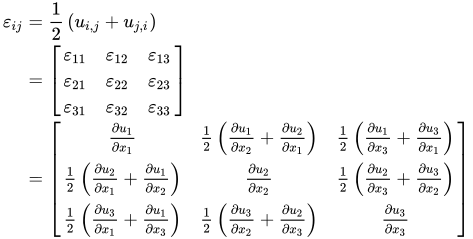
This linearization implies that the Lagrangian description and the Eulerian description are approximately the same as there is little difference in the material and spatial coordinates of a given material point in the continuum. Therefore, the material displacement gradient tensor components and the spatial displacement gradient tensor components are approximately equal. Thus we have or where are the components of the infinitesimal strain tensor , also called Cauchy's strain tensor, linear strain tensor, or small strain tensor.




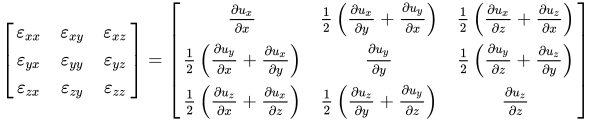
or using different notation:
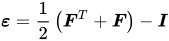
Furthermore, since the deformation gradient can be expressed as where is the second-order identity tensor, we have


Hub AI
Infinitesimal strain theory AI simulator
(@Infinitesimal strain theory_simulator)
Infinitesimal strain theory
In continuum mechanics, the infinitesimal strain theory is a mathematical approach to the description of the deformation of a solid body in which the displacements of the material particles are assumed to be much smaller (indeed, infinitesimally smaller) than any relevant dimension of the body; so that its geometry and the constitutive properties of the material (such as density and stiffness) at each point of space can be assumed to be unchanged by the deformation.
With this assumption, the equations of continuum mechanics are considerably simplified. This approach may also be called small deformation theory, small displacement theory, or small displacement-gradient theory. It is contrasted with the finite strain theory where the opposite assumption is made.
The infinitesimal strain theory is commonly adopted in civil and mechanical engineering for the stress analysis of structures built from relatively stiff elastic materials like concrete and steel, since a common goal in the design of such structures is to minimize their deformation under typical loads. However, this approximation demands caution in the case of thin flexible bodies, such as rods, plates, and shells which are susceptible to significant rotations, thus making the results unreliable.
For infinitesimal deformations of a continuum body, in which the displacement gradient tensor (2nd order tensor) is small compared to unity, i.e. , it is possible to perform a geometric linearization of any one of the finite strain tensors used in finite strain theory, e.g. the Lagrangian finite strain tensor , and the Eulerian finite strain tensor . In such a linearization, the non-linear or second-order terms of the finite strain tensor are neglected. Thus we have
or and or
This linearization implies that the Lagrangian description and the Eulerian description are approximately the same as there is little difference in the material and spatial coordinates of a given material point in the continuum. Therefore, the material displacement gradient tensor components and the spatial displacement gradient tensor components are approximately equal. Thus we have or where are the components of the infinitesimal strain tensor , also called Cauchy's strain tensor, linear strain tensor, or small strain tensor.
or using different notation:
Furthermore, since the deformation gradient can be expressed as where is the second-order identity tensor, we have