



Community hub
Recent from talks

Knowledge base stats:
Talk channels stats:
Members stats:
Concrete
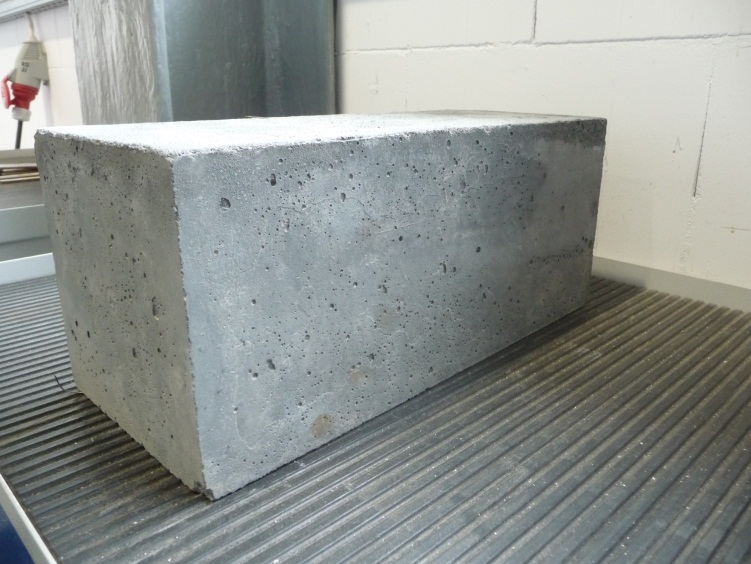
Concrete is a composite material composed of aggregate bound together with a fluid cement that cures to a solid over time. It is the second-most-used substance (after water), the most–widely used building material, and the most-manufactured material in the world.
When aggregate is mixed with dry Portland cement and water, the mixture forms a fluid slurry that can be poured and molded into shape. The cement reacts with the water through a process called hydration, which hardens it after several hours to form a solid matrix that binds the materials together into a durable stone-like material with various uses. This time allows concrete to not only be cast in forms, but also to have a variety of tooled processes performed. The hydration process is exothermic, which means that ambient temperature plays a significant role in how long it takes concrete to set. Often, additives (such as pozzolans or superplasticizers) are included in the mixture to improve the physical properties of the wet mix, delay or accelerate the curing time, or otherwise modify the finished material. Most structural concrete is poured with reinforcing materials (such as steel rebar) embedded to provide tensile strength, yielding reinforced concrete.
Before the invention of Portland cement in the early 1800s, lime-based cement binders, such as lime putty, were often used. The overwhelming majority of concretes are produced using Portland cement, but sometimes with other hydraulic cements, such as calcium aluminate cement. Many other non-cementitious types of concrete exist with other methods of binding aggregate together, including asphalt concrete with a bitumen binder, which is frequently used for road surfaces, and polymer concretes that use polymers as a binder.
Concrete is distinct from mortar. Whereas concrete is itself a building material, and contains both coarse (large) and fine (small) aggregate particles, mortar contains only fine aggregates and is mainly used as a bonding agent to hold bricks, tiles and other masonry units together. Grout is another material associated with concrete and cement. It also does not contain coarse aggregates and is usually either pourable or thixotropic, and is used to fill gaps between masonry components or coarse aggregate which has already been put in place. Some methods of concrete manufacture and repair involve pumping grout into the gaps to make up a solid mass in situ.
The word concrete comes from the Latin word "concretus" (meaning compact or condensed), the perfect passive participle of "concrescere", from "con-" (together) and "crescere" (to grow).
Concrete floors were found in the royal palace of Tiryns, Greece, which dates roughly to 1400 to 1200 BC. Lime mortars were used in Greece, such as in Crete and Cyprus, in 800 BC. The Assyrian Jerwan Aqueduct (688 BC) made use of waterproof concrete. Concrete was used for construction in many ancient structures.
Mayan concrete at the ruins of Uxmal (AD 850–925) is referenced in Incidents of Travel in the Yucatán by John L. Stephens. "The roof is flat and had been covered with cement". "The floors were cement, in some places hard, but, by long exposure, broken, and now crumbling under the feet." "But throughout the wall was solid, and consisting of large stones imbedded in mortar, almost as hard as rock."
Small-scale production of concrete-like materials was pioneered by the Nabatean traders who occupied and controlled a series of oases and developed a small empire in the regions of southern Syria and northern Jordan from the 4th century BC. They discovered the advantages of hydraulic lime, with some self-cementing properties, by 700 BC. They built kilns to supply mortar for the construction of rubble masonry houses, concrete floors, and underground waterproof cisterns. They kept the cisterns secret as these enabled the Nabataeans to thrive in the desert. Some of these structures survive to this day.
Hub AI
Concrete AI simulator
(@Concrete_simulator)
Concrete
Concrete is a composite material composed of aggregate bound together with a fluid cement that cures to a solid over time. It is the second-most-used substance (after water), the most–widely used building material, and the most-manufactured material in the world.
When aggregate is mixed with dry Portland cement and water, the mixture forms a fluid slurry that can be poured and molded into shape. The cement reacts with the water through a process called hydration, which hardens it after several hours to form a solid matrix that binds the materials together into a durable stone-like material with various uses. This time allows concrete to not only be cast in forms, but also to have a variety of tooled processes performed. The hydration process is exothermic, which means that ambient temperature plays a significant role in how long it takes concrete to set. Often, additives (such as pozzolans or superplasticizers) are included in the mixture to improve the physical properties of the wet mix, delay or accelerate the curing time, or otherwise modify the finished material. Most structural concrete is poured with reinforcing materials (such as steel rebar) embedded to provide tensile strength, yielding reinforced concrete.
Before the invention of Portland cement in the early 1800s, lime-based cement binders, such as lime putty, were often used. The overwhelming majority of concretes are produced using Portland cement, but sometimes with other hydraulic cements, such as calcium aluminate cement. Many other non-cementitious types of concrete exist with other methods of binding aggregate together, including asphalt concrete with a bitumen binder, which is frequently used for road surfaces, and polymer concretes that use polymers as a binder.
Concrete is distinct from mortar. Whereas concrete is itself a building material, and contains both coarse (large) and fine (small) aggregate particles, mortar contains only fine aggregates and is mainly used as a bonding agent to hold bricks, tiles and other masonry units together. Grout is another material associated with concrete and cement. It also does not contain coarse aggregates and is usually either pourable or thixotropic, and is used to fill gaps between masonry components or coarse aggregate which has already been put in place. Some methods of concrete manufacture and repair involve pumping grout into the gaps to make up a solid mass in situ.
The word concrete comes from the Latin word "concretus" (meaning compact or condensed), the perfect passive participle of "concrescere", from "con-" (together) and "crescere" (to grow).
Concrete floors were found in the royal palace of Tiryns, Greece, which dates roughly to 1400 to 1200 BC. Lime mortars were used in Greece, such as in Crete and Cyprus, in 800 BC. The Assyrian Jerwan Aqueduct (688 BC) made use of waterproof concrete. Concrete was used for construction in many ancient structures.
Mayan concrete at the ruins of Uxmal (AD 850–925) is referenced in Incidents of Travel in the Yucatán by John L. Stephens. "The roof is flat and had been covered with cement". "The floors were cement, in some places hard, but, by long exposure, broken, and now crumbling under the feet." "But throughout the wall was solid, and consisting of large stones imbedded in mortar, almost as hard as rock."
Small-scale production of concrete-like materials was pioneered by the Nabatean traders who occupied and controlled a series of oases and developed a small empire in the regions of southern Syria and northern Jordan from the 4th century BC. They discovered the advantages of hydraulic lime, with some self-cementing properties, by 700 BC. They built kilns to supply mortar for the construction of rubble masonry houses, concrete floors, and underground waterproof cisterns. They kept the cisterns secret as these enabled the Nabataeans to thrive in the desert. Some of these structures survive to this day.