
Recent from talks
Influenza-like illness
Knowledge base stats:
Talk channels stats:
Members stats:
Influenza-like illness
Influenza-like illness (ILI), also known as flu-like syndrome or flu-like symptoms, is a medical diagnosis of possible influenza or other illness causing a set of common symptoms. These include fever, shivering, chills, malaise, dry cough, loss of appetite, body aches, nausea, and sneezing typically in connection with a sudden onset of illness. In most cases, the symptoms are caused by cytokines released by immune system activation,[citation needed] and are thus relatively non-specific.
Common causes of ILI include the common cold and influenza, which tends to be less common but more severe than the common cold. Less common causes include side effects of many drugs and manifestations of many other diseases.[citation needed]
The term ILI can be used casually, but when used in the surveillance of influenza cases, can have a strict definition. The World Health Organization defines an illness as an ILI if the patient has a fever greater than or equal to 38 °C and a cough, which began in the last 10 days. If the patient's condition requires hospitalisation, the illness is classified instead as a severe acute respiratory infection (SARI). Other organisations may have different definitions. For instance, the CDC defines it as a 100 °F (38 °C) fever or greater, and a cough or sore throat.
The causes of influenza-like illness range from benign self-limited illnesses such as gastroenteritis, rhinoviral disease, and influenza, to severe, sometimes life-threatening, diseases such as meningitis, sepsis, and leukemia.[citation needed]
Technically, any clinical diagnosis of influenza is a diagnosis of ILI, not of influenza. This distinction usually is of no great concern because, regardless of cause, most cases of ILI are mild and self-limiting. Furthermore, except perhaps during the peak of a major outbreak of influenza, most cases of ILI are not due to influenza. ILI is very common: in the United States each adult can average 1–3 episodes per year and each child can average 3–6 episodes per year.
Influenza in humans is subject to clinical surveillance by a global network of more than 110 National Influenza Centers. These centers receive samples obtained from patients diagnosed with ILI, and test the samples for the presence of an influenza virus. Not all patients diagnosed with ILI are tested, and not all test results are reported. Samples are selected for testing based on severity of ILI, and as part of routine sampling, and at participating surveillance clinics and laboratories. The United States has a general surveillance program, a border surveillance program, and a hospital surveillance program, all devoted to finding new outbreaks of influenza.[citation needed]
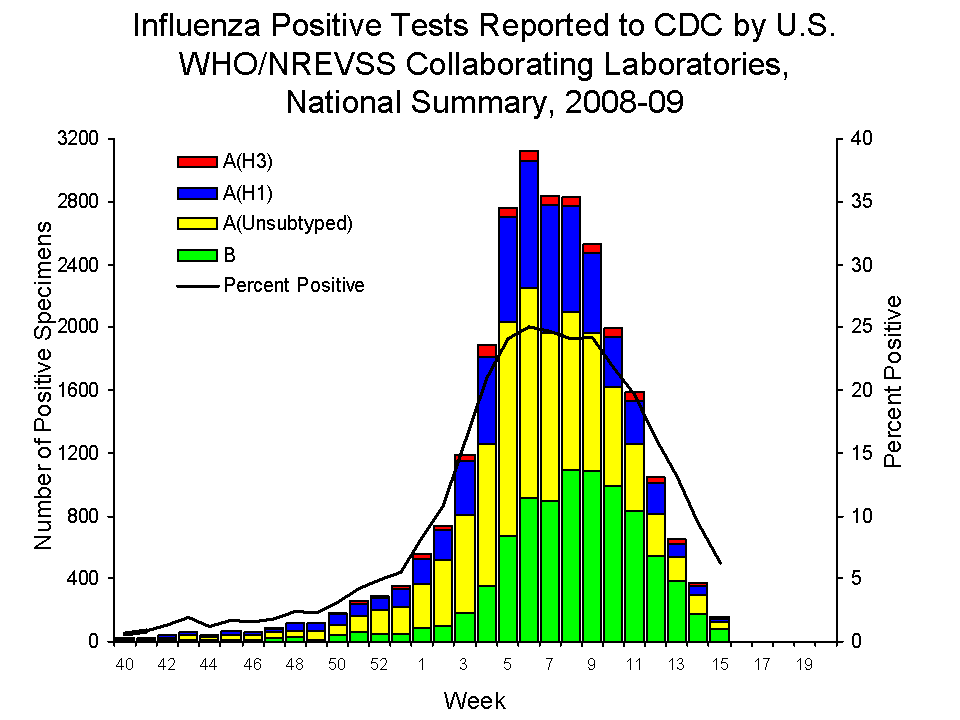
In most years, in the majority of samples tested, the influenza virus is not present (see figure above). In the United States during the 2008–9 influenza season through 18 April, out of 183,839 samples tested and reported to the CDC, only 25,925 (14.1%) were positive for influenza. The percent positive reached a maximum of about 25%. The percent positive increases with the incidence of infection, peaking with the peak incidence of influenza (see figure). During an epidemic, 60–70% of patients with a clear influenza-like illness actually have influenza.
Samples are respiratory samples, usually collected by a physician, nurse, or assistant, and sent to a hospital laboratory for preliminary testing. There are several methods of collecting a respiratory sample, depending on requirements of the laboratory that will test the sample. A sample may be obtained from around the nose simply by wiping with a dry cotton swab.
Hub AI
Influenza-like illness AI simulator
(@Influenza-like illness_simulator)
Influenza-like illness
Influenza-like illness (ILI), also known as flu-like syndrome or flu-like symptoms, is a medical diagnosis of possible influenza or other illness causing a set of common symptoms. These include fever, shivering, chills, malaise, dry cough, loss of appetite, body aches, nausea, and sneezing typically in connection with a sudden onset of illness. In most cases, the symptoms are caused by cytokines released by immune system activation,[citation needed] and are thus relatively non-specific.
Common causes of ILI include the common cold and influenza, which tends to be less common but more severe than the common cold. Less common causes include side effects of many drugs and manifestations of many other diseases.[citation needed]
The term ILI can be used casually, but when used in the surveillance of influenza cases, can have a strict definition. The World Health Organization defines an illness as an ILI if the patient has a fever greater than or equal to 38 °C and a cough, which began in the last 10 days. If the patient's condition requires hospitalisation, the illness is classified instead as a severe acute respiratory infection (SARI). Other organisations may have different definitions. For instance, the CDC defines it as a 100 °F (38 °C) fever or greater, and a cough or sore throat.
The causes of influenza-like illness range from benign self-limited illnesses such as gastroenteritis, rhinoviral disease, and influenza, to severe, sometimes life-threatening, diseases such as meningitis, sepsis, and leukemia.[citation needed]
Technically, any clinical diagnosis of influenza is a diagnosis of ILI, not of influenza. This distinction usually is of no great concern because, regardless of cause, most cases of ILI are mild and self-limiting. Furthermore, except perhaps during the peak of a major outbreak of influenza, most cases of ILI are not due to influenza. ILI is very common: in the United States each adult can average 1–3 episodes per year and each child can average 3–6 episodes per year.
Influenza in humans is subject to clinical surveillance by a global network of more than 110 National Influenza Centers. These centers receive samples obtained from patients diagnosed with ILI, and test the samples for the presence of an influenza virus. Not all patients diagnosed with ILI are tested, and not all test results are reported. Samples are selected for testing based on severity of ILI, and as part of routine sampling, and at participating surveillance clinics and laboratories. The United States has a general surveillance program, a border surveillance program, and a hospital surveillance program, all devoted to finding new outbreaks of influenza.[citation needed]
In most years, in the majority of samples tested, the influenza virus is not present (see figure above). In the United States during the 2008–9 influenza season through 18 April, out of 183,839 samples tested and reported to the CDC, only 25,925 (14.1%) were positive for influenza. The percent positive reached a maximum of about 25%. The percent positive increases with the incidence of infection, peaking with the peak incidence of influenza (see figure). During an epidemic, 60–70% of patients with a clear influenza-like illness actually have influenza.
Samples are respiratory samples, usually collected by a physician, nurse, or assistant, and sent to a hospital laboratory for preliminary testing. There are several methods of collecting a respiratory sample, depending on requirements of the laboratory that will test the sample. A sample may be obtained from around the nose simply by wiping with a dry cotton swab.
Recent media