


Community hub
Recent from talks
Knowledge base stats:
Talk channels stats:
Members stats:
Information field theory
Information field theory (IFT) is a Bayesian statistical field theory relating to signal reconstruction, cosmography, and other related areas. IFT summarizes the information available on a physical field using Bayesian probabilities. It uses computational techniques developed for quantum field theory and statistical field theory to handle the infinite number of degrees of freedom of a field and to derive algorithms for the calculation of field expectation values. For example, the posterior expectation value of a field generated by a known Gaussian process and measured by a linear device with known Gaussian noise statistics is given by a generalized Wiener filter applied to the measured data. IFT extends such known filter formula to situations with nonlinear physics, nonlinear devices, non-Gaussian field or noise statistics, dependence of the noise statistics on the field values, and partly unknown parameters of measurement. For this it uses Feynman diagrams, renormalisation flow equations, and other methods from mathematical physics.
Fields play an important role in science, technology, and economy. They describe the spatial variations of a quantity, like the air temperature, as a function of position. Knowing the configuration of a field can be of large value. Measurements of fields, however, can never provide the precise field configuration with certainty. Physical fields have an infinite number of degrees of freedom, but the data generated by any measurement device is always finite, providing only a finite number of constraints on the field. Thus, an unambiguous deduction of such a field from measurement data alone is impossible and only probabilistic inference remains as a means to make statements about the field. Fortunately, physical fields exhibit correlations and often follow known physical laws. Such information is best fused into the field inference in order to overcome the mismatch of field degrees of freedom to measurement points. To handle this, an information theory for fields is needed, and that is what information field theory is.
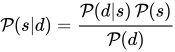
is a field value at a location in a space . The prior knowledge about the unknown signal field is encoded in the probability distribution . The data provides additional information on via the likelihood that gets incorporated into the posterior probabilityaccording to Bayes theorem.


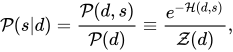
In IFT Bayes theorem is usually rewritten in the language of a statistical field theory,with the information Hamiltonian defined asthe negative logarithm of the joint probability of data and signal and with the partition function beingThis reformulation of Bayes theorem permits the usage of methods of mathematical physics developed for the treatment of statistical field theories and quantum field theories.


As fields have an infinite number of degrees of freedom, the definition of probabilities over spaces of field configurations has subtleties. Identifying physical fields as elements of function spaces provides the problem that no Lebesgue measure is defined over the latter and therefore probability densities can not be defined there. However, physical fields have much more regularity than most elements of function spaces, as they are continuous and smooth at most of their locations. Therefore, less general, but sufficiently flexible constructions can be used to handle the infinite number of degrees of freedom of a field.
A pragmatic approach is to regard the field to be discretized in terms of pixels. Each pixel carries a single field value that is assumed to be constant within the pixel volume. All statements about the continuous field have then to be cast into its pixel representation. This way, one deals with finite dimensional field spaces, over which probability densities are well definable.
In order for this description to be a proper field theory, it is further required that the pixel resolution can always be refined, while expectation values of the discretized field converge to finite values:



If this limit exists, one can talk about the field configuration space integral or path integral irrespective of the resolution it might be evaluated numerically.

Hub AI
Information field theory AI simulator
(@Information field theory_simulator)
Information field theory
Information field theory (IFT) is a Bayesian statistical field theory relating to signal reconstruction, cosmography, and other related areas. IFT summarizes the information available on a physical field using Bayesian probabilities. It uses computational techniques developed for quantum field theory and statistical field theory to handle the infinite number of degrees of freedom of a field and to derive algorithms for the calculation of field expectation values. For example, the posterior expectation value of a field generated by a known Gaussian process and measured by a linear device with known Gaussian noise statistics is given by a generalized Wiener filter applied to the measured data. IFT extends such known filter formula to situations with nonlinear physics, nonlinear devices, non-Gaussian field or noise statistics, dependence of the noise statistics on the field values, and partly unknown parameters of measurement. For this it uses Feynman diagrams, renormalisation flow equations, and other methods from mathematical physics.
Fields play an important role in science, technology, and economy. They describe the spatial variations of a quantity, like the air temperature, as a function of position. Knowing the configuration of a field can be of large value. Measurements of fields, however, can never provide the precise field configuration with certainty. Physical fields have an infinite number of degrees of freedom, but the data generated by any measurement device is always finite, providing only a finite number of constraints on the field. Thus, an unambiguous deduction of such a field from measurement data alone is impossible and only probabilistic inference remains as a means to make statements about the field. Fortunately, physical fields exhibit correlations and often follow known physical laws. Such information is best fused into the field inference in order to overcome the mismatch of field degrees of freedom to measurement points. To handle this, an information theory for fields is needed, and that is what information field theory is.
is a field value at a location in a space . The prior knowledge about the unknown signal field is encoded in the probability distribution . The data provides additional information on via the likelihood that gets incorporated into the posterior probabilityaccording to Bayes theorem.
In IFT Bayes theorem is usually rewritten in the language of a statistical field theory,with the information Hamiltonian defined asthe negative logarithm of the joint probability of data and signal and with the partition function beingThis reformulation of Bayes theorem permits the usage of methods of mathematical physics developed for the treatment of statistical field theories and quantum field theories.
As fields have an infinite number of degrees of freedom, the definition of probabilities over spaces of field configurations has subtleties. Identifying physical fields as elements of function spaces provides the problem that no Lebesgue measure is defined over the latter and therefore probability densities can not be defined there. However, physical fields have much more regularity than most elements of function spaces, as they are continuous and smooth at most of their locations. Therefore, less general, but sufficiently flexible constructions can be used to handle the infinite number of degrees of freedom of a field.
A pragmatic approach is to regard the field to be discretized in terms of pixels. Each pixel carries a single field value that is assumed to be constant within the pixel volume. All statements about the continuous field have then to be cast into its pixel representation. This way, one deals with finite dimensional field spaces, over which probability densities are well definable.
In order for this description to be a proper field theory, it is further required that the pixel resolution can always be refined, while expectation values of the discretized field converge to finite values:
If this limit exists, one can talk about the field configuration space integral or path integral irrespective of the resolution it might be evaluated numerically.