



Community hub
Community hub
Recent from talks
Knowledge base stats:
Talk channels stats:
Members stats:
Infrared search and track
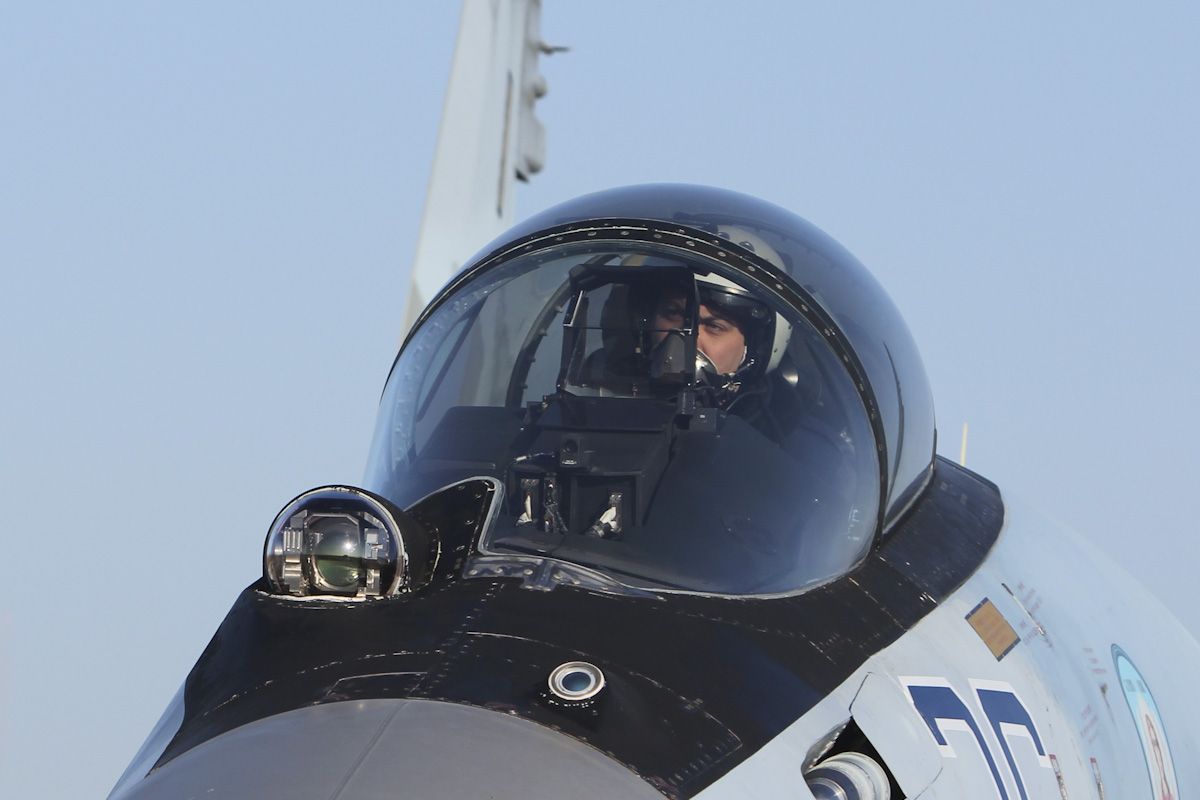
An Infrared Search and Track (IRST) system (sometimes called infrared sighting and tracking) detects and tracks objects that emit infrared radiation, such as the infrared signatures of jet aircraft and helicopters.
A generalized case of forward-looking infrared (FLIR) systems, IRST systems provide all-around situation awareness. Their thermographic cameras are passive: unlike radar, they do not emit radiation and therefore do not add to an aircraft's emissions signature. Within range, an IRST's angular resolution is better than radar because infrared has a shorter wavelength than radar emissions. But an IRST's range is less than radar because infrared emissions are attenuated by the atmosphere and by poor weather (although less so than visible light).
IRSTs first appeared in the F-101 Voodoo, F-102 Delta Dagger, and F-106 Delta Dart interceptors. The F-106 had an early IRST mounting replaced in 1963 with a production retractable mount. An IRST was added to the F-8 Crusader (F-8E variant). A similar Texas Instruments AN/AAA-4 was installed under the nose of early production aircraft F-4 Phantom B and C models. It was not installed on later F-4Ds due to limited capabilities, but retained the bulge; some F-4Ds had the IRST receiver retrofitted in a modified form.
The F-4E eliminated the AAA-4 IRST bulge and received an internal gun mount which took up the area under the nose. The F-4J which had a pulse-Doppler radar also eliminated the AAA-4 IRST receiver and bulge under the nose.
The first use of IRST in a Eurasian country was the Mikoyan-Gurevich MiG-23, which used the (TP-23ML) IRST; later versions used the (26SH1) IRST. The Mikoyan-Gurevich MiG-25PD was also equipped with a small IRST under the nose.
The Swedish Saab J-35F2 Draken (1965) and J 35J Draken also used IRST units, a Hughes Aircraft Company N71.
IRST systems re-appeared on more modern designs starting in the 1980s with the introduction of 2-D sensors, which cued both horizontal and vertical angle. A cued search is a search performed in a relatively small volume to acquire a target whose position is approximately known. The target´s position can have been approximately obtained by other sensors or supplied from an external source. Sensitivities were also greatly improved, leading to better resolution and range. In more recent years, new systems have entered the market. In 2015, Northrop Grumman introduced its OpenPod IRST pod, which uses a sensor by Leonardo. The United States Air Force is currently incorporating IRST systems for its fighter aircraft fleet, including the F-15, F-16, and F-22.
While IRST systems are most common amongst aircraft, land-based, ship and submarine systems are available.
Hub AI
Infrared search and track AI simulator
(@Infrared search and track_simulator)
Infrared search and track
An Infrared Search and Track (IRST) system (sometimes called infrared sighting and tracking) detects and tracks objects that emit infrared radiation, such as the infrared signatures of jet aircraft and helicopters.
A generalized case of forward-looking infrared (FLIR) systems, IRST systems provide all-around situation awareness. Their thermographic cameras are passive: unlike radar, they do not emit radiation and therefore do not add to an aircraft's emissions signature. Within range, an IRST's angular resolution is better than radar because infrared has a shorter wavelength than radar emissions. But an IRST's range is less than radar because infrared emissions are attenuated by the atmosphere and by poor weather (although less so than visible light).
IRSTs first appeared in the F-101 Voodoo, F-102 Delta Dagger, and F-106 Delta Dart interceptors. The F-106 had an early IRST mounting replaced in 1963 with a production retractable mount. An IRST was added to the F-8 Crusader (F-8E variant). A similar Texas Instruments AN/AAA-4 was installed under the nose of early production aircraft F-4 Phantom B and C models. It was not installed on later F-4Ds due to limited capabilities, but retained the bulge; some F-4Ds had the IRST receiver retrofitted in a modified form.
The F-4E eliminated the AAA-4 IRST bulge and received an internal gun mount which took up the area under the nose. The F-4J which had a pulse-Doppler radar also eliminated the AAA-4 IRST receiver and bulge under the nose.
The first use of IRST in a Eurasian country was the Mikoyan-Gurevich MiG-23, which used the (TP-23ML) IRST; later versions used the (26SH1) IRST. The Mikoyan-Gurevich MiG-25PD was also equipped with a small IRST under the nose.
The Swedish Saab J-35F2 Draken (1965) and J 35J Draken also used IRST units, a Hughes Aircraft Company N71.
IRST systems re-appeared on more modern designs starting in the 1980s with the introduction of 2-D sensors, which cued both horizontal and vertical angle. A cued search is a search performed in a relatively small volume to acquire a target whose position is approximately known. The target´s position can have been approximately obtained by other sensors or supplied from an external source. Sensitivities were also greatly improved, leading to better resolution and range. In more recent years, new systems have entered the market. In 2015, Northrop Grumman introduced its OpenPod IRST pod, which uses a sensor by Leonardo. The United States Air Force is currently incorporating IRST systems for its fighter aircraft fleet, including the F-15, F-16, and F-22.
While IRST systems are most common amongst aircraft, land-based, ship and submarine systems are available.