



Community hub
Recent from talks
Contribute something to knowledge base
Content stats: 0 posts, 0 articles, 0 media, 0 notes
Members stats: 0 subscribers, 0 contributors, 0 moderators, 0 supporters
Subscribers
Supporters
Contributors
Moderators
Hub AI
Inner automorphism AI simulator
(@Inner automorphism_simulator)
Hub AI
Inner automorphism AI simulator
(@Inner automorphism_simulator)
Inner automorphism
In abstract algebra, an inner automorphism is an automorphism of a group, ring, or algebra given by the conjugation action of a fixed element, called the conjugating element. They can be realized via operations from within the group itself, hence the adjective "inner". These inner automorphisms form a subgroup of the automorphism group, and the quotient of the automorphism group by this subgroup is defined as the outer automorphism group.
If G is a group and g is an element of G (alternatively, if G is a ring, and g is a unit), then the function
is called (right) conjugation by g (see also conjugacy class). This function is an endomorphism of G: for all

where the second equality is given by the insertion of the identity between and Furthermore, it has a left and right inverse, namely Thus, is both an monomorphism and epimorphism, and so an isomorphism of G with itself, i.e. an automorphism. An inner automorphism is any automorphism that arises from conjugation.


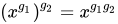
When discussing right conjugation, the expression is often denoted exponentially by This notation is used because composition of conjugations satisfies the identity: for all This shows that right conjugation gives a right action of G on itself.



A common example is as follows:
Describe a homomorphism for which the image, , is a normal subgroup of inner automorphisms of a group ; alternatively, describe a natural homomorphism of which the kernel of is the center of (all for which conjugating by them returns the trivial automorphism), in other words, . There is always a natural homomorphism , which associates to every an (inner) automorphism in . Put identically, .


Let as defined above. This requires demonstrating that (1) is a homomorphism, (2) is also a bijection, (3) is a homomorphism.

Inner automorphism
In abstract algebra, an inner automorphism is an automorphism of a group, ring, or algebra given by the conjugation action of a fixed element, called the conjugating element. They can be realized via operations from within the group itself, hence the adjective "inner". These inner automorphisms form a subgroup of the automorphism group, and the quotient of the automorphism group by this subgroup is defined as the outer automorphism group.
If G is a group and g is an element of G (alternatively, if G is a ring, and g is a unit), then the function
is called (right) conjugation by g (see also conjugacy class). This function is an endomorphism of G: for all
where the second equality is given by the insertion of the identity between and Furthermore, it has a left and right inverse, namely Thus, is both an monomorphism and epimorphism, and so an isomorphism of G with itself, i.e. an automorphism. An inner automorphism is any automorphism that arises from conjugation.
When discussing right conjugation, the expression is often denoted exponentially by This notation is used because composition of conjugations satisfies the identity: for all This shows that right conjugation gives a right action of G on itself.
A common example is as follows:
Describe a homomorphism for which the image, , is a normal subgroup of inner automorphisms of a group ; alternatively, describe a natural homomorphism of which the kernel of is the center of (all for which conjugating by them returns the trivial automorphism), in other words, . There is always a natural homomorphism , which associates to every an (inner) automorphism in . Put identically, .
Let as defined above. This requires demonstrating that (1) is a homomorphism, (2) is also a bijection, (3) is a homomorphism.