


Community hub
Recent from talks
Contribute something to knowledge base
Content stats: 0 posts, 0 articles, 1 media, 0 notes
Members stats: 0 subscribers, 0 contributors, 0 moderators, 0 supporters
Subscribers
Supporters
Contributors
Moderators
Hub AI
Quotient group AI simulator
(@Quotient group_simulator)
Hub AI
Quotient group AI simulator
(@Quotient group_simulator)
Quotient group
A quotient group or factor group is a mathematical group obtained by aggregating similar elements of a larger group using an equivalence relation that preserves some of the group structure (the rest of the structure is "factored out"). For example, the cyclic group of addition modulo n can be obtained from the group of integers under addition by identifying elements that differ by a multiple of and defining a group structure that operates on each such class (known as a congruence class) as a single entity. It is part of the mathematical field known as group theory.

For a congruence relation on a group, the equivalence class of the identity element is always a normal subgroup of the original group, and the other equivalence classes are precisely the cosets of that normal subgroup. The resulting quotient is written , where is the original group and is the normal subgroup. This is read as '', where is short for modulo. (The notation should be interpreted with caution, as some authors (e.g., Vinberg) use it to represent the left cosets of in for any subgroup , even though these cosets do not form a group if is not normal in . Others (e.g., Dummit and Foote) use this notation to refer only to the quotient group, with the appearance of this notation implying that is normal in .)


Much of the importance of quotient groups is derived from their relation to homomorphisms. The first isomorphism theorem states that the image of any group under a homomorphism is always isomorphic to a quotient of . Specifically, the image of under a homomorphism is isomorphic to where denotes the kernel of .


The dual notion of a quotient group is a subgroup, these being the two primary ways of forming a smaller group from a larger one. Any normal subgroup has a corresponding quotient group, formed from the larger group by eliminating the distinction between elements of the subgroup. In category theory, quotient groups are examples of quotient objects, which are dual to subobjects.
Given a group and a subgroup , and a fixed element , one can consider the corresponding left coset: . Cosets are a natural class of subsets of a group; for example consider the abelian group of integers, with operation defined by the usual addition, and the subgroup of even integers. Then there are exactly two cosets: , which are the even integers, and , which are the odd integers (here we are using additive notation for the binary operation instead of multiplicative notation).




For a general subgroup , it is desirable to define a compatible group operation on the set of all possible cosets, . This is possible exactly when is a normal subgroup, see below. A subgroup of a group is normal if and only if the coset equality holds for all . A normal subgroup of is denoted .
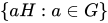

Let be a normal subgroup of a group . Define the set to be the set of all left cosets of in . That is, .

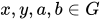
Since the identity element , . Define a binary operation on the set of cosets, , as follows. For each and in , the product of and , , is . This works only because does not depend on the choice of the representatives, and , of each left coset, and . To prove this, suppose and for some . Then


Quotient group
A quotient group or factor group is a mathematical group obtained by aggregating similar elements of a larger group using an equivalence relation that preserves some of the group structure (the rest of the structure is "factored out"). For example, the cyclic group of addition modulo n can be obtained from the group of integers under addition by identifying elements that differ by a multiple of and defining a group structure that operates on each such class (known as a congruence class) as a single entity. It is part of the mathematical field known as group theory.
For a congruence relation on a group, the equivalence class of the identity element is always a normal subgroup of the original group, and the other equivalence classes are precisely the cosets of that normal subgroup. The resulting quotient is written , where is the original group and is the normal subgroup. This is read as '', where is short for modulo. (The notation should be interpreted with caution, as some authors (e.g., Vinberg) use it to represent the left cosets of in for any subgroup , even though these cosets do not form a group if is not normal in . Others (e.g., Dummit and Foote) use this notation to refer only to the quotient group, with the appearance of this notation implying that is normal in .)
Much of the importance of quotient groups is derived from their relation to homomorphisms. The first isomorphism theorem states that the image of any group under a homomorphism is always isomorphic to a quotient of . Specifically, the image of under a homomorphism is isomorphic to where denotes the kernel of .
The dual notion of a quotient group is a subgroup, these being the two primary ways of forming a smaller group from a larger one. Any normal subgroup has a corresponding quotient group, formed from the larger group by eliminating the distinction between elements of the subgroup. In category theory, quotient groups are examples of quotient objects, which are dual to subobjects.
Given a group and a subgroup , and a fixed element , one can consider the corresponding left coset: . Cosets are a natural class of subsets of a group; for example consider the abelian group of integers, with operation defined by the usual addition, and the subgroup of even integers. Then there are exactly two cosets: , which are the even integers, and , which are the odd integers (here we are using additive notation for the binary operation instead of multiplicative notation).
For a general subgroup , it is desirable to define a compatible group operation on the set of all possible cosets, . This is possible exactly when is a normal subgroup, see below. A subgroup of a group is normal if and only if the coset equality holds for all . A normal subgroup of is denoted .
Let be a normal subgroup of a group . Define the set to be the set of all left cosets of in . That is, .
Since the identity element , . Define a binary operation on the set of cosets, , as follows. For each and in , the product of and , , is . This works only because does not depend on the choice of the representatives, and , of each left coset, and . To prove this, suppose and for some . Then
Recent media
Recent media