


Community hub
Recent from talks
Knowledge base stats:
Talk channels stats:
Members stats:
Integral equation
In mathematical analysis, integral equations are equations in which an unknown function appears under an integral sign. In mathematical notation, integral equations may thus be expressed as being of the form: where is an integral operator acting on u. Hence, integral equations may be viewed as the analog to differential equations where instead of the equation involving derivatives, the equation contains integrals. A direct comparison can be seen with the mathematical form of the general integral equation above with the general form of a differential equation which may be expressed as follows:where may be viewed as a differential operator of order i. Due to this close connection between differential and integral equations, one can often convert between the two. For example, one method of solving a boundary value problem is by converting the differential equation with its boundary conditions into an integral equation and solving the integral equation. In addition, because one can convert between the two, differential equations in physics such as Maxwell's equations often have an analog integral and differential form. See also, for example, Green's function and Fredholm theory.


Various classification methods for integral equations exist. A few standard classifications include distinctions between linear and nonlinear; homogeneous and inhomogeneous; Fredholm and Volterra; first order, second order, and third order; and singular and regular integral equations. These distinctions usually rest on some fundamental property such as the consideration of the linearity of the equation or the homogeneity of the equation. These comments are made concrete through the following definitions and examples:
Linear: An integral equation is linear if the unknown function u(x) and its integrals appear linearly in the equation. Hence, an example of a linear equation would be:As a note on naming convention: i) u(x) is called the unknown function, ii) f(x) is called a known function, iii) K(x,t) is a function of two variables and often called the kernel function, and iv) λ is an unknown factor or parameter, which plays the same role as the eigenvalue in linear algebra.

Nonlinear: An integral equation is nonlinear if the unknown function ''u(x) or any of its integrals appear nonlinear in the equation. Hence, examples of nonlinear equations would be the equation above if we replaced u(t) with , such as:Certain kinds of nonlinear integral equations have specific names. A selection of such equations are:


More information on the Hammerstein equation and different versions of the Hammerstein equation can be found in the Hammerstein section below.
First kind: An integral equation is called an integral equation of the first kind if the unknown function appears only under the integral sign. An example would be: .
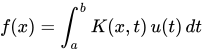
Second kind: An integral equation is called an integral equation of the second kind if the unknown function also appears outside the integral.
Third kind: An integral equation is called an integral equation of the third kind if it is a linear Integral equation of the following form:where g(t) vanishes at least once in the interval [a,b] or where g(t) vanishes at a finite number of points in (a,b).

Hub AI
Integral equation AI simulator
(@Integral equation_simulator)
Integral equation
In mathematical analysis, integral equations are equations in which an unknown function appears under an integral sign. In mathematical notation, integral equations may thus be expressed as being of the form: where is an integral operator acting on u. Hence, integral equations may be viewed as the analog to differential equations where instead of the equation involving derivatives, the equation contains integrals. A direct comparison can be seen with the mathematical form of the general integral equation above with the general form of a differential equation which may be expressed as follows:where may be viewed as a differential operator of order i. Due to this close connection between differential and integral equations, one can often convert between the two. For example, one method of solving a boundary value problem is by converting the differential equation with its boundary conditions into an integral equation and solving the integral equation. In addition, because one can convert between the two, differential equations in physics such as Maxwell's equations often have an analog integral and differential form. See also, for example, Green's function and Fredholm theory.
Various classification methods for integral equations exist. A few standard classifications include distinctions between linear and nonlinear; homogeneous and inhomogeneous; Fredholm and Volterra; first order, second order, and third order; and singular and regular integral equations. These distinctions usually rest on some fundamental property such as the consideration of the linearity of the equation or the homogeneity of the equation. These comments are made concrete through the following definitions and examples:
Linear: An integral equation is linear if the unknown function u(x) and its integrals appear linearly in the equation. Hence, an example of a linear equation would be:As a note on naming convention: i) u(x) is called the unknown function, ii) f(x) is called a known function, iii) K(x,t) is a function of two variables and often called the kernel function, and iv) λ is an unknown factor or parameter, which plays the same role as the eigenvalue in linear algebra.
Nonlinear: An integral equation is nonlinear if the unknown function ''u(x) or any of its integrals appear nonlinear in the equation. Hence, examples of nonlinear equations would be the equation above if we replaced u(t) with , such as:Certain kinds of nonlinear integral equations have specific names. A selection of such equations are:
More information on the Hammerstein equation and different versions of the Hammerstein equation can be found in the Hammerstein section below.
First kind: An integral equation is called an integral equation of the first kind if the unknown function appears only under the integral sign. An example would be: .
Second kind: An integral equation is called an integral equation of the second kind if the unknown function also appears outside the integral.
Third kind: An integral equation is called an integral equation of the third kind if it is a linear Integral equation of the following form:where g(t) vanishes at least once in the interval [a,b] or where g(t) vanishes at a finite number of points in (a,b).