Hubbry Logo
Boundary value problemBoundary value problemMain
Open search
Boundary value problem
Community hub
Boundary value problem
logo
8 pages, 0 posts
0 subscribers
Be the first to start a discussion here.
Contribute something
Boundary value problem
from Wikipedia
Shows a region where a differential equation is valid and the associated boundary values

In the study of differential equations, a boundary-value problem is a differential equation subjected to constraints called boundary conditions.[1] A solution to a boundary value problem is a solution to the differential equation which also satisfies the boundary conditions.

Boundary value problems arise in several branches of physics as any physical differential equation will have them. Problems involving the wave equation, such as the determination of normal modes, are often stated as boundary value problems. A large class of important boundary value problems are the Sturm–Liouville problems. The analysis of these problems, in the linear case, involves the eigenfunctions of a differential operator.

To be useful in applications, a boundary value problem should be well posed. This means that given the input to the problem there exists a unique solution, which depends continuously on the input. Much theoretical work in the field of partial differential equations is devoted to proving that boundary value problems arising from scientific and engineering applications are in fact well-posed.

Among the earliest boundary value problems to be studied is the Dirichlet problem, of finding the harmonic functions (solutions to Laplace's equation); the solution was given by the Dirichlet's principle.

Explanation

[edit]

Boundary value problems are similar to initial value problems. A boundary value problem has conditions specified at the extremes ("boundaries") of the independent variable in the equation whereas an initial value problem has all of the conditions specified at the same value of the independent variable (and that value is at the lower boundary of the domain, thus the term "initial" value). A boundary value is a data value that corresponds to a minimum or maximum input, internal, or output value specified for a system or component.[2]

For example, if the independent variable is time over the domain [0,1], a boundary value problem would specify values for at both and , whereas an initial value problem would specify a value of and at time .

Finding the temperature at all points of an iron bar with one end kept at absolute zero and the other end at the freezing point of water would be a boundary value problem.

If the problem is dependent on both space and time, one could specify the value of the problem at a given point for all time or at a given time for all space.

Concretely, an example of a boundary value problem (in one spatial dimension) is

to be solved for the unknown function with the boundary conditions


Without the boundary conditions, the general solution to this equation is

From the boundary condition one obtains


which implies that From the boundary condition one finds

and so One sees that imposing boundary conditions allowed one to determine a unique solution, which in this case is


Types of boundary value problems

[edit]

Boundary value conditions

[edit]
Finding a function to describe the temperature of this idealised 2D rod is a boundary value problem with Dirichlet boundary conditions. Any solution function will both solve the heat equation, and fulfill the boundary conditions of a temperature of 0 K on the left boundary and a temperature of 273.15 K on the right boundary.

A boundary condition which specifies the value of the function itself is a Dirichlet boundary condition, or first-type boundary condition. For example, if one end of an iron rod is held at absolute zero, then the value of the problem would be known at that point in space.

A boundary condition which specifies the value of the normal derivative of the function is a Neumann boundary condition, or second-type boundary condition. For example, if there is a heater at one end of an iron rod, then energy would be added at a constant rate but the actual temperature would not be known.

If the boundary has the form of a curve or surface that gives a value to the normal derivative and the variable itself then it is a Cauchy boundary condition.

Examples

[edit]

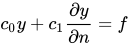
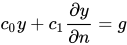
Summary of boundary conditions for the unknown function, , constants and specified by the boundary conditions, and known scalar functions and specified by the boundary conditions.

Name Form on 1st part of boundary Form on 2nd part of boundary
Dirichlet
Neumann
Robin
Mixed
Cauchy both and

Differential operators

[edit]

Aside from the boundary condition, boundary value problems are also classified according to the type of differential operator involved. For an elliptic operator, one discusses elliptic boundary value problems. For a hyperbolic operator, one discusses hyperbolic boundary value problems. These categories are further subdivided into linear and various nonlinear types.

Applications

[edit]

Electromagnetic potential

[edit]

In electrostatics, a common problem is to find a function which describes the electric potential of a given region. If the region does not contain charge, the potential must be a solution to Laplace's equation (a so-called harmonic function). The boundary conditions in this case are the Interface conditions for electromagnetic fields. If there is no current density in the region, it is also possible to define a magnetic scalar potential using a similar procedure.

See also

[edit]

Notes

[edit]

References

[edit]
[edit]
Revisions and contributorsEdit on WikipediaRead on Wikipedia
from Grokipedia
A boundary value problem (BVP) in is a supplemented by boundary conditions that specify the values of the solution or its at the boundaries of the domain, such as endpoints of an interval for ordinary differential equations or surfaces enclosing a for partial differential equations. These conditions distinguish BVPs from initial value problems, where all constraints are imposed at a single point, and BVPs may yield no solution, a unique solution, or infinitely many solutions depending on the formulation. BVPs are central to , as they model steady-state behaviors in physical systems where boundary influences are critical. For ordinary differential equations, BVPs typically involve second-order linear equations of the form y+p(x)y+q(x)y=g(x)y'' + p(x)y' + q(x)y = g(x) with two-point boundary conditions, such as y(a)=αy(a) = \alpha and y(b)=βy(b) = \beta (Dirichlet type), y(a)=αy'(a) = \alpha and y(b)=βy'(b) = \beta (Neumann type), or mixed forms like αy(a)+βy(a)=γ\alpha y(a) + \beta y'(a) = \gamma. Homogeneous BVPs, where g(x)=0g(x) = 0 and boundary values are zero, often relate to eigenvalue problems, such as y+λy=0y'' + \lambda y = 0 with conditions y(0)=0y(0) = 0 and y(L)=0y(L) = 0, yielding eigenvalues λn=(nπ/L)2\lambda_n = (n\pi/L)^2 and eigenfunctions sin(nπx/L)\sin(n\pi x / L) for n=1,2,n = 1, 2, \dots. Solution methods include Green's functions for nonhomogeneous cases and shooting techniques for numerical approximation, with existence and uniqueness theorems relying on continuity and Lipschitz conditions similar to those for initial value problems. In partial differential equations, BVPs are essential for elliptic, parabolic, and hyperbolic equations, such as Laplace's equation 2u=0\nabla^2 u = 0 for steady-state heat or electrostatics, the heat equation ut=kuxxu_t = k u_{xx} for transient diffusion, and the wave equation utt=c2uxxu_{tt} = c^2 u_{xx} for vibrations. Boundary types extend to periodic conditions, where solutions match at domain endpoints, or boundedness requirements to prevent singularities. These problems underpin Fourier series expansions and Sturm-Liouville theory, enabling separation of variables to solve complex geometries in rectangular, cylindrical, or spherical coordinates. Applications of BVPs span physics and engineering, including temperature distribution in rods (heat conduction), deflection of beams under loads (elasticity), wave propagation in strings or membranes, potential fields in , and quantum mechanical eigenvalue spectra for bound states. In , they model diffusion-reaction processes; in , vibration analysis of structures; and in , steady currents in networks via . Numerical solvers like or multigrid methods address large-scale BVPs in computational simulations.

Fundamentals

Definition and Basic Concepts

A boundary value problem (BVP) consists of a , either ordinary () or partial (PDE), together with a set of boundary conditions that specify the values of the solution or its on the boundaries of the domain. These problems arise when seeking solutions that satisfy constraints at the edges or surfaces of the domain, distinguishing them from problems where conditions are specified at a single point. The key components of a BVP include the differential equation itself, which governs the behavior of the unknown function within the domain; the domain, such as a finite interval [a,b][a, b] for ODEs or a bounded in higher dimensions for PDEs; and the boundary conditions, which impose constraints at the endpoints of the interval or on the boundary surfaces of the . For instance, in an ODE context, the domain is typically a one-dimensional interval, while for PDEs, it extends to two- or three-dimensional spatial . These elements ensure the problem is well-posed, allowing for the determination of a unique solution under appropriate conditions. The origins of boundary value problems trace back to 19th-century physics, particularly in the study of heat conduction, where and developed foundational models involving differential s with boundary specifications. 's work in the late introduced the for steady-state phenomena, while 's 1807 formulation of the , published in 1822, explicitly incorporated boundary conditions to describe flow in solids. These early examples from laid the groundwork for BVPs as essential tools in . A basic example of a BVP is the second-order linear given by u(x)=f(x),x[a,b],-u''(x) = f(x), \quad x \in [a, b], with boundary conditions u(a)=Au(a) = A and u(b)=Bu(b) = B, where f(x)f(x) represents a forcing term, and AA and BB are specified values. Physically, this models steady-state heat conduction along a rod of length bab - a, where u(x)u(x) denotes the distribution, u(x)-u''(x) accounts for the heat source or sink via f(x)f(x), and the boundary conditions fix the temperatures at the endpoints. Boundary value problems are often classified as linear, meaning the differential equation and boundary conditions are linear in the unknown function and its derivatives, allowing superposition of solutions. Within linear BVPs, a problem is homogeneous if both the has no forcing term (i.e., the right-hand side is zero) and the boundary conditions are homogeneous (e.g., specifying zero values or zero at the boundaries); otherwise, it is nonhomogeneous. Homogeneous BVPs frequently yield trivial solutions like the zero function unless nontrivial conditions, such as eigenvalues, are introduced, whereas nonhomogeneous cases incorporate external influences like sources or prescribed boundary values.

Comparison with Initial Value Problems

Boundary value problems (BVPs) differ fundamentally from initial value problems (IVPs) in the placement and nature of the specified conditions. In an IVP for an (ODE), conditions are provided at a single initial point, typically corresponding to time t=0t = 0, allowing the solution to be constructed by marching forward along the domain. This local specification enables straightforward integration from the starting point. In contrast, a BVP imposes conditions at the boundaries of the domain, such as the endpoints of an interval, necessitating a global adjustment of the solution to satisfy all constraints simultaneously. BVPs often involve two-point conditions, where values or are specified at two distinct points, or more generally multi-point conditions across several locations, which complicates the solving process compared to the unidirectional progression in IVPs. Solvability presents another key distinction. For IVPs, the Picard-Lindelöf theorem guarantees the and of solutions under mild conditions, such as when the right-hand side function is continuous in the dependent variable. This theorem ensures a unique solution in a neighborhood of the initial point for ODEs, and similar results extend to higher-order systems. BVPs, however, lack such general assurances; and may fail without additional constraints like specific boundary condition types or eigenvalue considerations, potentially leading to no solution, infinitely many solutions, or a unique one depending on the problem parameters. To illustrate, consider the second-order linear y+y=0y'' + y = 0. For the IVP with conditions y(0)=1y(0) = 1, y(0)=0y'(0) = 0, the general solution is y(x)=Acosx+Bsinxy(x) = A \cos x + B \sin x; applying the conditions yields A=1A = 1, B=0B = 0, so y(x)=cosxy(x) = \cos x, a unique solution. For a corresponding BVP with conditions y(0)=0y(0) = 0, y(π/2)=1y(\pi/2) = 1, the same general solution applies, but now A=0A = 0, B=1B = 1, giving y(x)=sinxy(x) = \sin x, which satisfies the boundaries. However, altering the BVP to y(0)=1y(0) = 1, y(π)=0y(\pi) = 0 results in A=1A = 1 and A=0-A = 0, or 1=0-1 = 0, demonstrating non-existence. These examples highlight how boundary placements can enforce or preclude solutions, unlike the guaranteed outcome in IVPs. Computationally, these differences have significant implications. IVPs are well-suited for simulating time-dependent evolutions, such as dynamical systems or transient phenomena, where forward integration methods like Runge-Kutta suffice./02%3A_Second_Order_Partial_Differential_Equations/2.03%3A_Boundary_Value_Problems) BVPs, by contrast, model steady-state configurations or spatial distributions, such as conduction in a rod or beam deflection, requiring iterative global methods like or finite differences to match boundary requirements across the entire domain./02%3A_Second_Order_Partial_Differential_Equations/2.03%3A_Boundary_Value_Problems) This global nature often demands more sophisticated analysis to ensure convergence and accuracy.

Formulation

For Ordinary Differential Equations

Boundary value problems for ordinary differential equations are posed on a one-dimensional finite interval [a,b][a, b], where the solution u(x)u(x) satisfies a along with conditions specified at the endpoints x=ax = a and x=bx = b. These two-point boundary conditions distinguish boundary value problems from initial value problems, which specify conditions at a single point. A common general form is the second-order Lu=fLu = f on [a,b][a, b], where LL is a , typically of the form Lu=p0(x)u+p1(x)u+p2(x)uL u = p_0(x) u'' + p_1(x) u' + p_2(x) u, and the boundary conditions are B1u(a)=αB_1 u(a) = \alpha, B2u(b)=βB_2 u(b) = \beta, with B1B_1 and B2B_2 linear operators involving uu and its derivatives. represent a variant, where u(a)=u(b)u(a) = u(b) and u(a)=u(b)u'(a) = u'(b), effectively treating the domain as a . A prominent example is the Sturm-Liouville boundary value problem, which takes the form ddx(p(x)dudx)+q(x)u=λw(x)u\frac{d}{dx} \left( p(x) \frac{du}{dx} \right) + q(x) u = -\lambda w(x) u on [a,b][a, b], where p(x)>0p(x) > 0, w(x)>0w(x) > 0 are positive continuous functions, and q(x)q(x) is continuous, subject to separated boundary conditions such as αu(a)+βu(a)=0\alpha u(a) + \beta u'(a) = 0 and γu(b)+δu(b)=0\gamma u(b) + \delta u'(b) = 0, with α2+β2>0\alpha^2 + \beta^2 > 0 and γ2+δ2>0\gamma^2 + \delta^2 > 0. This form arises in applications like vibration analysis and is regular if p(a)=p(b)>0p(a) = p(b) > 0. Linear boundary value problems are classified as homogeneous if f0f \equiv 0 (or λ=0\lambda = 0) and the boundary conditions are homogeneous (α=β=0\alpha = \beta = 0), or non-homogeneous otherwise. For non-homogeneous linear cases Lu=fLu = f with homogeneous boundary conditions, the solution can be expressed using the Green's function G(x,t)G(x, t), which satisfies LG(x,t)=δ(xt)L G(x, t) = \delta(x - t) for t(a,b)t \in (a, b) and the same boundary conditions in xx, yielding u(x)=abG(x,t)f(t)dtu(x) = \int_a^b G(x, t) f(t) \, dt. To construct G(x,t)G(x, t), one solves the homogeneous equation Ly1=0L y_1 = 0 and Ly2=0L y_2 = 0 for left and right solutions satisfying the boundary conditions at aa and bb, respectively, then sets G(x,t)=y1(min(x,t))y2(max(x,t))W(y1,y2)(t)p(t)G(x, t) = \frac{y_1(\min(x,t)) y_2(\max(x,t))}{W(y_1, y_2)(t) p(t)}, where WW is the , ensuring continuity and a jump discontinuity in the derivative at x=tx = t to match the delta function. Eigenvalue problems for ordinary differential equations extend the homogeneous case to Lu=λuLu = \lambda u with boundary conditions, seeking non-trivial solutions where λ\lambda are eigenvalues and uu are eigenfunctions; in the Sturm-Liouville setting, these eigenvalues are real and form an increasing sequence λ1<λ2<\lambda_1 < \lambda_2 < \cdots \to \infty, with corresponding eigenfunctions ϕn(x)\phi_n(x) that are orthogonal with respect to the weight w(x)w(x), satisfying abϕm(x)ϕn(x)w(x)dx=0\int_a^b \phi_m(x) \phi_n(x) w(x) \, dx = 0 for mnm \neq n. This orthogonality facilitates expansions similar to .

For Partial Differential Equations

Boundary value problems (BVPs) for partial differential equations (PDEs) extend the formulation from ordinary differential equations to multi-dimensional settings, where solutions are sought over a bounded domain ΩRn\Omega \subset \mathbb{R}^n with conditions specified on its boundary Ω\partial \Omega. A prototypical example is the elliptic PDE -Δ u = f (Poisson equation) in Ω\Omega, where Δ denotes the Laplacian and f is a given function, accompanied by boundary conditions on Ω\partial \Omega. This setup models steady-state phenomena, such as electrostatic potentials, and contrasts with the one-dimensional case by requiring conditions along the entire surface Ω\partial \Omega, which must be sufficiently smooth for well-defined problems. Common PDEs in BVPs include elliptic, parabolic, and hyperbolic types. For elliptic equations, Laplace's equation Δ u = 0 in Ω\Omega represents harmonic functions with boundary values prescribed on Ω\partial \Omega. Parabolic equations, like the heat equation utΔu=0u_t - \Delta u = 0 in a spatial domain Ω×(0,)\Omega \times (0, \infty), combine spatial boundary conditions on Ω\partial \Omega with initial conditions u(,0)=u0u(\cdot, 0) = u_0 at t=0t=0, distinguishing temporal evolution from spatial constraints. Similarly, the hyperbolic wave equation uttΔu=0u_{tt} - \Delta u = 0 in Ω×(0,)\Omega \times (0, \infty) requires spatial boundaries on Ω\partial \Omega alongside initial displacement u(,0)=fu(\cdot, 0) = f and velocity ut(,0)=gu_t(\cdot, 0) = g. These formulations capture diffusion and propagation in physical systems, with Ω\Omega typically a bounded region like a rectangle or ball in Rn\mathbb{R}^n. A weak formulation provides an integral perspective, particularly useful for existence proofs and numerical methods, as in the variational form Ωuvdx=Ωfvdx\int_\Omega \nabla u \cdot \nabla v \, dx = \int_\Omega f v \, dx for all test functions vv in a suitable , derived from Green's identities for the Poisson equation -Δ u = f. This approach reformulates the strong PDE pointwise solution into a weaker integral condition over Ω\Omega. For time-dependent problems, separation of variables assumes a product form u(x,t)=X(x)T(t)u(\mathbf{x}, t) = X(\mathbf{x}) T(t), reducing the PDE to an eigenvalue problem for the spatial operator, such as ΔX=λX-\Delta X = \lambda X in Ω\Omega with boundary conditions on Ω\partial \Omega, yielding a sequence of spatial BVPs.

Boundary Conditions

Dirichlet Boundary Conditions

Dirichlet boundary conditions prescribe the value of the solution uu on the boundary Ω\partial \Omega of the domain Ω\Omega, expressed mathematically as u=gu = g on Ω\partial \Omega, where gg is a given function; when g=0g = 0, the conditions are homogeneous. These conditions arise in boundary value problems for both ordinary and partial differential equations, ensuring the solution matches specified values at the domain's edge. A key property of Dirichlet conditions is their role in guaranteeing continuity of the solution up to the boundary, which is essential for the well-posedness of elliptic boundary value problems. Under these conditions, solutions to elliptic equations satisfy the maximum principle: for a solution uu to Lu0Lu \leq 0 where LL is an elliptic operator with nonpositive zeroth-order coefficient, the maximum and minimum values of uu are attained on Ω\partial \Omega. This principle implies uniqueness, as the difference of two solutions would be a nonconstant function violating the boundary matching without interior extrema. As an illustrative example, consider the Poisson equation Δu=f\Delta u = f in the unit disk with homogeneous Dirichlet conditions u=0u = 0 on the boundary circle. The solution can be represented via a series expansion using eigenfunctions of the Laplacian that vanish on the boundary, such as products of angular Fourier modes and radial Bessel functions. Dirichlet conditions offer the advantage of strongly enforcing prescribed values, which physically corresponds to scenarios like fixed potentials in electrostatics or temperatures in heat conduction. However, if the boundary data gg is discontinuous, the solution may exhibit singularities or reduced regularity near the boundary, complicating analysis and numerical treatment. In functional analysis, Dirichlet conditions relate to trace spaces, where the boundary function gg must lie in the trace space of the Sobolev space H1(Ω)H^1(\Omega), specifically H1/2(Ω)H^{1/2}(\partial \Omega), ensuring a well-defined extension for weak solutions. For the unit disk, the trace operator maps continuously from W1,pW^{1,p} (the LpL^p-based Sobolev space) to the boundary space Bp,p11/p(B)B^{1-1/p}_{p,p}(\partial B), with estimates bounding the trace norm by the Sobolev norm of the interior function.

Neumann and Robin Boundary Conditions

Neumann boundary conditions specify the value of the normal derivative of the solution function uu on the boundary Ω\partial \Omega of the domain Ω\Omega, typically expressed as un=h\frac{\partial u}{\partial n} = h on Ω\partial \Omega, where n\mathbf{n} denotes the outward-pointing unit normal vector and hh is a prescribed function. When h=0h = 0, the condition is homogeneous and represents zero flux across the boundary, such as in scenarios modeling impermeable or insulated surfaces. For the solvability of boundary value problems like the Poisson equation Δu=f-\Delta u = f in Ω\Omega subject to Neumann conditions, a compatibility condition must hold: ΩfdV=ΩhdS\int_{\Omega} f \, dV = \int_{\partial \Omega} h \, dS, derived via integration of the equation and application of the divergence theorem. Solutions to such Neumann problems are not unique, as any constant can be added to a particular solution while preserving the boundary condition. In physical contexts, particularly the heat equation, homogeneous Neumann conditions ux=0\frac{\partial u}{\partial x} = 0 at the endpoints of an interval (e.g., x=0x = 0 and x=Lx = L) describe insulated boundaries where no heat flux occurs, conserving total thermal energy within the domain. Robin boundary conditions generalize both Neumann and Dirichlet types by imposing a linear relation αu+βun=k\alpha u + \beta \frac{\partial u}{\partial n} = k on Ω\partial \Omega, where α\alpha and β\beta are nonzero coefficients and kk is given; setting β=0\beta = 0 recovers Dirichlet conditions, while α=0\alpha = 0 yields Neumann. Physically, Robin conditions often model convective heat transfer in the heat equation, where the heat flux is proportional to the temperature difference between the boundary and an external medium, aligning with Newton's law of cooling—for instance, un=γ(uuext)-\frac{\partial u}{\partial n} = \gamma (u - u_{\text{ext}}) at the boundary, with γ>0\gamma > 0 as the coefficient. For elliptic boundary value problems, Robin conditions with coefficients α\alpha and β\beta of the same sign (typically both positive) guarantee uniqueness of the solution, as the associated becomes coercive. In contrast to Dirichlet conditions that enforce fixed values on the boundary, Neumann and Robin conditions incorporate flux or mixed specifications, which are essential for modeling without prescribed temperatures.

Solution Approaches

Analytical Methods

Analytical methods provide exact solutions to boundary value problems (BVPs), particularly for linear differential equations with constant coefficients and simple geometries, by exploiting symmetries and properties./01:_A_Brief_Review_of_Linear_PDEs/1.01:_Introduction) These techniques transform the original partial or (ODE) into solvable forms, such as s (ODEs) or algebraic equations, while ensuring boundary conditions are satisfied through superposition of basis functions. Common approaches include , eigenfunction expansions, Green's functions, and integral transforms, each suited to specific problem structures. The method is a cornerstone for solving linear partial differential equations (PDEs) like on rectangular domains. Consider 2u=0\nabla^2 u = 0 in a 0<x<a0 < x < a, 0<y<b0 < y < b, with homogeneous Dirichlet boundary conditions u(0,y)=u(a,y)=0u(0,y) = u(a,y) = 0 and u(x,0)=0u(x,0) = 0, and a nonhomogeneous condition u(x,b)=f(x)u(x,b) = f(x). Assume a product solution u(x,y)=X(x)Y(y)u(x,y) = X(x) Y(y); substituting yields XX=YY=λ\frac{X''}{X} = -\frac{Y''}{Y} = -\lambda, where λ\lambda is the separation constant. For the XX-problem with boundary conditions X(0)=X(a)=0X(0) = X(a) = 0, the eigenvalues are λn=(nπ/a)2\lambda_n = (n\pi/a)^2 and eigenfunctions Xn(x)=sin(nπx/a)X_n(x) = \sin(n\pi x / a) for n=1,2,n = 1, 2, \dots. The corresponding Yn(y)Y_n(y) satisfies Yn(nπ/a)2Yn=0Y_n'' - (n\pi/a)^2 Y_n = 0, with general solution Yn(y)=Ansinh(nπy/a)+Bncosh(nπy/a)Y_n(y) = A_n \sinh(n\pi y / a) + B_n \cosh(n\pi y / a); the condition u(x,0)=0u(x,0) = 0 implies Bn=0B_n = 0, so Yn(y)=Ansinh(nπy/a)Y_n(y) = A_n \sinh(n\pi y / a). Superimposing solutions gives u(x,y)=n=1Ansinh(nπy/a)sin(nπx/a)u(x,y) = \sum_{n=1}^\infty A_n \sinh(n\pi y / a) \sin(n\pi x / a). Applying the boundary condition at y=by = b yields the Fourier sine series coefficients An=2asinh(nπb/a)0af(x)sin(nπx/a)dxA_n = \frac{2}{a \sinh(n\pi b / a)} \int_0^a f(x) \sin(n\pi x / a) \, dx. Thus, the solution is u(x,y)=n=1Ansinh(nπy/a)sin(nπx/a)u(x,y) = \sum_{n=1}^\infty A_n \sinh(n\pi y / a) \sin(n\pi x / a)./05:_Separation_of_Variables_on_Rectangular_Domains) For Sturm-Liouville BVPs in ODEs, eigenfunction expansions leverage the orthogonality of eigenfunctions to represent solutions. A regular Sturm-Liouville problem is of the form ddx[p(x)dudx]+q(x)u+λw(x)u=0\frac{d}{dx} \left[ p(x) \frac{du}{dx} \right] + q(x) u + \lambda w(x) u = 0 on [a,b][a,b], with separated boundary conditions such as α1u(a)+α2u(a)=0\alpha_1 u(a) + \alpha_2 u'(a) = 0 and β1u(b)+β2u(b)=0\beta_1 u(b) + \beta_2 u'(b) = 0. Under suitable conditions on p,q,w>0p, q, w > 0, there exists a complete orthogonal set of eigenfunctions {ϕn(x)}\{\phi_n(x)\} with respect to the weight w(x)w(x), corresponding to eigenvalues {λn}\{\lambda_n\} that are real and form an increasing sequence to infinity. For a nonhomogeneous problem Lu=fL u = f with the same boundary conditions, where LL is the Sturm-Liouville operator, the solution is expanded as u(x)=n=1cnϕn(x)u(x) = \sum_{n=1}^\infty c_n \phi_n(x), with coefficients cn=abf(x)ϕn(x)w(x)dxλnabϕn2(x)w(x)dxc_n = \frac{\int_a^b f(x) \phi_n(x) w(x) \, dx}{\lambda_n \int_a^b \phi_n^2(x) w(x) \, dx}, obtained via orthogonality abϕmϕnwdx=0\int_a^b \phi_m \phi_n w \, dx = 0 for mnm \neq n. This method ensures the expansion converges in the Lw2L^2_w norm and satisfies the boundaries./04:_Sturm-Liouville_Boundary_Value_Problems/4.03:_The_Eigenfunction_Expansion_Method) Green's functions offer a integral representation for solutions to linear BVPs, constructed to incorporate boundary conditions and the delta function source. For the second-order ODE BVP u(x)=f(x)-u''(x) = f(x) on [0,1][0,1] with u(0)=u(1)=0u(0) = u(1) = 0, the Green's function G(x,ξ)G(x,\xi) satisfies 2Gx2=δ(xξ)- \frac{\partial^2 G}{\partial x^2} = \delta(x - \xi) with the same boundaries, and is continuous at x=ξx = \xi with a jump in derivative Gx(ξ+,ξ)Gx(ξ,ξ)=1\frac{\partial G}{\partial x}(\xi^+,\xi) - \frac{\partial G}{\partial x}(\xi^-,\xi) = -1. The homogeneous solutions are linear: u1(x)=xu_1(x) = x (satisfying left BC) and u2(x)=1xu_2(x) = 1 - x (right BC). Thus, G(x,ξ)={x(1ξ)0xξξ(1x)ξx1G(x,\xi) = \begin{cases} x (1 - \xi) & 0 \leq x \leq \xi \\ \xi (1 - x) & \xi \leq x \leq 1 \end{cases}, or equivalently G(x,ξ)=min(x,ξ)(1max(x,ξ))G(x,\xi) = \min(x,\xi) (1 - \max(x,\xi)). The solution is then u(x)=01G(x,ξ)f(ξ)dξu(x) = \int_0^1 G(x,\xi) f(\xi) \, d\xi. For PDEs, Green's functions extend via the method of images, placing fictitious sources outside the domain to enforce boundaries, as in Poisson's equation on a half-plane. Transform methods, such as Fourier or Laplace transforms, are effective for BVPs on infinite or semi-infinite domains by converting PDEs into algebraic equations. For uxx+uyy=0u_{xx} + u_{yy} = 0 on the half-plane y>0y > 0 with u(x,0)=f(x)u(x,0) = f(x), apply the in xx: u^(ω,y)=u(x,y)eiωxdx\hat{u}(\omega, y) = \int_{-\infty}^\infty u(x,y) e^{-i \omega x} \, dx. This yields 2u^y2ω2u^=0\frac{\partial^2 \hat{u}}{\partial y^2} - \omega^2 \hat{u} = 0, with solution u^(ω,y)=A(ω)eωy\hat{u}(\omega, y) = A(\omega) e^{-|\omega| y} (decaying as yy \to \infty). The boundary gives A(ω)=f^(ω)A(\omega) = \hat{f}(\omega), so inverting the transform produces u(x,y)=12πf^(ω)eiωxωydωu(x,y) = \frac{1}{2\pi} \int_{-\infty}^\infty \hat{f}(\omega) e^{i \omega x - |\omega| y} \, d\omega, satisfying the conditions. Laplace transforms similarly handle time-dependent BVPs on unbounded intervals. These analytical methods are primarily applicable to linear BVPs with coefficients and regular geometries, where basis functions or transforms exist; they generally fail for nonlinear equations, variable coefficients, or irregular domains, necessitating numerical alternatives.

Numerical Methods

Numerical methods are essential for solving boundary value problems (BVPs) when analytical solutions are unavailable or impractical, particularly for nonlinear or higher-dimensional cases. These approaches discretize the domain or transform the problem into solvable forms, balancing accuracy, computational efficiency, and stability. Common strategies include direct techniques like finite differences and finite elements, as well as iterative methods that leverage solvers. While analytical methods provide benchmarks for validation, numerical techniques approximate solutions with controlled error, often achieving high precision through refinement. The shooting method addresses BVPs for ordinary differential equations (ODEs) by converting them into initial value problems (IVPs). For a second-order BVP of the form u(x)=f(x,u(x),u(x))u''(x) = f(x, u(x), u'(x)) with boundary conditions u(a)=αu(a) = \alpha and u(b)=βu(b) = \beta, the method guesses an initial slope ss at x=ax = a, solves the IVP u(a)=su'(a) = s, u(a)=αu(a) = \alpha using a standard integrator to obtain u(b;s)u(b; s), and adjusts ss iteratively until u(b;s)=βu(b; s) = \beta. The adjustment typically employs : define the mismatch function ϕ(s)=u(b;s)β\phi(s) = u(b; s) - \beta, and update sk+1=skϕ(sk)/ϕ(sk)s_{k+1} = s_k - \phi(s_k) / \phi'(s_k), where ϕ(sk)\phi'(s_k) is approximated by solving a variational IVP for the sensitivity v(x)=fuv+fuvv''(x) = f_u v + f_{u'} v' with v(a)=0v(a) = 0, v(a)=1v'(a) = 1, yielding ϕ(sk)v(b;sk)\phi'(s_k) \approx v(b; s_k). This converges quadratically under suitable conditions on ff, making it efficient for one-dimensional problems. Finite difference methods discretize the domain into a grid with spacing hh, approximating derivatives via Taylor expansions. For the second-order linear BVP u(x)=g(x)-u''(x) = g(x) on [a,b][a, b] with Dirichlet conditions, central differences yield δ2ui/h2u(xi)\delta^2 u_i / h^2 \approx u''(x_i), where δ2ui=ui12ui+ui+1\delta^2 u_i = u_{i-1} - 2u_i + u_{i+1}, leading to the discrete equation (ui12ui+ui+1)/h2=g(xi)- (u_{i-1} - 2u_i + u_{i+1}) / h^2 = g(x_i) for interior points i=1,,Ni = 1, \dots, N. Incorporating boundary conditions u0=αu_0 = \alpha, uN+1=βu_{N+1} = \beta results in a tridiagonal Au=gA \mathbf{u} = \mathbf{g}, solvable in O(N)O(N) time via Thomas algorithm. This second-order central scheme achieves global accuracy of O(h2)O(h^2), with error bounded by uuhCh2maxu(4)\| u - u_h \|_\infty \leq C h^2 \max |u^{(4)}| for smooth uu, where CC is a constant. Finite element methods (FEM) are particularly suited for elliptic BVPs in partial differential equations (PDEs), relying on a variational formulation. For the Poisson equation Δu=f-\Delta u = f in domain Ω\Omega with Dirichlet conditions u=0u = 0 on Ω\partial \Omega, multiply by test function vH01(Ω)v \in H_0^1(\Omega) and integrate by parts to obtain the weak form: find uH01(Ω)u \in H_0^1(\Omega) such that Ωuvdx=Ωfvdx\int_\Omega \nabla u \cdot \nabla v \, dx = \int_\Omega f v \, dx for all vv. Discretize Ω\Omega into a mesh of elements, approximate uh=jujϕju_h = \sum_j u_j \phi_j using piecewise linear basis functions ϕj\phi_j (hat functions, linear on each edge and zero elsewhere), and project onto the finite-dimensional space VhV_h, yielding the Galerkin system Au=bA \mathbf{u} = \mathbf{b}, where stiffness matrix entries Aij=ΩϕiϕjdxA_{ij} = \int_\Omega \nabla \phi_i \cdot \nabla \phi_j \, dx and load vector bi=Ωfϕidxb_i = \int_\Omega f \phi_i \, dx. Assembly involves local element matrices, and the method converges with error uuhH1ChuH2\| u - u_h \|_{H^1} \leq C h \| u \|_{H^2}, optimal for linear elements. Collocation and spectral methods exploit global basis functions for exponential convergence on smooth problems. In the Chebyshev collocation approach for BVPs on [1,1][-1, 1], approximate u(x)k=0NukTk(x)u(x) \approx \sum_{k=0}^N u_k T_k(x), where TkT_k are Chebyshev polynomials satisfying Tk(cosθ)=cos(kθ)T_k(\cos \theta) = \cos(k \theta). Collocate the differential equation at Chebyshev-Gauss-Lobatto points xj=cos(jπ/N)x_j = \cos(j \pi / N), j=0,,Nj = 0, \dots, N, enforcing boundary conditions at endpoints x0=1x_0 = 1, xN=1x_N = -1. Differentiation uses the Chebyshev differentiation matrix DD, with entries derived from barycentric weights, transforming the BVP into a Lu=fL \mathbf{u} = \mathbf{f}, where LL incorporates D2D^2 for second-order operators. This yields spectral accuracy, with error decaying faster than any power of NN for analytic solutions, outperforming polynomial methods on regular domains. Nonlinear BVPs require iterative handling of the nonlinearity in the above frameworks. Relaxation methods, such as , linearize the discrete system iteratively: for a nonlinear scheme F(u)=0F(\mathbf{u}) = 0, update uk+1=(1ω)uk+ωG(uk)\mathbf{u}^{k+1} = (1 - \omega) \mathbf{u}^k + \omega G(\mathbf{u}^k), where GG solves the system approximately, and ω\omega accelerates convergence. methods parameterize the nonlinearity, e.g., solve F(λ,u)=0F(\lambda, \mathbf{u}) = 0 for λ[0,1]\lambda \in [0, 1] starting from a known linear solution at λ=0\lambda = 0, advancing via predictor-corrector steps like Euler-Newton: predict (Δλ,Δu)(\Delta \lambda, \Delta \mathbf{u}) tangent to the branch, then correct with Newton on the augmented system. These techniques trace solution branches reliably, avoiding singularities.

Theoretical Aspects

Existence and Uniqueness Theorems

In boundary value problems (BVPs), the and of solutions are fundamental theoretical concerns, particularly for linear problems where solvability can be characterized precisely. For linear elliptic BVPs of the form Lu=fLu = f with homogeneous boundary conditions, where LL is a linear , the provides a complete criterion: a solution exists the right-hand side ff is orthogonal to the kernel of the adjoint operator LL^*, and the solution is unique provided the kernel of LL is trivial. This alternative arises from the properties of Sobolev spaces and the for operators on Banach spaces, ensuring that the range of LL is closed when the index is finite. For second-order linear elliptic partial differential equations (PDEs), such as Δu+cu=f-\Delta u + c u = f with c0c \geq 0, the strong guarantees under Dirichlet boundary conditions. Specifically, if uC2(Ω)C1(Ω)u \in C^2(\Omega) \cap C^1(\overline{\Omega}) satisfies Lu0Lu \leq 0 in a bounded connected domain Ω\Omega and attains its maximum at an interior point x0Ωx_0 \in \Omega with u(x0)0u(x_0) \geq 0, then uu is constant throughout Ω\Omega. Applying this to the difference of two solutions of the homogeneous Dirichlet problem Lu=0Lu = 0 with zero boundary data yields that the difference is zero, hence . This principle extends to more general elliptic operators and relies on the non-negativity of the zeroth-order to prevent interior extrema for non-constant subsolutions. Sturm-Liouville theory addresses existence and uniqueness for self-adjoint second-order ordinary differential equation (ODE) BVPs of the form ddx(p(x)dydx)+(q(x)+λw(x))y=0\frac{d}{dx} \left( p(x) \frac{dy}{dx} \right) + (q(x) + \lambda w(x)) y = 0 on [a,b][a, b], with separated boundary conditions. The associated operator Ly=ddx(p(x)dydx)+q(x)yL y = -\frac{d}{dx} \left( p(x) \frac{dy}{dx} \right) + q(x) y is self-adjoint with respect to the weighted inner product f,gw=abf(x)g(x)w(x)dx\langle f, g \rangle_w = \int_a^b f(x) g(x) w(x) \, dx, yielding real eigenvalues λn\lambda_n that form a countable increasing sequence tending to infinity, with corresponding eigenfunctions {yn}\{y_n\} forming an orthonormal basis in Lw2[a,b]L^2_w[a, b]. Uniqueness of eigenfunctions up to scaling follows from orthogonality for distinct eigenvalues, while oscillation theorems state that the nnth eigenfunction has exactly n1n-1 zeros in (a,b)(a, b), ensuring a complete spectral decomposition for solutions. In the variational framework for elliptic BVPs with Robin or Neumann boundary conditions, the Lax-Milgram theorem establishes existence and uniqueness of weak solutions in Hilbert spaces. For a bounded domain Ω\Omega, consider the bilinear form a(u,v)=Ωuvdx+ΩσuvdSa(u, v) = \int_\Omega \nabla u \cdot \nabla v \, dx + \int_{\partial \Omega} \sigma u v \, dS associated with Δu=f-\Delta u = f in Ω\Omega and un+σu=g\frac{\partial u}{\partial n} + \sigma u = g on Ω\partial \Omega (with σ0\sigma \geq 0), defined on H1(Ω)H^1(\Omega). If a(,)a(\cdot, \cdot) is continuous and coercive (i.e., a(v,v)αvH12a(v, v) \geq \alpha \|v\|_{H^1}^2 for some α>0\alpha > 0) and the linear functional l(v)=Ωfvdx+ΩgvdSl(v) = \int_\Omega f v \, dx + \int_{\partial \Omega} g v \, dS is continuous, then there exists a unique uH1(Ω)u \in H^1(\Omega) such that a(u,v)=l(v)a(u, v) = l(v) for all vH1(Ω)v \in H^1(\Omega). Coercivity holds for σ>0\sigma > 0 (Robin) by Poincaré-Friedrichs inequalities, but requires a compatibility condition for pure Neumann (σ=0\sigma = 0). Counterexamples illustrate limitations: for the pure Neumann problem Δu=f-\Delta u = f in Ω\Omega with un=h\frac{\partial u}{\partial n} = h on Ω\partial \Omega, non-existence occurs if ΩfdxΩhdS\int_\Omega f \, dx \neq \int_{\partial \Omega} h \, dS, violating the compatibility required for solvability up to constants. Similarly, non-uniqueness arises even when the condition holds, as solutions differ by arbitrary constants (the kernel of the Neumann Laplacian includes constants). For the homogeneous case (f=0f = 0, h=0h = 0), any constant satisfies the equation, confirming the trivial kernel only under additional normalization like Ωudx=0\int_\Omega u \, dx = 0.

Stability and Well-Posedness

In the theory of boundary value problems (BVPs), well-posedness, as defined by , requires three key criteria: the existence of a solution, the of that solution within an appropriate , and continuous dependence of the solution on the problem data, such as the right-hand side function and boundary conditions. Continuous dependence ensures that small perturbations in the data result in correspondingly small changes in the solution, measured in suitable norms, thereby guaranteeing stability. This framework applies to both ordinary and BVPs, where violations of any criterion render the problem ill-posed, often leading to in practical computations or physical interpretations. A prominent illustration of ill-posedness arises in the backward , formulated as a BVP to recover initial temperature from final data with homogeneous Dirichlet boundary conditions. Here, the forward heat operator is compact, with singular values decaying exponentially, causing minute noise in the final data—on the order of σk\sqrt{\sigma_k}
Add your contribution
Related Hubs
Contribute something
User Avatar
No comments yet.