
Recent from talks
Intelligent lighting
Knowledge base stats:
Talk channels stats:
Members stats:
Intelligent lighting
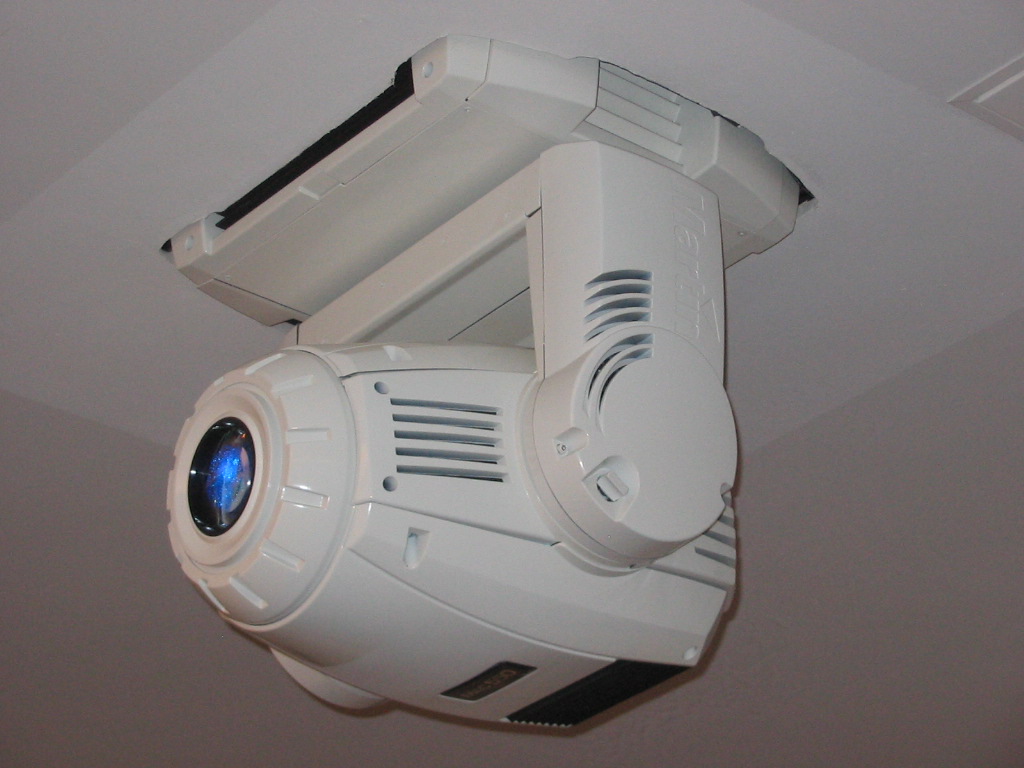
Intelligent lighting refers to lighting that has automated or mechanical abilities beyond those of conventional, stationary illumination. Although the most advanced intelligent lights can produce extraordinarily complex effects, the intelligence lies with the human lighting designer, control system programmer, or the lighting operator, rather than the fixture itself. Intelligent lighting (ILS) is also known as automated lighting, moving lights, moving heads, or simply movers.
More recently the term has fallen into disuse as abilities once reserved to a specific category of lighting instruments (most notably colour changing and variable focus) have become pervasive across a range of fixtures. The distinction has become more blurred with the introduction of machines that would not be considered lights but share the ability to move their orientation and are operated by the same DMX512 control protocol, such as moving yoke projectors.
There are many patents for intelligent lighting dating back from 1906, with Edmond Sohlberg of Kansas City, USA. The lantern used a carbon-arc bulb and was operated not by motors or any form of electronics, but by cords that were operated manually to control pan, tilt and zoom.
1925 saw the first use of electrical motors to move the fixture, and with it the beam position, by Herbet F. King (US patent number: 1,680,685). In 1936 US patent number 2,054,224 was granted to a similar device, with which the pan and tilt were controlled by means of a joystick as opposed to switches. From this point on until 1969, various other inventors made similar lights and improved on the technology, but with no major breakthroughs. During this period, Century Lighting (now Strand) started retailing such units specially made to order, retrofitted onto any of their existing lanterns up to 750 W to control pan and tilt.
George Izenour made the next breakthrough in 1969 with the first ever fixture to use a mirror on the end of an ellipsoidal to redirect the beam of light remotely. In 1969, Jules Fisher, from Casa Mañana area theatre in Texas saw the invention and use of 12 PAR 64 lanterns with 120 W, 12 V lamps fitted, 360 degrees of pan and 270 degrees of tilt, a standard that lasted until the 1990s. This lamp was also known as the 'Mac-Spot'
In Bristol in 1968, progress was also being made, mainly for use in live music. Peter Wynne Wilson refers to the use of 1 kW profiles, with slides onto which gobos were printed, inserted from a reel just like on a slide projector. The fixtures also had an iris and a multiple colored gel wheel. These lights were also fitted with mirrors and made for an impressive light show for a Pink Floyd gig in London. Another fixture known as the 'Cycklops' was also used for music in the USA, although it was limited in terms of capabilities. With only pan, tilt, and color functions, and at 1.2 meters long and weighing in at 97 kilograms including the ballast, they were heavy and cumbersome. These units were designed more for replacing the ever unreliable local spotlight operators.
In 1978 a Dallas, Texas-based lighting and sound company called Showco began developing a lighting fixture that changed color by rotating dichroic filters. During its development, the designers decided to add motors to motorize pan and tilt. They demonstrated the fixture for the band Genesis in a barn in England in 1980. The band decided to financially back the project. Showco spun off their lighting project into a company called Vari-Lite, and the first fixture was also called the Vari-lite. It also used one of the first lighting desks with a digital core and this enabled lighting states to be programmed in.
Genesis was later to order 55 Vari-lites to use in their next chain of gigs across the UK. The lights were supplied with a Vari-Lite console which had 32 channels, five 1802 processors and a dramatic improvement of the first console which was very simple and had an external processing unit.
Hub AI
Intelligent lighting AI simulator
(@Intelligent lighting_simulator)
Intelligent lighting
Intelligent lighting refers to lighting that has automated or mechanical abilities beyond those of conventional, stationary illumination. Although the most advanced intelligent lights can produce extraordinarily complex effects, the intelligence lies with the human lighting designer, control system programmer, or the lighting operator, rather than the fixture itself. Intelligent lighting (ILS) is also known as automated lighting, moving lights, moving heads, or simply movers.
More recently the term has fallen into disuse as abilities once reserved to a specific category of lighting instruments (most notably colour changing and variable focus) have become pervasive across a range of fixtures. The distinction has become more blurred with the introduction of machines that would not be considered lights but share the ability to move their orientation and are operated by the same DMX512 control protocol, such as moving yoke projectors.
There are many patents for intelligent lighting dating back from 1906, with Edmond Sohlberg of Kansas City, USA. The lantern used a carbon-arc bulb and was operated not by motors or any form of electronics, but by cords that were operated manually to control pan, tilt and zoom.
1925 saw the first use of electrical motors to move the fixture, and with it the beam position, by Herbet F. King (US patent number: 1,680,685). In 1936 US patent number 2,054,224 was granted to a similar device, with which the pan and tilt were controlled by means of a joystick as opposed to switches. From this point on until 1969, various other inventors made similar lights and improved on the technology, but with no major breakthroughs. During this period, Century Lighting (now Strand) started retailing such units specially made to order, retrofitted onto any of their existing lanterns up to 750 W to control pan and tilt.
George Izenour made the next breakthrough in 1969 with the first ever fixture to use a mirror on the end of an ellipsoidal to redirect the beam of light remotely. In 1969, Jules Fisher, from Casa Mañana area theatre in Texas saw the invention and use of 12 PAR 64 lanterns with 120 W, 12 V lamps fitted, 360 degrees of pan and 270 degrees of tilt, a standard that lasted until the 1990s. This lamp was also known as the 'Mac-Spot'
In Bristol in 1968, progress was also being made, mainly for use in live music. Peter Wynne Wilson refers to the use of 1 kW profiles, with slides onto which gobos were printed, inserted from a reel just like on a slide projector. The fixtures also had an iris and a multiple colored gel wheel. These lights were also fitted with mirrors and made for an impressive light show for a Pink Floyd gig in London. Another fixture known as the 'Cycklops' was also used for music in the USA, although it was limited in terms of capabilities. With only pan, tilt, and color functions, and at 1.2 meters long and weighing in at 97 kilograms including the ballast, they were heavy and cumbersome. These units were designed more for replacing the ever unreliable local spotlight operators.
In 1978 a Dallas, Texas-based lighting and sound company called Showco began developing a lighting fixture that changed color by rotating dichroic filters. During its development, the designers decided to add motors to motorize pan and tilt. They demonstrated the fixture for the band Genesis in a barn in England in 1980. The band decided to financially back the project. Showco spun off their lighting project into a company called Vari-Lite, and the first fixture was also called the Vari-lite. It also used one of the first lighting desks with a digital core and this enabled lighting states to be programmed in.
Genesis was later to order 55 Vari-lites to use in their next chain of gigs across the UK. The lights were supplied with a Vari-Lite console which had 32 channels, five 1802 processors and a dramatic improvement of the first console which was very simple and had an external processing unit.
Recent media