
Recent from talks
Intercarpal joints
Knowledge base stats:
Talk channels stats:
Members stats:
Intercarpal joints
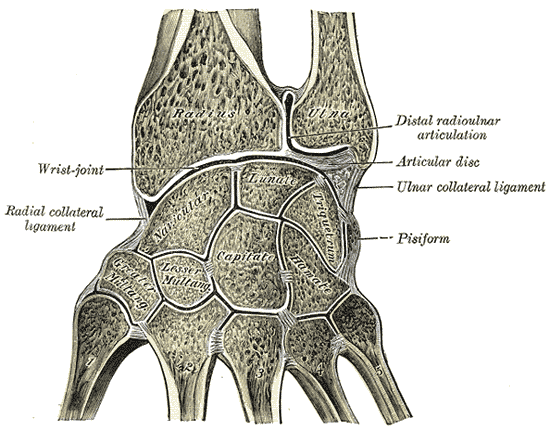
The intercarpal joints (joints of the carpal bones of the wrist) can be subdivided into three sets of joints (also called articulations): Those of the proximal row of carpal bones, those of the distal row of carpal bones, and those of the two rows with each other.
The bones in each carpal row interlock with each other and each row can therefore be considered a single joint. In the proximal row a limited degree of mobility is possible, but the bones of the distal row are connected to each other and to the metacarpal bones by strong ligaments that make this row and the metacarpus a functional entity.
The joints of the proximal row are arthrodial joints, The scaphoid, lunate, and triquetrum are connected by dorsal, volar, and interosseous ligaments.
The dorsal intercarpal ligament are two in number and placed transversely behind the bones of the first row; they connect the scaphoid and lunate, and the lunate and triquetrum.
The palmar intercarpal ligaments are also two, connect the scaphoid and lunate, and the lunate and triangular; they are less strong than the dorsal, and placed very deeply behind the Flexor tendons and the volar radiocarpal ligament.
The interosseous intercarpal ligaments are two narrow bundles, one connecting the lunate with the scaphoid, the other joining it to the triangular. They are on a level with the superior surfaces of these bones, and their upper surfaces are smooth, and form part of the convex articular surface of the wrist-joint.
The ligaments connecting the pisiform bone are the articular capsule and the two volar ligaments. The articular capsule is a thin membrane which connects the pisiform to the triangular; it is lined by synovial membrane.
The two volar ligaments are strong fibrous bands; one, the pisohamate ligament, connects the pisiform to the hamate, the other, the pisometacarpal ligament, joins the pisiform to the base of the fifth metacarpal bone. These ligaments are, in reality, prolongations of the tendon of the Flexor carpi ulnaris.
Hub AI
Intercarpal joints AI simulator
(@Intercarpal joints_simulator)
Intercarpal joints
The intercarpal joints (joints of the carpal bones of the wrist) can be subdivided into three sets of joints (also called articulations): Those of the proximal row of carpal bones, those of the distal row of carpal bones, and those of the two rows with each other.
The bones in each carpal row interlock with each other and each row can therefore be considered a single joint. In the proximal row a limited degree of mobility is possible, but the bones of the distal row are connected to each other and to the metacarpal bones by strong ligaments that make this row and the metacarpus a functional entity.
The joints of the proximal row are arthrodial joints, The scaphoid, lunate, and triquetrum are connected by dorsal, volar, and interosseous ligaments.
The dorsal intercarpal ligament are two in number and placed transversely behind the bones of the first row; they connect the scaphoid and lunate, and the lunate and triquetrum.
The palmar intercarpal ligaments are also two, connect the scaphoid and lunate, and the lunate and triangular; they are less strong than the dorsal, and placed very deeply behind the Flexor tendons and the volar radiocarpal ligament.
The interosseous intercarpal ligaments are two narrow bundles, one connecting the lunate with the scaphoid, the other joining it to the triangular. They are on a level with the superior surfaces of these bones, and their upper surfaces are smooth, and form part of the convex articular surface of the wrist-joint.
The ligaments connecting the pisiform bone are the articular capsule and the two volar ligaments. The articular capsule is a thin membrane which connects the pisiform to the triangular; it is lined by synovial membrane.
The two volar ligaments are strong fibrous bands; one, the pisohamate ligament, connects the pisiform to the hamate, the other, the pisometacarpal ligament, joins the pisiform to the base of the fifth metacarpal bone. These ligaments are, in reality, prolongations of the tendon of the Flexor carpi ulnaris.
Recent media