



Community hub
Recent from talks
Knowledge base stats:
Talk channels stats:
Members stats:
Interchangeable core
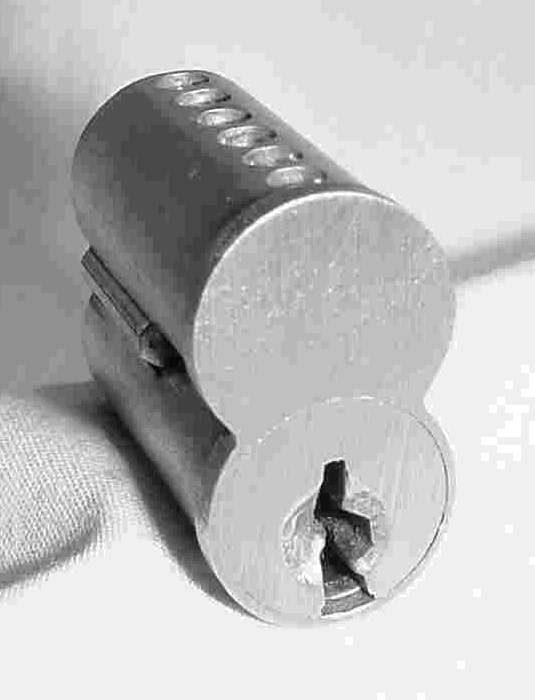
An interchangeable core or IC is an adaptable locking key cylinder, which can be rapidly exchanged in the field via the use of specialized "control keys".
Unlike a standard key cylinder, which is accessible for combinating only via locking device disassembly, an interchangeable mechanism relies upon a specialized "control" key for insertion and extraction of the essential (or "core") combinating components. "Small format" interchangeable cores (SFIC) are in a figure-eight shape that is standardized among lock manufacturers. "Large format" interchangeable cores (LFIC) are of varying sizes.
By use of an appropriate control key, interchangeable cores can be extracted from one lock type (bored cylindrical lock, mortise lock, padlock, and so forth) and then installed into another without requiring the removal or disassembly of any single component. These units are readily adapted for master keying systems, and can be set up with spare cores and keys for quick replacement when security is compromised, such as when a key is lost or stolen or when a personnel change takes place. Extracted cores can then be recombinated at a workshop without urgency and placed back into maintenance storage for future use.
The "modern interchangeable core"—and all other cores, as well—actually has its roots in "a bulkier, pedestal-shaped removable configuration" developed in 1919 by Frank Best, then proprietor of Best Universal Lock Company.
Interchangeable cores require a notch at the tip of each key to properly align the peaks and valleys of each blade with the combinating pins in the chambers of the mechanism; as a consequence, these keys are always configured and cut from blade tip to bow. Conversely, conventional cylinders and removable cores use a shoulder near the bow of each key to properly align all peaks and valleys; as a consequence, these keys are always configured and cut from bow to blade tip. As a further consequence of this fundamental difference, neither of these two key types can ever be cross- or master-keyed with the other.
As a benefit to keying from blade tip to bow, a six, or seven-pin interchangeable core key blank can be machined to precisely fit a smaller five-pin system configuration. Although the blade of such keys may be a pin or two longer than need be, this extra length never enters the locking mechanism; therefore, five-, six- and seven-pin interchangeable core systems can be easily integrated to work with one another or to provide different levels of access control within the same system. Conventional cylinder and removable core systems are significantly more limited in this regard since the extra length of their keys must pass through to the inside of the locking mechanism, which is often just not physically possible.
Since entering the market in the mid-1960s, and in spite of its atypical keying configuration and limited availability, the interchangeable core has gradually evolved into a de facto standard for keying interoperability throughout the commercial door hardware industry. Product offerings are no longer limited just to the two originally competing companies (Best Universal Lock and Falcon Lock), and can be optionally specified from all OEM and most aftermarket door hardware brands in North America:
Abus, Alarm Lock, American, Arrow, Best Access, Best Security, BlueWave, Cal-Royal, Corbin-Russwin, CX-5, Dorma, Falcon, GMS, General Lock, Hager, IEI, Ilco, Independence2, InstaKey, K2, Kaba, KSP - Killeen Security Products, Lori, LSDA, Marks, Master, Medeco, Mul-T-Lock, Oak Security Group, Olympus, Omnilock, Onity, Pacific Lock, PDQ, Precision, Saflok, Sargent, Schlage, SDC, Tell, Trans-Atlantic, Von Duprin and Yale either produce their own interchangeable cores or else offer product lines or product options to accommodate such cores by others.
Hub AI
Interchangeable core AI simulator
(@Interchangeable core_simulator)
Interchangeable core
An interchangeable core or IC is an adaptable locking key cylinder, which can be rapidly exchanged in the field via the use of specialized "control keys".
Unlike a standard key cylinder, which is accessible for combinating only via locking device disassembly, an interchangeable mechanism relies upon a specialized "control" key for insertion and extraction of the essential (or "core") combinating components. "Small format" interchangeable cores (SFIC) are in a figure-eight shape that is standardized among lock manufacturers. "Large format" interchangeable cores (LFIC) are of varying sizes.
By use of an appropriate control key, interchangeable cores can be extracted from one lock type (bored cylindrical lock, mortise lock, padlock, and so forth) and then installed into another without requiring the removal or disassembly of any single component. These units are readily adapted for master keying systems, and can be set up with spare cores and keys for quick replacement when security is compromised, such as when a key is lost or stolen or when a personnel change takes place. Extracted cores can then be recombinated at a workshop without urgency and placed back into maintenance storage for future use.
The "modern interchangeable core"—and all other cores, as well—actually has its roots in "a bulkier, pedestal-shaped removable configuration" developed in 1919 by Frank Best, then proprietor of Best Universal Lock Company.
Interchangeable cores require a notch at the tip of each key to properly align the peaks and valleys of each blade with the combinating pins in the chambers of the mechanism; as a consequence, these keys are always configured and cut from blade tip to bow. Conversely, conventional cylinders and removable cores use a shoulder near the bow of each key to properly align all peaks and valleys; as a consequence, these keys are always configured and cut from bow to blade tip. As a further consequence of this fundamental difference, neither of these two key types can ever be cross- or master-keyed with the other.
As a benefit to keying from blade tip to bow, a six, or seven-pin interchangeable core key blank can be machined to precisely fit a smaller five-pin system configuration. Although the blade of such keys may be a pin or two longer than need be, this extra length never enters the locking mechanism; therefore, five-, six- and seven-pin interchangeable core systems can be easily integrated to work with one another or to provide different levels of access control within the same system. Conventional cylinder and removable core systems are significantly more limited in this regard since the extra length of their keys must pass through to the inside of the locking mechanism, which is often just not physically possible.
Since entering the market in the mid-1960s, and in spite of its atypical keying configuration and limited availability, the interchangeable core has gradually evolved into a de facto standard for keying interoperability throughout the commercial door hardware industry. Product offerings are no longer limited just to the two originally competing companies (Best Universal Lock and Falcon Lock), and can be optionally specified from all OEM and most aftermarket door hardware brands in North America:
Abus, Alarm Lock, American, Arrow, Best Access, Best Security, BlueWave, Cal-Royal, Corbin-Russwin, CX-5, Dorma, Falcon, GMS, General Lock, Hager, IEI, Ilco, Independence2, InstaKey, K2, Kaba, KSP - Killeen Security Products, Lori, LSDA, Marks, Master, Medeco, Mul-T-Lock, Oak Security Group, Olympus, Omnilock, Onity, Pacific Lock, PDQ, Precision, Saflok, Sargent, Schlage, SDC, Tell, Trans-Atlantic, Von Duprin and Yale either produce their own interchangeable cores or else offer product lines or product options to accommodate such cores by others.