



Community hub
0 subscribers7 pages, 0 posts
Recent from talks
All channels
Be the first to start a discussion here.
Be the first to start a discussion here.
Be the first to start a discussion here.
Be the first to start a discussion here.
Contribute something
Welcome to the community hub built to collect knowledge and have discussions related to Interleave sequence.
Nothing was collected or created yet.
Interleave sequence
View on Wikipediafrom Wikipedia
In mathematics, an interleave sequence is obtained by merging two sequences via an in shuffle.
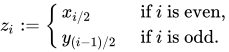
Let be a set, and let and , be two sequences in The interleave sequence is defined to be the sequence . Formally, it is the sequence given by






Properties
[edit]- The interleave sequence is convergent if and only if the sequences and are convergent and have the same limit.[1]
- Consider two real numbers a and b greater than zero and smaller than 1. One can interleave the sequences of digits of a and b, which will determine a third number c, also greater than zero and smaller than 1. In this way one obtains an injection from the square (0, 1) × (0, 1) to the interval (0, 1). Different radixes give rise to different injections; the one for the binary numbers is called the Z-order curve or Morton code.[2]

References
[edit]- ^ Strichartz, Robert S. (2000), The Way of Analysis, Jones & Bartlett Learning, p. 78, ISBN 9780763714970.
- ^ Mamoulis, Nikos (2012), Spatial Data Management, Synthesis lectures on data management, vol. 21, Morgan & Claypool Publishers, pp. 22–23, ISBN 9781608458325.
This article incorporates material from Interleave sequence on PlanetMath, which is licensed under the Creative Commons Attribution/Share-Alike License.