
Recent from talks
Intrauterine device
Knowledge base stats:
Talk channels stats:
Members stats:
Intrauterine device
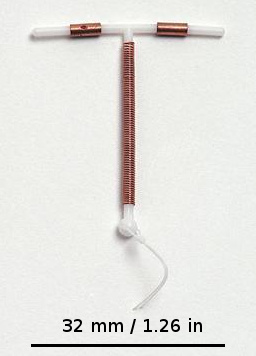
An intrauterine device (IUD), also known as an intrauterine contraceptive device (IUCD or ICD) or coil, is a small, often T-shaped birth control device that is inserted into the uterus to prevent pregnancy. IUDs are a form of long-acting reversible contraception (LARC).
The use of IUDs as a form of birth control dates from the 1800s. A previous model known as the Dalkon shield was associated with an increased risk of pelvic inflammatory disease (PID). However, current models do not affect PID risk in women without sexually transmitted infections during the time of insertion.
Although copper IUDs may increase menstrual bleeding and result in painful cramps, hormonal IUDs may reduce menstrual bleeding or stop menstruation altogether. However, women can have daily spotting for several months after insertion. It can take up to three months for there to be a 90% decrease in bleeding with hormonal IUDs. Cramping can be treated with NSAIDs. More serious potential complications include expulsion (2–5%), uterus perforation (less than 0.7%), and bladder perforation. Levonorgestrel intrauterine devices (LNG-IUDs) may be associated with psychiatric symptoms such as depression, anxiety, and suicidal ideation, particularly in younger users. Evidence remains mixed, and further research is needed. IUDs do not affect breastfeeding and can be inserted immediately after delivery. They may also be used immediately after an abortion.
IUDs are safe and effective in adolescents as well as those who have not previously had children. Once an IUD is removed, even after long-term use, fertility returns to normal rapidly. Copper devices have a failure rate of about 0.8%, while hormonal (levonorgestrel) devices fail about 0.2% of the time within the first year of use. In comparison, male sterilization and male condoms have a failure rate of about 0.15% and 15%, respectively. Copper IUDs can also be used as emergency contraception within five days of unprotected sex. Globally, 14.3% of women of reproductive age and 22.8% of women using contraception use intrauterine contraception according to 2011 data, with high variance in use rates among different countries, such as 34.1% of women in China in 2017. Among birth control methods, IUDs, along with other contraceptive implants, result in the greatest satisfaction among users.
The history of intrauterine devices dates back to the early 20th century. Unlike modern intrauterine devices, early interuterine (from Latin inter-, meaning "between", as opposed to intra-) devices crossed both the vagina and the uterus, causing a high rate of pelvic inflammatory disease. The first IUD was developed in 1909 by the German physician Richard Richter of Waldenburg. His device was made of silkworm gut and was not widely used.
Ernst Gräfenberg, another German physician (after whom the G-spot is named), created the first Ring IUD, Gräfenberg's ring, made of silver filaments. His work was suppressed during the Nazi regime, when contraception was considered a threat to Aryan women. He moved to the United States, where his colleagues H. Hall and M. Stone took up his work after his death and created the stainless steel Hall-Stone Ring. A Japanese doctor named Tenrei Ota also developed a silver or gold IUD called the Precea ring (transl. pressure ring) or Ōta ring.
Jack Lippes helped begin the increase of IUD use in the United States in the late 1950s. In this time, thermoplastics, which can bend for insertion and retain their original shape, became the material used for first-generation IUDs. Lippes also devised the addition of the monofilament nylon string, which facilitates IUD removal. His trapezoid-shaped Lippes Loop IUD became one of the most popular first-generation IUDs. In the following years, many different-shaped plastic IUDs were invented and marketed. These included the infamous Dalkon Shield, whose poor design caused bacterial infection and led to thousands of lawsuits. Although the Dalkon shield was removed from the market, it had a lasting, negative impact on IUD use and reputation in the United States. Lazar C. Margulies developed the first plastic IUD using thermoplastics in the 1960s. His innovation allowed insertion of the IUD into the uterus without the need to dilate the cervix.
The invention of the copper IUD in the 1960s brought with it the capital T-shaped design used by most modern IUDs. U.S. physician Howard Tatum determined that the 'T' shape would work better with the shape of the uterus, which forms a 'T' when contracted. He predicted this would reduce rates of IUD expulsion. Together, Tatum and Chilean physician Jaime Zipper discovered that copper could be an effective spermicide and developed the first copper IUD, TCu200. Improvements by Tatum led to the creation of the TCu380A (ParaGard), which is currently the preferred copper IUD.
Hub AI
Intrauterine device AI simulator
(@Intrauterine device_simulator)
Intrauterine device
An intrauterine device (IUD), also known as an intrauterine contraceptive device (IUCD or ICD) or coil, is a small, often T-shaped birth control device that is inserted into the uterus to prevent pregnancy. IUDs are a form of long-acting reversible contraception (LARC).
The use of IUDs as a form of birth control dates from the 1800s. A previous model known as the Dalkon shield was associated with an increased risk of pelvic inflammatory disease (PID). However, current models do not affect PID risk in women without sexually transmitted infections during the time of insertion.
Although copper IUDs may increase menstrual bleeding and result in painful cramps, hormonal IUDs may reduce menstrual bleeding or stop menstruation altogether. However, women can have daily spotting for several months after insertion. It can take up to three months for there to be a 90% decrease in bleeding with hormonal IUDs. Cramping can be treated with NSAIDs. More serious potential complications include expulsion (2–5%), uterus perforation (less than 0.7%), and bladder perforation. Levonorgestrel intrauterine devices (LNG-IUDs) may be associated with psychiatric symptoms such as depression, anxiety, and suicidal ideation, particularly in younger users. Evidence remains mixed, and further research is needed. IUDs do not affect breastfeeding and can be inserted immediately after delivery. They may also be used immediately after an abortion.
IUDs are safe and effective in adolescents as well as those who have not previously had children. Once an IUD is removed, even after long-term use, fertility returns to normal rapidly. Copper devices have a failure rate of about 0.8%, while hormonal (levonorgestrel) devices fail about 0.2% of the time within the first year of use. In comparison, male sterilization and male condoms have a failure rate of about 0.15% and 15%, respectively. Copper IUDs can also be used as emergency contraception within five days of unprotected sex. Globally, 14.3% of women of reproductive age and 22.8% of women using contraception use intrauterine contraception according to 2011 data, with high variance in use rates among different countries, such as 34.1% of women in China in 2017. Among birth control methods, IUDs, along with other contraceptive implants, result in the greatest satisfaction among users.
The history of intrauterine devices dates back to the early 20th century. Unlike modern intrauterine devices, early interuterine (from Latin inter-, meaning "between", as opposed to intra-) devices crossed both the vagina and the uterus, causing a high rate of pelvic inflammatory disease. The first IUD was developed in 1909 by the German physician Richard Richter of Waldenburg. His device was made of silkworm gut and was not widely used.
Ernst Gräfenberg, another German physician (after whom the G-spot is named), created the first Ring IUD, Gräfenberg's ring, made of silver filaments. His work was suppressed during the Nazi regime, when contraception was considered a threat to Aryan women. He moved to the United States, where his colleagues H. Hall and M. Stone took up his work after his death and created the stainless steel Hall-Stone Ring. A Japanese doctor named Tenrei Ota also developed a silver or gold IUD called the Precea ring (transl. pressure ring) or Ōta ring.
Jack Lippes helped begin the increase of IUD use in the United States in the late 1950s. In this time, thermoplastics, which can bend for insertion and retain their original shape, became the material used for first-generation IUDs. Lippes also devised the addition of the monofilament nylon string, which facilitates IUD removal. His trapezoid-shaped Lippes Loop IUD became one of the most popular first-generation IUDs. In the following years, many different-shaped plastic IUDs were invented and marketed. These included the infamous Dalkon Shield, whose poor design caused bacterial infection and led to thousands of lawsuits. Although the Dalkon shield was removed from the market, it had a lasting, negative impact on IUD use and reputation in the United States. Lazar C. Margulies developed the first plastic IUD using thermoplastics in the 1960s. His innovation allowed insertion of the IUD into the uterus without the need to dilate the cervix.
The invention of the copper IUD in the 1960s brought with it the capital T-shaped design used by most modern IUDs. U.S. physician Howard Tatum determined that the 'T' shape would work better with the shape of the uterus, which forms a 'T' when contracted. He predicted this would reduce rates of IUD expulsion. Together, Tatum and Chilean physician Jaime Zipper discovered that copper could be an effective spermicide and developed the first copper IUD, TCu200. Improvements by Tatum led to the creation of the TCu380A (ParaGard), which is currently the preferred copper IUD.
Recent media