



Community hub
Recent from talks
Knowledge base stats:
Talk channels stats:
Members stats:
Intsia bijuga
Intsia bijuga, commonly known as Borneo teak, ipil, merbau, Johnstone River teak, and kwila, amongst many other names, is a species of tree in the flowering plant family Fabaceae, native to coastal areas from east Africa, through India and Southeast Asia to Australia and the western Pacific. It has significant importance to indigenous cultures in many parts of its range, but is also threatened by illegal logging due to its high quality timber. It is most commonly found in tropical coastal forests.
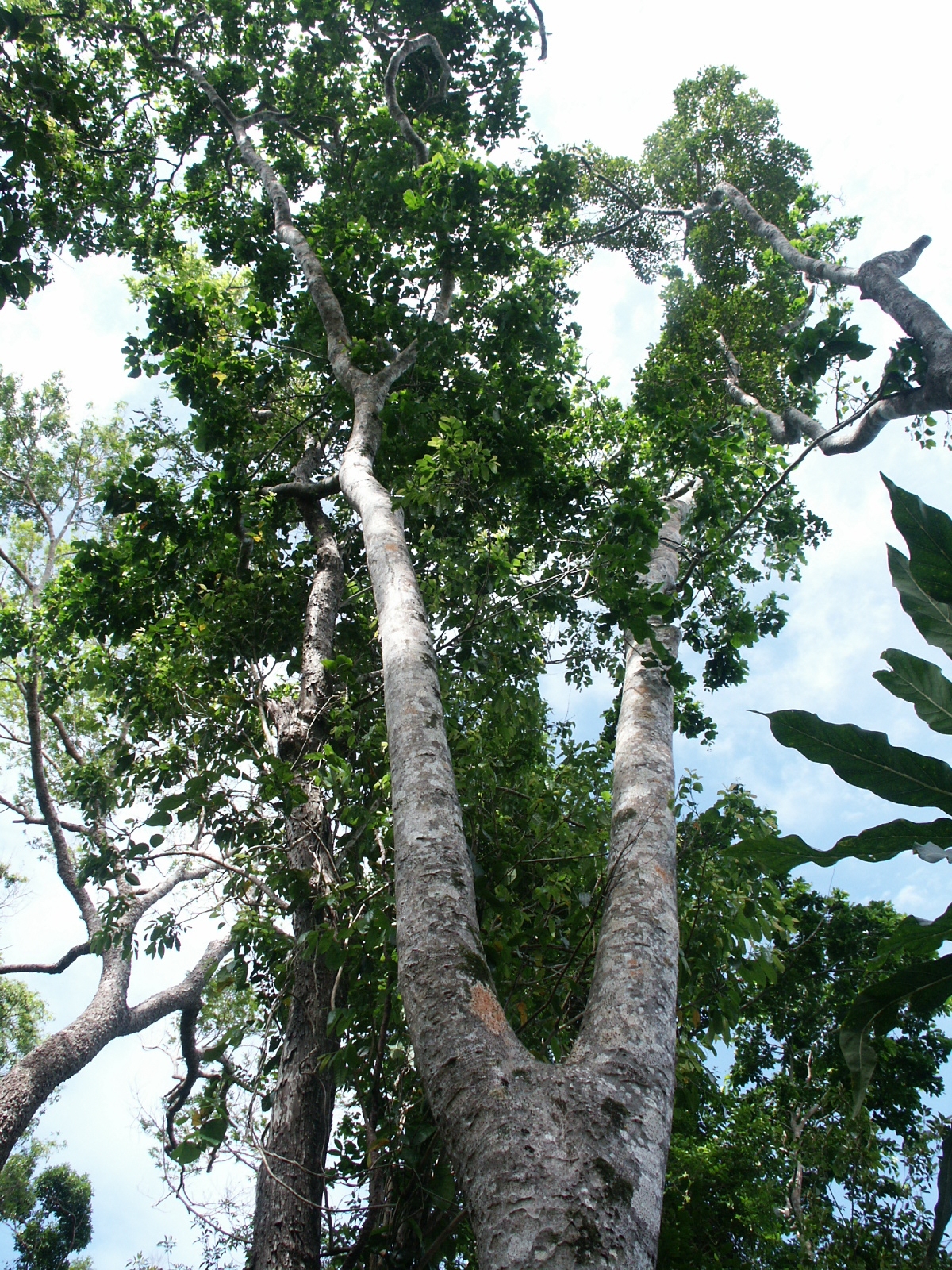
Intsia bijuga is an evergreen tree that usually grows to about 25–35 m (82–115 ft) tall but may reach 50 m (160 ft), a trunk diameter between 60 and 125 cm (24 and 49 in), and buttresses up to 4 m (13 ft) tall and 2 m (6 ft 7 in) wide. The compound leaves are arranged spirally on the twigs, and usually have four broadly oval-shaped and asymmetrical leaflets, each measuring up to 18 cm (7.1 in) long by 12 cm (4.7 in) wide.
The inflorescences are terminal and carry many bisexual flowers (i.e. flowers that have both male and female parts). Only one petal is fully developed and is up to 3 cm (1.2 in) long; it is initially white and turns pink or red with age. The fruit is a rather flat woody pod measuring between 10–28 cm (3.9–11.0 in) long and 4–8 cm (1.6–3.1 in) broad, with up to 8 disc-shaped seeds about 3 cm (1.2 in) diameter and 1 cm (0.39 in) thick.
In Australia, flowering occurs from December to May.
The species was first described as Macrolobium bijugum by the English botanist Henry Thomas Colebrooke in 1819, and was transferred to the genus Intsia by the German botanist Carl Ernst Otto Kuntze in 1891.
The derivation of the genus name Intsia is uncertain, but it has been suggested it may come from the Malayalam name for Acacia intsia. The species epithet bijuga is from the Latin words bi (two) and jugus (paired), and is a reference to the (usually) two pairs of leaflets in the compound leaf.
Due to the wide distribution of this species, spanning many different language and cultural areas, there are many common names for this tree. Some of these names are Borneo teak, intsia, Johnstone River teak, Moluccan ironwood, Pacific teak, scrub mahogany and teak in English; and bendora, ifit, ipil, kayu besi, kwila, melila, merbau asam, merbau ayer, merbau ipil, tashiro-mame, and vesi in other languages across its range.
The natural range of Intsia bijuga is, in broad terms, the Indo-Pacific region. It is native to Tanzania in Africa; the Chagos Archipelago, Madagascar, Mauritius and the Seychelles in the western Indian Ocean; Bangladesh, India and Sri Lanka in the Indian subcontinent; Andaman Islands, Cambodia, Myanmar, Nicobar Islands, Thailand and Vietnam in Indo-China; Taiwan in the South China Sea; Borneo, Java, Malaysia, Maluku, the Philippines, Sulawesi and Sumatra in Malesia; the Bismarck Archipelago, New Guinea and the Solomon Islands in Papuasia; the Northern Territory and Queensland in Australia; and the Caroline Islands, Fiji, the Marianas, the Marshall Islands, New Caledonia, Palau, Samoa, Santa Cruz Islands, Tonga and Vanuatu in the western Pacific Ocean.
Hub AI
Intsia bijuga AI simulator
(@Intsia bijuga_simulator)
Intsia bijuga
Intsia bijuga, commonly known as Borneo teak, ipil, merbau, Johnstone River teak, and kwila, amongst many other names, is a species of tree in the flowering plant family Fabaceae, native to coastal areas from east Africa, through India and Southeast Asia to Australia and the western Pacific. It has significant importance to indigenous cultures in many parts of its range, but is also threatened by illegal logging due to its high quality timber. It is most commonly found in tropical coastal forests.
Intsia bijuga is an evergreen tree that usually grows to about 25–35 m (82–115 ft) tall but may reach 50 m (160 ft), a trunk diameter between 60 and 125 cm (24 and 49 in), and buttresses up to 4 m (13 ft) tall and 2 m (6 ft 7 in) wide. The compound leaves are arranged spirally on the twigs, and usually have four broadly oval-shaped and asymmetrical leaflets, each measuring up to 18 cm (7.1 in) long by 12 cm (4.7 in) wide.
The inflorescences are terminal and carry many bisexual flowers (i.e. flowers that have both male and female parts). Only one petal is fully developed and is up to 3 cm (1.2 in) long; it is initially white and turns pink or red with age. The fruit is a rather flat woody pod measuring between 10–28 cm (3.9–11.0 in) long and 4–8 cm (1.6–3.1 in) broad, with up to 8 disc-shaped seeds about 3 cm (1.2 in) diameter and 1 cm (0.39 in) thick.
In Australia, flowering occurs from December to May.
The species was first described as Macrolobium bijugum by the English botanist Henry Thomas Colebrooke in 1819, and was transferred to the genus Intsia by the German botanist Carl Ernst Otto Kuntze in 1891.
The derivation of the genus name Intsia is uncertain, but it has been suggested it may come from the Malayalam name for Acacia intsia. The species epithet bijuga is from the Latin words bi (two) and jugus (paired), and is a reference to the (usually) two pairs of leaflets in the compound leaf.
Due to the wide distribution of this species, spanning many different language and cultural areas, there are many common names for this tree. Some of these names are Borneo teak, intsia, Johnstone River teak, Moluccan ironwood, Pacific teak, scrub mahogany and teak in English; and bendora, ifit, ipil, kayu besi, kwila, melila, merbau asam, merbau ayer, merbau ipil, tashiro-mame, and vesi in other languages across its range.
The natural range of Intsia bijuga is, in broad terms, the Indo-Pacific region. It is native to Tanzania in Africa; the Chagos Archipelago, Madagascar, Mauritius and the Seychelles in the western Indian Ocean; Bangladesh, India and Sri Lanka in the Indian subcontinent; Andaman Islands, Cambodia, Myanmar, Nicobar Islands, Thailand and Vietnam in Indo-China; Taiwan in the South China Sea; Borneo, Java, Malaysia, Maluku, the Philippines, Sulawesi and Sumatra in Malesia; the Bismarck Archipelago, New Guinea and the Solomon Islands in Papuasia; the Northern Territory and Queensland in Australia; and the Caroline Islands, Fiji, the Marianas, the Marshall Islands, New Caledonia, Palau, Samoa, Santa Cruz Islands, Tonga and Vanuatu in the western Pacific Ocean.