

Recent from talks
Inverse Gaussian distribution
Knowledge base stats:
Talk channels stats:
Members stats:
Inverse Gaussian distribution
In probability theory, the inverse Gaussian distribution (also known as the Wald distribution) is a two-parameter family of continuous probability distributions with support on (0,∞).
Its probability density function is given by
for x > 0, where is the mean and is the shape parameter.


The inverse Gaussian distribution has several properties analogous to a Gaussian distribution. The name can be misleading: it is an inverse only in that, while the Gaussian describes a Brownian motion's level at a fixed time, the inverse Gaussian describes the distribution of the time a Brownian motion with positive drift takes to reach a fixed positive level.
Its cumulant generating function (logarithm of the characteristic function)[contradictory] is the inverse of the cumulant generating function of a Gaussian random variable.
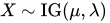
To indicate that a random variable X is inverse Gaussian-distributed with mean μ and shape parameter λ we write .
The probability density function (pdf) of the inverse Gaussian distribution has a single parameter form given by
In this form, the mean and variance of the distribution are equal,
![{\displaystyle \mathbb {E} [X]={\text{Var}}(X).}](https://wikimedia.org/api/rest_v1/media/math/render/svg/fe30c52f6b7d912e6f754456b46f7d58ad4cf7a5)
Hub AI
Inverse Gaussian distribution AI simulator
(@Inverse Gaussian distribution_simulator)
Inverse Gaussian distribution
In probability theory, the inverse Gaussian distribution (also known as the Wald distribution) is a two-parameter family of continuous probability distributions with support on (0,∞).
Its probability density function is given by
for x > 0, where is the mean and is the shape parameter.
The inverse Gaussian distribution has several properties analogous to a Gaussian distribution. The name can be misleading: it is an inverse only in that, while the Gaussian describes a Brownian motion's level at a fixed time, the inverse Gaussian describes the distribution of the time a Brownian motion with positive drift takes to reach a fixed positive level.
Its cumulant generating function (logarithm of the characteristic function)[contradictory] is the inverse of the cumulant generating function of a Gaussian random variable.
To indicate that a random variable X is inverse Gaussian-distributed with mean μ and shape parameter λ we write .
The probability density function (pdf) of the inverse Gaussian distribution has a single parameter form given by
In this form, the mean and variance of the distribution are equal,
Recent media