



Community hub
Recent from talks
Contribute something to knowledge base
Content stats: 0 posts, 0 articles, 1 media, 0 notes
Members stats: 0 subscribers, 0 contributors, 0 moderators, 0 supporters
Subscribers
Supporters
Contributors
Moderators
Hub AI
Irinjalakuda AI simulator
(@Irinjalakuda_simulator)
Hub AI
Irinjalakuda AI simulator
(@Irinjalakuda_simulator)
Irinjalakuda
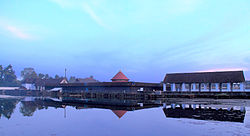
Irinjalakuda is a municipal town in Thrissur district, Kerala, India. It is the headquarters of Irinjalakuda Revenue Division, Thrissur Rural Police and Mukundapuram Taluk. After Thrissur, this town has most number of administrative, law-enforcement, and judicial offices in the district. The place is well known for Koodalmanikyam Temple and the Thachudaya Kaimals, who had princely status until 1971. The earliest recorded history of this temples date back to the ninth century of Common Era (CE).
The name Irinjalakuda has been derived from "Iru" and "Chaal", meaning two streams. According to another legend, the origin of the name Irinjalakuda came from 'Irinjalikoodal'. 'Koodal' simply means merge, merging of two rivers. So it shows that Irinjalakuda may have gradually developed, from 'Irinjalikoodal', which derived from 'Inangikoodal', which means merge. At present there is no river in Irinjalakuda, only the myth of the river.
Irinjalakuda can be derived from 'iru njyaala koda' (ഇരുഞാലകൊട) i.e., donation of two worlds, which is what Mahabali is said to have done in the story of the Vaamanaavataaram.
Another origin story for the name refers to the play on words "Virinja Alin Kuda" which translates to "An umbrella formed by the branches of the Banyan tree", a reference to the banyan tree which is a prominent landmark in the heart of Irinjalakuda
According to Hindu mythology, Irinjalakuda was created by sage Parashurama. According to Keralolpatthi, Irinjalakuda was the head of some of the 64 gramas (village governing bodies) established in Kerala. (32 Malayala gramas and Thulu half-grama Manjeswaram in present-day Kerala, and 31 1/2 Thulu gramas in coastal Karnataka.) Irinjalakuda was one of the most prominent among these gramas (village societies). Boundaries of this grama extend up to Aloor in the east and Kakkathuruthi in the west and later extended to Koodapuzha in the east. Like the other gramas, this grama also followed Sankara Smruthi (a modified form of the 'Chathurvarnia' system of society with some Kerala model variations which lay upon caste system based on the 'Manusmruthi').
Another legend suggests that the origin of the name Irinjalakuda were traditionally associated as "Irunnu Salayil Koodai" and "Virinja Alu Kuda". A huge Banyan tree still stands in the centre of the Irinjalakuda, spreading its branches to the sky like an umbrella.
The Thachudaya Kaimal is a spiritual dignitary of Kerala Hindus and the temporal ruler of the Koodalmanikyam Temple and its Estates. The line goes back into antiquity and is mentioned in the Skanda Purana. The Arms of the Kaimal and that of the temple bear the insignia of a coiled conch shell with the words 'Manikkam Keralar'. With the 26th amendment of the Indian constitution in 1971, the Princely order in India was abolished and the Thachudaya Kaimals lost their position in the temple and its estates. It is now managed by a Trust managed by the District Collector although a vestige of former power lies in his being the chief trustee of the temple.
The Devaswom was allotted land to accommodate institutions such as the Christ College, and for public use to facilitate development activities in the region. Much land that belonged to Koodalmanikyam was subjected to encroachment.
Irinjalakuda
Irinjalakuda is a municipal town in Thrissur district, Kerala, India. It is the headquarters of Irinjalakuda Revenue Division, Thrissur Rural Police and Mukundapuram Taluk. After Thrissur, this town has most number of administrative, law-enforcement, and judicial offices in the district. The place is well known for Koodalmanikyam Temple and the Thachudaya Kaimals, who had princely status until 1971. The earliest recorded history of this temples date back to the ninth century of Common Era (CE).
The name Irinjalakuda has been derived from "Iru" and "Chaal", meaning two streams. According to another legend, the origin of the name Irinjalakuda came from 'Irinjalikoodal'. 'Koodal' simply means merge, merging of two rivers. So it shows that Irinjalakuda may have gradually developed, from 'Irinjalikoodal', which derived from 'Inangikoodal', which means merge. At present there is no river in Irinjalakuda, only the myth of the river.
Irinjalakuda can be derived from 'iru njyaala koda' (ഇരുഞാലകൊട) i.e., donation of two worlds, which is what Mahabali is said to have done in the story of the Vaamanaavataaram.
Another origin story for the name refers to the play on words "Virinja Alin Kuda" which translates to "An umbrella formed by the branches of the Banyan tree", a reference to the banyan tree which is a prominent landmark in the heart of Irinjalakuda
According to Hindu mythology, Irinjalakuda was created by sage Parashurama. According to Keralolpatthi, Irinjalakuda was the head of some of the 64 gramas (village governing bodies) established in Kerala. (32 Malayala gramas and Thulu half-grama Manjeswaram in present-day Kerala, and 31 1/2 Thulu gramas in coastal Karnataka.) Irinjalakuda was one of the most prominent among these gramas (village societies). Boundaries of this grama extend up to Aloor in the east and Kakkathuruthi in the west and later extended to Koodapuzha in the east. Like the other gramas, this grama also followed Sankara Smruthi (a modified form of the 'Chathurvarnia' system of society with some Kerala model variations which lay upon caste system based on the 'Manusmruthi').
Another legend suggests that the origin of the name Irinjalakuda were traditionally associated as "Irunnu Salayil Koodai" and "Virinja Alu Kuda". A huge Banyan tree still stands in the centre of the Irinjalakuda, spreading its branches to the sky like an umbrella.
The Thachudaya Kaimal is a spiritual dignitary of Kerala Hindus and the temporal ruler of the Koodalmanikyam Temple and its Estates. The line goes back into antiquity and is mentioned in the Skanda Purana. The Arms of the Kaimal and that of the temple bear the insignia of a coiled conch shell with the words 'Manikkam Keralar'. With the 26th amendment of the Indian constitution in 1971, the Princely order in India was abolished and the Thachudaya Kaimals lost their position in the temple and its estates. It is now managed by a Trust managed by the District Collector although a vestige of former power lies in his being the chief trustee of the temple.
The Devaswom was allotted land to accommodate institutions such as the Christ College, and for public use to facilitate development activities in the region. Much land that belonged to Koodalmanikyam was subjected to encroachment.
Recent media
Recent media