
Recent from talks
Irrigation sprinkler
Knowledge base stats:
Talk channels stats:
Members stats:
Irrigation sprinkler
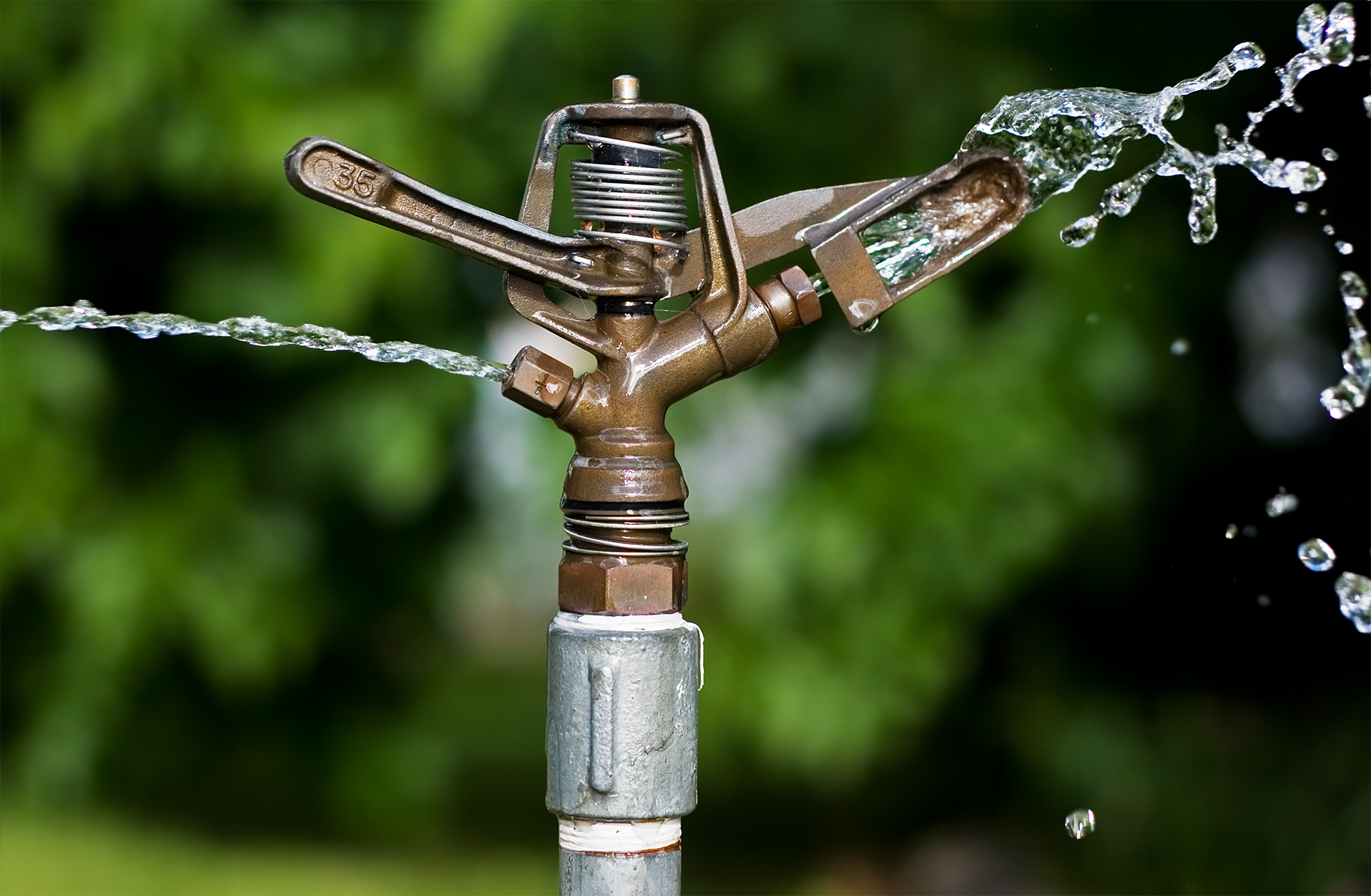
An irrigation sprinkler (also known as a water sprinkler or simply a sprinkler) is a device used to irrigate (water) agricultural crops, lawns, landscapes, golf courses, and other areas. They are also used for cooling and for the control of airborne dust. Sprinkler irrigation is the method of applying water in a controlled manner that mimics rainfall. The water is distributed through a network that may consist of pumps, valves, pipes, and sprinklers.
Irrigation sprinklers can be used for residential, industrial, and agricultural usage. It is useful on uneven land where sufficient water is not available as well as on sandy soil. The perpendicular pipes, having rotating nozzles on top, are joined to the main pipeline at regular intervals. When water is pressurized through the main pipe it escapes from the rotating nozzles. It gets sprinkled on the crop. In sprinkler or overhead irrigation, water is piped to one more central locations within the field and distributed by overhead high pressure sprinklers or guns.
Rotating sprinkler-heads for higher pressures are driven by a ball drive, gear drive, or impact mechanisms. They can be designed to rotate in a full or partial circle.
Rainguns are similar to impact sprinklers, except that they generally operate at very high pressures of 2.8 to 9.0 bar (280 to 900 kPa; 40 to 130 lbf/in2) and flows of 3 to 76 L/s (50 to 1,200 US gal/min), usually with nozzle diameters in the range of 10 to 50 mm (0.5 to 1.9 in). In addition to irrigation, guns are used for industrial applications such as dust suppression and logging.
Many irrigation sprinklers are buried in the ground along with their supporting plumbing, although above ground and moving sprinklers are also common. Most irrigation sprinklers operate through electric and hydraulic technology and are grouped together in zones that can be collectively turned on and off by actuating a solenoid valve.
Home lawn sprinklers vary widely in their size, cost, and complexity. They include impact sprinklers, oscillating sprinklers, drip sprinklers, underground sprinkler systems, and portable sprinklers. Permanently installed systems may often operate on timers or other automated processes. They are occasionally installed with retractable heads for aesthetic and practical reasons, reducing damage during lawn mowing. These types of systems usually can be programmed to start automatically on a set time and day each week.
Small portable sprinklers can be placed temporarily on lawns if additional watering is needed or if no permanent system is in place. These are often attached to an outdoor water faucet and are placed for a short period of time. Other systems may be professionally installed permanently in the ground and are attached permanently to a home's plumbing system.
An antique sprinkler developed by Nomad called a 'set-and-forget tractor sprinkler' was used in Australia in the 1950s. Water pressure ensured that the sprinkler moved slowly across a lawn.
Hub AI
Irrigation sprinkler AI simulator
(@Irrigation sprinkler_simulator)
Irrigation sprinkler
An irrigation sprinkler (also known as a water sprinkler or simply a sprinkler) is a device used to irrigate (water) agricultural crops, lawns, landscapes, golf courses, and other areas. They are also used for cooling and for the control of airborne dust. Sprinkler irrigation is the method of applying water in a controlled manner that mimics rainfall. The water is distributed through a network that may consist of pumps, valves, pipes, and sprinklers.
Irrigation sprinklers can be used for residential, industrial, and agricultural usage. It is useful on uneven land where sufficient water is not available as well as on sandy soil. The perpendicular pipes, having rotating nozzles on top, are joined to the main pipeline at regular intervals. When water is pressurized through the main pipe it escapes from the rotating nozzles. It gets sprinkled on the crop. In sprinkler or overhead irrigation, water is piped to one more central locations within the field and distributed by overhead high pressure sprinklers or guns.
Rotating sprinkler-heads for higher pressures are driven by a ball drive, gear drive, or impact mechanisms. They can be designed to rotate in a full or partial circle.
Rainguns are similar to impact sprinklers, except that they generally operate at very high pressures of 2.8 to 9.0 bar (280 to 900 kPa; 40 to 130 lbf/in2) and flows of 3 to 76 L/s (50 to 1,200 US gal/min), usually with nozzle diameters in the range of 10 to 50 mm (0.5 to 1.9 in). In addition to irrigation, guns are used for industrial applications such as dust suppression and logging.
Many irrigation sprinklers are buried in the ground along with their supporting plumbing, although above ground and moving sprinklers are also common. Most irrigation sprinklers operate through electric and hydraulic technology and are grouped together in zones that can be collectively turned on and off by actuating a solenoid valve.
Home lawn sprinklers vary widely in their size, cost, and complexity. They include impact sprinklers, oscillating sprinklers, drip sprinklers, underground sprinkler systems, and portable sprinklers. Permanently installed systems may often operate on timers or other automated processes. They are occasionally installed with retractable heads for aesthetic and practical reasons, reducing damage during lawn mowing. These types of systems usually can be programmed to start automatically on a set time and day each week.
Small portable sprinklers can be placed temporarily on lawns if additional watering is needed or if no permanent system is in place. These are often attached to an outdoor water faucet and are placed for a short period of time. Other systems may be professionally installed permanently in the ground and are attached permanently to a home's plumbing system.
An antique sprinkler developed by Nomad called a 'set-and-forget tractor sprinkler' was used in Australia in the 1950s. Water pressure ensured that the sprinkler moved slowly across a lawn.
Recent media