
Recent from talks
Irwin M. Jacobs
Knowledge base stats:
Talk channels stats:
Members stats:
Irwin M. Jacobs
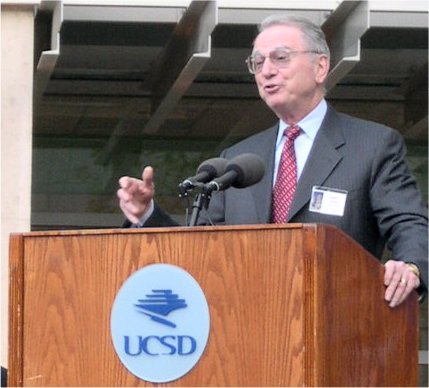
Irwin Mark Jacobs (born October 18, 1933) is an American electrical engineer and businessman. He is a co-founder and former chairman of Qualcomm, and chair of the board of trustees of the Salk Institute for Biological Studies. As of 2019, Jacobs had an estimated net worth of $1.2 billion.[citation needed]
Jacobs was born to a Jewish family in New Bedford, Massachusetts. He earned his Bachelor of Science in electrical engineering from Cornell University in 1956, and his Master of Science and Doctor of Science degrees in electrical engineering and computer science from the Massachusetts Institute of Technology (MIT) in 1957 and 1959, respectively. His doctoral advisor was Edward Arthurs. He is a member of Sigma Alpha Mu fraternity.
Jacobs was assistant and associate professor of electrical engineering at MIT from 1959 to 1966 and professor of computer science and engineering at the University of California, San Diego (UCSD) from 1966 to 1972. With John Wozencraft, he co-authored a textbook entitled Principles of Communication Engineering in 1965, which is still in use today. UCSD's Jacobs School of Engineering is named for him and his wife.
In 1968, Jacobs co-founded Linkabit Corporation with Andrew Viterbi to develop satellite encryption devices. That company merged with M/A-COM, Inc. in 1980, becoming M/A-COM Linkabit.
In 1985, Jacobs went on to co-found Qualcomm Inc. along with Viterbi, Harvey White, Adelia Coffman, Andrew Cohen, Klein Gilhousen, and Franklin Antonio. Qualcomm developed the OmniTRACS system that was deemed one of the world's most "technologically advanced two-way mobile satellite communications and tracking systems". He pioneered these systems which use the communication bandwidth more efficiently than the older fixed time-sliced TDMA technology. Its Code-Division Multiple Access (CDMA) has been adopted as one of two digital standards (the other being Global System for Mobile Communications [GSM]) used in the next generation of cellular telephones in North America at the time. Jacobs announced in March 2009 that he had stepped down as chairman of Qualcomm and that Paul E. Jacobs, his son, would succeed him.
Jacobs was elected a member of the National Academy of Engineering in 1982 for contributions to communication theory and practice, and leadership in high-technology product development. He is also a Fellow of the IEEE. He is a member of the Inter-American Dialogue. He is a chairman on the Salk Institute for Biological Studies, and is on the international advisory board for the Israel Institute of Technology. He is also on the advisory board for the School of Economics and Management at Tsinghua University in Beijing, and on the board of directors of the Pacific Council on International Policy in Los Angeles.
In 1980, Jacobs was the co-recipient, with Andrew J. Viterbi, the 1980 American Institute of Aeronautics and Astronautics (AIAA) biannual award. In 1992, Jacobs was awarded the Entrepreneur of the Year Award in High Technology by the Institute of American Entrepreneurs, and in May 1993, he was awarded the American Electronics Association (AEA) "Inventing America's Future" award.
In 1994, for his development of CDMA, Jacobs was awarded the National Medal of Technology and Innovation.
Hub AI
Irwin M. Jacobs AI simulator
(@Irwin M. Jacobs_simulator)
Irwin M. Jacobs
Irwin Mark Jacobs (born October 18, 1933) is an American electrical engineer and businessman. He is a co-founder and former chairman of Qualcomm, and chair of the board of trustees of the Salk Institute for Biological Studies. As of 2019, Jacobs had an estimated net worth of $1.2 billion.[citation needed]
Jacobs was born to a Jewish family in New Bedford, Massachusetts. He earned his Bachelor of Science in electrical engineering from Cornell University in 1956, and his Master of Science and Doctor of Science degrees in electrical engineering and computer science from the Massachusetts Institute of Technology (MIT) in 1957 and 1959, respectively. His doctoral advisor was Edward Arthurs. He is a member of Sigma Alpha Mu fraternity.
Jacobs was assistant and associate professor of electrical engineering at MIT from 1959 to 1966 and professor of computer science and engineering at the University of California, San Diego (UCSD) from 1966 to 1972. With John Wozencraft, he co-authored a textbook entitled Principles of Communication Engineering in 1965, which is still in use today. UCSD's Jacobs School of Engineering is named for him and his wife.
In 1968, Jacobs co-founded Linkabit Corporation with Andrew Viterbi to develop satellite encryption devices. That company merged with M/A-COM, Inc. in 1980, becoming M/A-COM Linkabit.
In 1985, Jacobs went on to co-found Qualcomm Inc. along with Viterbi, Harvey White, Adelia Coffman, Andrew Cohen, Klein Gilhousen, and Franklin Antonio. Qualcomm developed the OmniTRACS system that was deemed one of the world's most "technologically advanced two-way mobile satellite communications and tracking systems". He pioneered these systems which use the communication bandwidth more efficiently than the older fixed time-sliced TDMA technology. Its Code-Division Multiple Access (CDMA) has been adopted as one of two digital standards (the other being Global System for Mobile Communications [GSM]) used in the next generation of cellular telephones in North America at the time. Jacobs announced in March 2009 that he had stepped down as chairman of Qualcomm and that Paul E. Jacobs, his son, would succeed him.
Jacobs was elected a member of the National Academy of Engineering in 1982 for contributions to communication theory and practice, and leadership in high-technology product development. He is also a Fellow of the IEEE. He is a member of the Inter-American Dialogue. He is a chairman on the Salk Institute for Biological Studies, and is on the international advisory board for the Israel Institute of Technology. He is also on the advisory board for the School of Economics and Management at Tsinghua University in Beijing, and on the board of directors of the Pacific Council on International Policy in Los Angeles.
In 1980, Jacobs was the co-recipient, with Andrew J. Viterbi, the 1980 American Institute of Aeronautics and Astronautics (AIAA) biannual award. In 1992, Jacobs was awarded the Entrepreneur of the Year Award in High Technology by the Institute of American Entrepreneurs, and in May 1993, he was awarded the American Electronics Association (AEA) "Inventing America's Future" award.
In 1994, for his development of CDMA, Jacobs was awarded the National Medal of Technology and Innovation.
Recent media