
Recent from talks
Ischigualasto Formation
Knowledge base stats:
Talk channels stats:
Members stats:
Ischigualasto Formation
The Ischigualasto Formation is a Late Triassic geological formation in the Ischigualasto-Villa Unión Basin of southwestern La Rioja Province and northeastern San Juan Province in northwestern Argentina. The formation dates to the late Carnian and early Norian stages of the Late Triassic (around 231.7 to 225 million years ago), according to radiometric dating of ash beds. The late Carnian portion is particularly rich in fossils, including early dinosaurs.
The Ischigualasto Formation is part of the Agua de la Peña Group, overlying the Los Rastros Formation and overlain by the Los Colorados Formation. The formation is typically subdivided into four members, from old to young; La Peña, Cancha de Bochas, Valle de la Luna and Quebrada de la Sal. The sandstones, mudstones, conglomerates and tuffs of the formation were deposited in an fluvial (river-dominated) floodplain environment, characterized by cool temperatures and strongly seasonal rainfall. The formation is most well-studied in Ischigualasto Provincial Park, a protected area established in San Juan Province in 1967 and designated a UNESCO World Heritage Site in 2000. Sites in La Rioja Province, such as Cerro Las Lajas and Cerro Bola, are less investigated but potentially even more stratigraphically extensive.
The Ischigualasto Formation is an important paleontological unit, considered a konzentrat-lagerstätte due to its density of fossils. It preserves a diverse assortment of Late Triassic synapsids, temnospondyls, and reptiles, including some of the earliest unambiguous dinosaur fossils. Herbivorous rhynchosaurs and cynodonts (especially the rhynchosaur Hyperodapedon sanjuanensis and the cynodont Exaeretodon argentinus) are by far the predominant findings among the tetrapod fossils in the formation. Herrerasaurus ischigualastensis is both the most numerous dinosaur and most abundant carnivore of the formation. Another important dinosaur with primitive characteristics is Eoraptor lunensis, found in Ischigualasto in the early 1990s. Coprolites, burrows, petrified wood, and plant compressions have also been found in the formation.
The name Ischigualasto is derived from the extinct Cacán language, spoken by an indigenous group referred to as the Diaguita by the Spanish conquistadors and means "place where the moon alights". The genus Ischigualastia and the species Herrerasaurus ischigualastensis, Pseudochampsa ischigualastensis, Pelorocephalus ischigualastensis and Protojuniperoxylon ischigualastianus were named after the formation.
The Ischigualasto Formation is found in the Ischigualasto-Villa Unión Basin, along the border between La Rioja and San Juan Provinces, in the badlands of Western Argentina. The formation is most widely exposed and studied in Ischigualasto Provincial Park (IPP), an Argentine national park and UNESCO World Heritage Site which occupies a large portion of the basin in San Juan province. In the western part of the park, the maximum thickness of the formation amounts to 691 metres (2,267 ft), narrowing to 397 metres (1,302 ft) in the eastern area. Conversely, the formation is thin and mostly covered by recent sediments in Talampaya National Park, which neighbors Ischigualasto Provincial Park in La Rioja to the north. Not every exposure in La Rioja is so limited, however. The previously neglected Cerro Las Lajas area, at the northwest tip of the basin, preserves an outcrop up to 1,059 metres (3,474 feet) thick in a small geographic area. Another well-exposed outcrop in La Rioja is Cerro Bola, which preserves nearly 800 metres (2,600 feet) of sediment.
The Ischigualasto-Villa Unión Basin is the remnant of an ancient half-graben which preserves a 3.5-kilometre (11,000 ft)-thick series of Triassic sediments. The Ischigualasto Formation represents the second syn-rift period within the basin, meaning that its sediments were emplaced during a brief interval when rifting was reactivated to widen the basin further. The rifting was accommodated by movement on Valle Fértil, a dormant fault along the western edge of the basin.
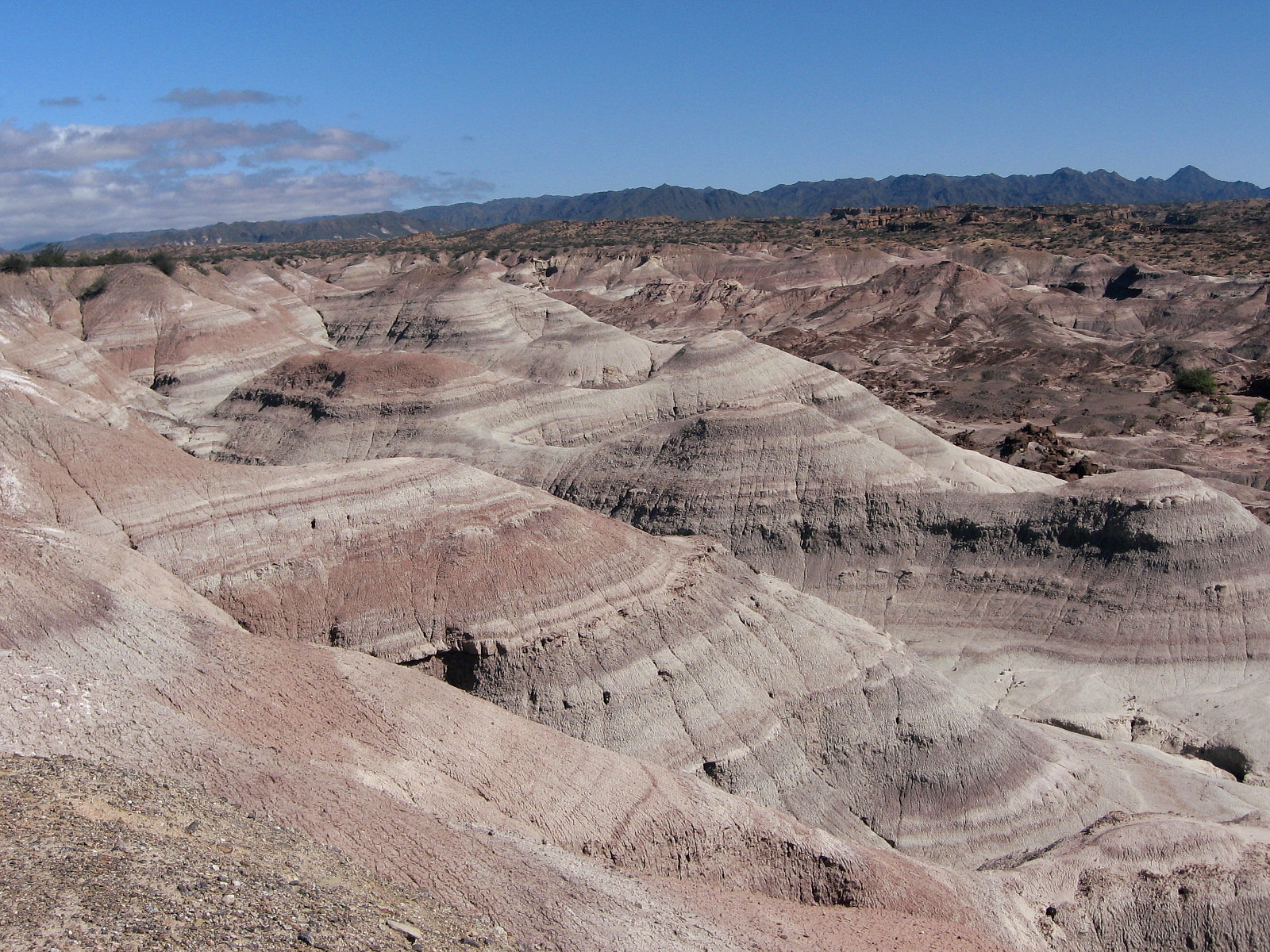
Stratigraphically, the formation is part of the Agua de la Peña Group, a name encompassing Late Triassic formations within the Ischigualasto-Villa Unión Basin. The Ischigualasto Formation overlies the Los Rastros Formation, a mid-Carnian unit dominated by green mudstone. It is subsequently overlain by the Los Colorados Formation, which is primarily Norian-age red sandstone. The comparatively pale color of the Ischigualasto Formation's sediments strongly contrasts with its predecessor and successor, helping to distinguish the three formations in the field.
The Ischigualasto Formation was a river-dominated environment as indicated by its rock types: coarse fluvial (river channel) sandstone beds, and finer floodplain deposits of sandstones, mudstones, and paleosols. Thin bentonite tuffs are scattered through the entire formation, derived from volcanic ash.
Hub AI
Ischigualasto Formation AI simulator
(@Ischigualasto Formation_simulator)
Ischigualasto Formation
The Ischigualasto Formation is a Late Triassic geological formation in the Ischigualasto-Villa Unión Basin of southwestern La Rioja Province and northeastern San Juan Province in northwestern Argentina. The formation dates to the late Carnian and early Norian stages of the Late Triassic (around 231.7 to 225 million years ago), according to radiometric dating of ash beds. The late Carnian portion is particularly rich in fossils, including early dinosaurs.
The Ischigualasto Formation is part of the Agua de la Peña Group, overlying the Los Rastros Formation and overlain by the Los Colorados Formation. The formation is typically subdivided into four members, from old to young; La Peña, Cancha de Bochas, Valle de la Luna and Quebrada de la Sal. The sandstones, mudstones, conglomerates and tuffs of the formation were deposited in an fluvial (river-dominated) floodplain environment, characterized by cool temperatures and strongly seasonal rainfall. The formation is most well-studied in Ischigualasto Provincial Park, a protected area established in San Juan Province in 1967 and designated a UNESCO World Heritage Site in 2000. Sites in La Rioja Province, such as Cerro Las Lajas and Cerro Bola, are less investigated but potentially even more stratigraphically extensive.
The Ischigualasto Formation is an important paleontological unit, considered a konzentrat-lagerstätte due to its density of fossils. It preserves a diverse assortment of Late Triassic synapsids, temnospondyls, and reptiles, including some of the earliest unambiguous dinosaur fossils. Herbivorous rhynchosaurs and cynodonts (especially the rhynchosaur Hyperodapedon sanjuanensis and the cynodont Exaeretodon argentinus) are by far the predominant findings among the tetrapod fossils in the formation. Herrerasaurus ischigualastensis is both the most numerous dinosaur and most abundant carnivore of the formation. Another important dinosaur with primitive characteristics is Eoraptor lunensis, found in Ischigualasto in the early 1990s. Coprolites, burrows, petrified wood, and plant compressions have also been found in the formation.
The name Ischigualasto is derived from the extinct Cacán language, spoken by an indigenous group referred to as the Diaguita by the Spanish conquistadors and means "place where the moon alights". The genus Ischigualastia and the species Herrerasaurus ischigualastensis, Pseudochampsa ischigualastensis, Pelorocephalus ischigualastensis and Protojuniperoxylon ischigualastianus were named after the formation.
The Ischigualasto Formation is found in the Ischigualasto-Villa Unión Basin, along the border between La Rioja and San Juan Provinces, in the badlands of Western Argentina. The formation is most widely exposed and studied in Ischigualasto Provincial Park (IPP), an Argentine national park and UNESCO World Heritage Site which occupies a large portion of the basin in San Juan province. In the western part of the park, the maximum thickness of the formation amounts to 691 metres (2,267 ft), narrowing to 397 metres (1,302 ft) in the eastern area. Conversely, the formation is thin and mostly covered by recent sediments in Talampaya National Park, which neighbors Ischigualasto Provincial Park in La Rioja to the north. Not every exposure in La Rioja is so limited, however. The previously neglected Cerro Las Lajas area, at the northwest tip of the basin, preserves an outcrop up to 1,059 metres (3,474 feet) thick in a small geographic area. Another well-exposed outcrop in La Rioja is Cerro Bola, which preserves nearly 800 metres (2,600 feet) of sediment.
The Ischigualasto-Villa Unión Basin is the remnant of an ancient half-graben which preserves a 3.5-kilometre (11,000 ft)-thick series of Triassic sediments. The Ischigualasto Formation represents the second syn-rift period within the basin, meaning that its sediments were emplaced during a brief interval when rifting was reactivated to widen the basin further. The rifting was accommodated by movement on Valle Fértil, a dormant fault along the western edge of the basin.
Stratigraphically, the formation is part of the Agua de la Peña Group, a name encompassing Late Triassic formations within the Ischigualasto-Villa Unión Basin. The Ischigualasto Formation overlies the Los Rastros Formation, a mid-Carnian unit dominated by green mudstone. It is subsequently overlain by the Los Colorados Formation, which is primarily Norian-age red sandstone. The comparatively pale color of the Ischigualasto Formation's sediments strongly contrasts with its predecessor and successor, helping to distinguish the three formations in the field.
The Ischigualasto Formation was a river-dominated environment as indicated by its rock types: coarse fluvial (river channel) sandstone beds, and finer floodplain deposits of sandstones, mudstones, and paleosols. Thin bentonite tuffs are scattered through the entire formation, derived from volcanic ash.
Recent media