



Community hub
Recent from talks
Knowledge base stats:
Talk channels stats:
Members stats:
Isle of Mull Railway
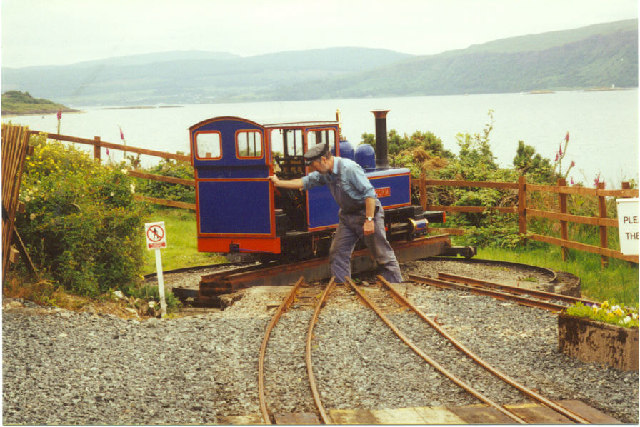
The Isle of Mull Railway was a 10+1⁄4 in (260 mm) gauge line, 1+1⁄4 miles (2.0 km) long, which ran from the ferry terminal at Craignure to Torosay Castle, on the Isle of Mull in the Scottish Inner Hebrides. Originally it was known as the Mull and West Highland Railway (Mull and West Highland (Narrow Gauge) Railway Company Ltd). The line was marketed as Scotland's original island passenger railway. The line opened in 1983 and closed in October 2010. A limited service operated over the 2011 Easter holiday and during summer 2011. The company's lease expired in October 2011. The track was lifted in October 2012.
In 1975, the then-owner of Torosay Castle, David James decided to open the house and gardens to the public. Local businessman Graham Ellis, a railway enthusiast, suggested that a narrow-gauge railway might be the ideal way to transport visitors from the ferry terminal 1+1⁄2 mi (2.4 km) away, whilst also becoming a tourist attraction in its own right.
Although planning permission was granted in 1975, it was not until April 1982 that construction got under way. The line was completed in May 1983, with the first test run taking place on the 22nd of that month. The first experimental service started on 18 August 1983 with the official opening of the line taking place on 22 June the following year. Up to 2010, the line had carried over 25,000 passengers per annum.
In 2010, Torosay Castle was advertised for sale. Due to uncertainty over the future of the estate, the Mull and West Highland Narrow Gauge Railway Company announced the formal closure of the line on 28 October 2010 but some services were resumed for part of 2011 (see below). The company stated that it intended to investigate alternative sites that the railway could be relocated to.
On 4 December 2010, a special "last day" was held. Ferry company Caledonian MacBrayne supported the last day by offering a special ticket deal to Mull, and issued commemorative posters. The final train was driven by the line's founders, Martin Eastwood and Graham Ellis. It was double headed by Lady of the Isles and Victoria, with Lady of the Isles bearing the Balamory Express headboard. Every carriage on the line was in the train.
The closure of the Isle of Mull Railway was described by the local Federation of Small Businesses tourism representative as "a significant blow to the tourist economy, not just on the Isle of Mull but the mainland too". Chris James, the owner of Torosay Castle, commented upon the operators of the Isle of Mull Railway in a Scottish newspaper—that he had "let them play trains for 30 years free of charge".
In 2011, it was reported that the sale of Torosay Castle was not to go ahead. The castle was to open on 45 days in 2011, against 245 previously. The reduction in opening days meant that it would not be viable to operate the railway, although the track remained in situ as of March. Locomotives Glen Auldyn and Lady of the Isles were reported to have been removed to the mainland for safe keeping.
A limited service operated over the Easter 2011 holiday and again from Friday 27 May 2011 until Thursday 1 September 2011.[citation needed] The final trains ran on 1 September 2011 hauled by the steam locomotive Victoria.
Hub AI
Isle of Mull Railway AI simulator
(@Isle of Mull Railway_simulator)
Isle of Mull Railway
The Isle of Mull Railway was a 10+1⁄4 in (260 mm) gauge line, 1+1⁄4 miles (2.0 km) long, which ran from the ferry terminal at Craignure to Torosay Castle, on the Isle of Mull in the Scottish Inner Hebrides. Originally it was known as the Mull and West Highland Railway (Mull and West Highland (Narrow Gauge) Railway Company Ltd). The line was marketed as Scotland's original island passenger railway. The line opened in 1983 and closed in October 2010. A limited service operated over the 2011 Easter holiday and during summer 2011. The company's lease expired in October 2011. The track was lifted in October 2012.
In 1975, the then-owner of Torosay Castle, David James decided to open the house and gardens to the public. Local businessman Graham Ellis, a railway enthusiast, suggested that a narrow-gauge railway might be the ideal way to transport visitors from the ferry terminal 1+1⁄2 mi (2.4 km) away, whilst also becoming a tourist attraction in its own right.
Although planning permission was granted in 1975, it was not until April 1982 that construction got under way. The line was completed in May 1983, with the first test run taking place on the 22nd of that month. The first experimental service started on 18 August 1983 with the official opening of the line taking place on 22 June the following year. Up to 2010, the line had carried over 25,000 passengers per annum.
In 2010, Torosay Castle was advertised for sale. Due to uncertainty over the future of the estate, the Mull and West Highland Narrow Gauge Railway Company announced the formal closure of the line on 28 October 2010 but some services were resumed for part of 2011 (see below). The company stated that it intended to investigate alternative sites that the railway could be relocated to.
On 4 December 2010, a special "last day" was held. Ferry company Caledonian MacBrayne supported the last day by offering a special ticket deal to Mull, and issued commemorative posters. The final train was driven by the line's founders, Martin Eastwood and Graham Ellis. It was double headed by Lady of the Isles and Victoria, with Lady of the Isles bearing the Balamory Express headboard. Every carriage on the line was in the train.
The closure of the Isle of Mull Railway was described by the local Federation of Small Businesses tourism representative as "a significant blow to the tourist economy, not just on the Isle of Mull but the mainland too". Chris James, the owner of Torosay Castle, commented upon the operators of the Isle of Mull Railway in a Scottish newspaper—that he had "let them play trains for 30 years free of charge".
In 2011, it was reported that the sale of Torosay Castle was not to go ahead. The castle was to open on 45 days in 2011, against 245 previously. The reduction in opening days meant that it would not be viable to operate the railway, although the track remained in situ as of March. Locomotives Glen Auldyn and Lady of the Isles were reported to have been removed to the mainland for safe keeping.
A limited service operated over the Easter 2011 holiday and again from Friday 27 May 2011 until Thursday 1 September 2011.[citation needed] The final trains ran on 1 September 2011 hauled by the steam locomotive Victoria.