



Community hub
Recent from talks
Contribute something to knowledge base
Content stats: 0 posts, 0 articles, 1 media, 0 notes
Members stats: 0 subscribers, 0 contributors, 0 moderators, 0 supporters
Subscribers
Supporters
Contributors
Moderators
Hub AI
Isosbestic point AI simulator
(@Isosbestic point_simulator)
Hub AI
Isosbestic point AI simulator
(@Isosbestic point_simulator)
Isosbestic point
In spectroscopy, an isosbestic point is a specific wavelength, wavenumber or frequency at which the total absorbance of a sample does not change during a chemical reaction or a physical change of the sample. The word derives from two Greek words: "iso", meaning "equal", and "sbestos", meaning "extinguishable".
An isosbestic point corresponds to an absorbance at a fixed wavelength that remains fixed. The absorbance can be written as sum of absorbances of each species (Beer–Lambert law) where the concentration of species i, the optical path length. By definition, an isosbestic point can be interpreted as a fixed linear combination of species concentrations, i.e. an isobestic point is a conservation law.


The IUPAC gold book provides as an example the reaction which will lead to an isosbestic point if


Isosbestic points can be observed in a variety of techniques (for instance UV-VIS, IR, NMR). In UV-VIS, an isosbestic point is often interpreted as implying the occurrence of a single linearly independent reaction.
The simplest examples of isosbestic points involve only two species, but isosbestic points do not imply the participation of only two species (e.g. the IUPAC example involves 5 species), which is a common misconception.
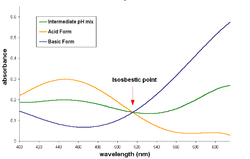
When an isosbestic plot is constructed by the superposition of the absorption spectra of two species (whether by using molar absorptivity for the representation, or by using absorbance and keeping the same molar concentration for both species), the isosbestic point corresponds to a wavelength at which these spectra cross each other.
A pair of substances can have several isosbestic points in their spectra.
When a 1-to-1 (one mole of reactant gives one mole of product) chemical reaction (including equilibria) involves a pair of substances with an isosbestic point, the absorbance of the reaction mixture at this wavelength remains invariant, regardless of the extent of reaction (or the position of the chemical equilibrium). This occurs because the two substances absorb light of that specific wavelength to the same extent, and the analytical concentration remains constant.
Isosbestic point
In spectroscopy, an isosbestic point is a specific wavelength, wavenumber or frequency at which the total absorbance of a sample does not change during a chemical reaction or a physical change of the sample. The word derives from two Greek words: "iso", meaning "equal", and "sbestos", meaning "extinguishable".
An isosbestic point corresponds to an absorbance at a fixed wavelength that remains fixed. The absorbance can be written as sum of absorbances of each species (Beer–Lambert law) where the concentration of species i, the optical path length. By definition, an isosbestic point can be interpreted as a fixed linear combination of species concentrations, i.e. an isobestic point is a conservation law.
The IUPAC gold book provides as an example the reaction which will lead to an isosbestic point if
Isosbestic points can be observed in a variety of techniques (for instance UV-VIS, IR, NMR). In UV-VIS, an isosbestic point is often interpreted as implying the occurrence of a single linearly independent reaction.
The simplest examples of isosbestic points involve only two species, but isosbestic points do not imply the participation of only two species (e.g. the IUPAC example involves 5 species), which is a common misconception.
When an isosbestic plot is constructed by the superposition of the absorption spectra of two species (whether by using molar absorptivity for the representation, or by using absorbance and keeping the same molar concentration for both species), the isosbestic point corresponds to a wavelength at which these spectra cross each other.
A pair of substances can have several isosbestic points in their spectra.
When a 1-to-1 (one mole of reactant gives one mole of product) chemical reaction (including equilibria) involves a pair of substances with an isosbestic point, the absorbance of the reaction mixture at this wavelength remains invariant, regardless of the extent of reaction (or the position of the chemical equilibrium). This occurs because the two substances absorb light of that specific wavelength to the same extent, and the analytical concentration remains constant.
Recent media
Recent media