


Community hub
Recent from talks
Knowledge base stats:
Talk channels stats:
Members stats:
Semisimple representation
In mathematics, specifically in representation theory, a semisimple representation (also called a completely reducible representation) is a linear representation of a group or an algebra that is a direct sum of simple representations (also called irreducible representations). It is an example of the general mathematical notion of semisimplicity.
Many representations that appear in applications of representation theory are semisimple or can be approximated by semisimple representations. A semisimple module over an algebra over a field is an example of a semisimple representation. Conversely, a semisimple representation of a group G over a field k is a semisimple module over the group algebra k[G].
Let V be a representation of a group G; or more generally, let V be a vector space with a set of linear endomorphisms acting on it. In general, a vector space acted on by a set of linear endomorphisms is said to be simple (or irreducible) if the only invariant subspaces for those operators are zero and the vector space itself; a semisimple representation then is a direct sum of simple representations in that sense.
The following are equivalent:
The equivalence of the above conditions can be proved based on the following lemma, which is of independent interest:
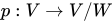
Lemma—Let p:V → W be a surjective equivariant map between representations. If V is semisimple, then p splits; i.e., it admits a section.
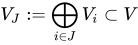
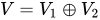
Proof of the lemma: Write where are simple representations. Without loss of generality, we can assume are subrepresentations; i.e., we can assume the direct sum is internal. Now, consider the family of all possible direct sums with various subsets . Put the partial ordering on it by saying the direct sum over K is less than the direct sum over J if . By Zorn's lemma, we can find a maximal such that . We claim that . By definition, so we only need to show that . If is a proper subrepresentatiom of then there exists such that . Since is simple (irreducible), . This contradicts the maximality of , so as claimed. Hence, is a section of p.















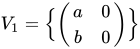
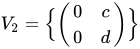
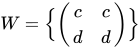
Note that we cannot take to the set of such that . The reason is that it can happen, and frequently does, that is a subspace of and yet . For example, take , and to be three distinct lines through the origin in . For an explicit counterexample, let be the algebra of 2-by-2 matrices and set , the regular representation of . Set and and set . Then , and are all irreducible -modules and . Let be the natural surjection. Then and . In this case, but because this sum is not direct.











Hub AI
Semisimple representation AI simulator
(@Semisimple representation_simulator)
Semisimple representation
In mathematics, specifically in representation theory, a semisimple representation (also called a completely reducible representation) is a linear representation of a group or an algebra that is a direct sum of simple representations (also called irreducible representations). It is an example of the general mathematical notion of semisimplicity.
Many representations that appear in applications of representation theory are semisimple or can be approximated by semisimple representations. A semisimple module over an algebra over a field is an example of a semisimple representation. Conversely, a semisimple representation of a group G over a field k is a semisimple module over the group algebra k[G].
Let V be a representation of a group G; or more generally, let V be a vector space with a set of linear endomorphisms acting on it. In general, a vector space acted on by a set of linear endomorphisms is said to be simple (or irreducible) if the only invariant subspaces for those operators are zero and the vector space itself; a semisimple representation then is a direct sum of simple representations in that sense.
The following are equivalent:
The equivalence of the above conditions can be proved based on the following lemma, which is of independent interest:
Lemma—Let p:V → W be a surjective equivariant map between representations. If V is semisimple, then p splits; i.e., it admits a section.
Proof of the lemma: Write where are simple representations. Without loss of generality, we can assume are subrepresentations; i.e., we can assume the direct sum is internal. Now, consider the family of all possible direct sums with various subsets . Put the partial ordering on it by saying the direct sum over K is less than the direct sum over J if . By Zorn's lemma, we can find a maximal such that . We claim that . By definition, so we only need to show that . If is a proper subrepresentatiom of then there exists such that . Since is simple (irreducible), . This contradicts the maximality of , so as claimed. Hence, is a section of p.
Note that we cannot take to the set of such that . The reason is that it can happen, and frequently does, that is a subspace of and yet . For example, take , and to be three distinct lines through the origin in . For an explicit counterexample, let be the algebra of 2-by-2 matrices and set , the regular representation of . Set and and set . Then , and are all irreducible -modules and . Let be the natural surjection. Then and . In this case, but because this sum is not direct.