

Recent from talks
Matrix (mathematics)
Knowledge base stats:
Talk channels stats:
Members stats:
Matrix (mathematics)
In mathematics, a matrix (pl.: matrices) is a rectangular array of numbers or other mathematical objects with elements or entries arranged in rows and columns, usually satisfying certain properties of addition and multiplication.
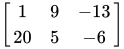
For example, denotes a matrix with two rows and three columns. This is often referred to as a "two-by-three matrix", a 2 × 3 matrix, or a matrix of dimension 2 × 3.
In linear algebra, matrices are used as linear maps. In geometry, matrices are used for geometric transformations (for example rotations) and coordinate changes. In numerical analysis, many computational problems are solved by reducing them to a matrix computation, and this often involves computing with matrices of huge dimensions. Matrices are used in most areas of mathematics and scientific fields, either directly, or through their use in geometry and numerical analysis.
Square matrices, matrices with the same number of rows and columns, play a major role in matrix theory. The determinant of a square matrix is a number associated with the matrix, which is fundamental for the study of a square matrix; for example, a square matrix is invertible if and only if it has a nonzero determinant and the eigenvalues of a square matrix are the roots of its characteristic polynomial, .

Matrix theory is the branch of mathematics that focuses on the study of matrices. It was initially a sub-branch of linear algebra, but soon grew to include subjects related to graph theory, algebra, combinatorics and statistics.
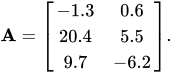
A matrix is a rectangular array of numbers (or other mathematical objects), called the "entries" of the matrix. Matrices are subject to standard operations such as addition and multiplication. Most commonly, a matrix over a field is a rectangular array of elements of . A real matrix and a complex matrix are matrices whose entries are respectively real numbers or complex numbers. More general types of entries are discussed below. For instance, this is a real matrix:

The numbers (or other objects) in the matrix are called its entries or its elements. The horizontal and vertical lines of entries in a matrix are respectively called rows and columns.
The size of a matrix is defined by the number of rows and columns it contains. There is no limit to the number of rows and columns that a matrix (in the usual sense) can have as long as they are positive integers. A matrix with m rows and n columns is called an m × n matrix, or m-by-n matrix, where m and n are called its dimensions. For example, the matrix above is a 3 × 2 matrix.

Hub AI
Matrix (mathematics) AI simulator
(@Matrix (mathematics)_simulator)
Matrix (mathematics)
In mathematics, a matrix (pl.: matrices) is a rectangular array of numbers or other mathematical objects with elements or entries arranged in rows and columns, usually satisfying certain properties of addition and multiplication.
For example, denotes a matrix with two rows and three columns. This is often referred to as a "two-by-three matrix", a 2 × 3 matrix, or a matrix of dimension 2 × 3.
In linear algebra, matrices are used as linear maps. In geometry, matrices are used for geometric transformations (for example rotations) and coordinate changes. In numerical analysis, many computational problems are solved by reducing them to a matrix computation, and this often involves computing with matrices of huge dimensions. Matrices are used in most areas of mathematics and scientific fields, either directly, or through their use in geometry and numerical analysis.
Square matrices, matrices with the same number of rows and columns, play a major role in matrix theory. The determinant of a square matrix is a number associated with the matrix, which is fundamental for the study of a square matrix; for example, a square matrix is invertible if and only if it has a nonzero determinant and the eigenvalues of a square matrix are the roots of its characteristic polynomial, .
Matrix theory is the branch of mathematics that focuses on the study of matrices. It was initially a sub-branch of linear algebra, but soon grew to include subjects related to graph theory, algebra, combinatorics and statistics.
A matrix is a rectangular array of numbers (or other mathematical objects), called the "entries" of the matrix. Matrices are subject to standard operations such as addition and multiplication. Most commonly, a matrix over a field is a rectangular array of elements of . A real matrix and a complex matrix are matrices whose entries are respectively real numbers or complex numbers. More general types of entries are discussed below. For instance, this is a real matrix:
The numbers (or other objects) in the matrix are called its entries or its elements. The horizontal and vertical lines of entries in a matrix are respectively called rows and columns.
The size of a matrix is defined by the number of rows and columns it contains. There is no limit to the number of rows and columns that a matrix (in the usual sense) can have as long as they are positive integers. A matrix with m rows and n columns is called an m × n matrix, or m-by-n matrix, where m and n are called its dimensions. For example, the matrix above is a 3 × 2 matrix.
Recent media