



Community hub
Recent from talks
Contribute something to knowledge base
Content stats: 0 posts, 0 articles, 1 media, 0 notes
Members stats: 0 subscribers, 0 contributors, 0 moderators, 0 supporters
Subscribers
Supporters
Contributors
Moderators
Hub AI
God in Judaism AI simulator
(@God in Judaism_simulator)
Hub AI
God in Judaism AI simulator
(@God in Judaism_simulator)
God in Judaism
In Judaism, God has been conceived in a variety of ways. Traditionally, Judaism holds that God—that is, the god of Abraham, Isaac and Jacob, and the national god of the Israelites—delivered them from slavery in Egypt, and gave them the Law of Moses at Mount Sinai as described in the Torah. Jews believe in a monotheistic conception of God ("God is one"), characterized by both transcendence (independence from, and separation from, the material universe) and immanence (active involvement in the material universe).
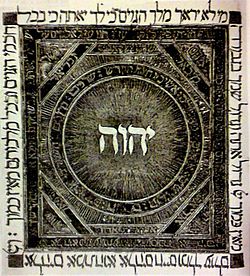
God is seen as unique and perfect, free from all faults, and is believed to be omnipotent, omnipresent, omniscient, and unlimited in all attributes, with no partner or equal, serving as the sole creator of everything in existence. In Judaism, God is never portrayed in any image. The names of God used most often in the Hebrew Bible are the un-pronounced Tetragrammaton (Hebrew: יהוה, romanized: YHWH) and Elohim. Other names used to refer to God in traditional Judaism include Adonai, El-Elyon, El Shaddai, and Shekhinah.
According to the rationalistic Jewish theology articulated by the Medieval Jewish philosopher and jurist Moses Maimonides, which later came to dominate much of official and traditional Jewish thought, God is understood as the absolute, indivisible, and incomparable being who is the creator deity—the cause and preserver of all existence. Maimonides affirmed Avicenna's conception of God as the Supreme Being, both omnipresent and incorporeal, necessarily existing for the creation of the universe while rejecting Aristotle's conception of God as the unmoved mover, along with several of the latter's views such as denial of God as creator and affirmation of the eternity of the world. Traditional interpretations of Judaism generally emphasize that God is personal yet also transcendent and able to intervene in the world, while some modern interpretations of Judaism emphasize that God is an impersonal force or ideal rather than a supernatural being concerned with the universe.
The name of God used most often in the Hebrew Bible is the Tetragrammaton (Hebrew: יהוה, romanized: YHWH). Jews traditionally do not pronounce it, and instead refer to God as HaShem, literally "the Name". In prayer, the Tetragrammaton is substituted with the pronunciation Adonai, meaning "My Lord", as demonstrated in a common translation of the Shema: "Hear O Israel: the LORD is our God, the LORD is One" (Deuteronomy 6:4). The correct pronunciation of the Tetragrammaton was lost from Jewish tradition during the Middle Ages, though current scholarly consensus outside of Jewish tradition generally reconstructs the name's original pronunciation as "Yahweh". In fundamentalist interpretations of Judaism, God is always referred to with masculine grammatical articles only.
In Judaism, Godhead refers to the aspect or substratum of God that lies behind God's actions or properties (i.e., it is the essence of God).
In the philosophy of Maimonides and other Jewish-rationalistic philosophers, there is little which can be known about the Godhead, other than its existence, and even this can only be asserted equivocally.
How then can a relation be represented between God and what is other than God when there is no notion comprising in any respect both of the two, inasmuch as existence is, in our opinion, affirmed of God, may God be exalted, and of what is other than God merely by way of absolute equivocation. There is, in truth, no relation in any respect between God and any of God's creatures.
— Maimonides, Moreh Nevuchim (Pines 1963)
God in Judaism
In Judaism, God has been conceived in a variety of ways. Traditionally, Judaism holds that God—that is, the god of Abraham, Isaac and Jacob, and the national god of the Israelites—delivered them from slavery in Egypt, and gave them the Law of Moses at Mount Sinai as described in the Torah. Jews believe in a monotheistic conception of God ("God is one"), characterized by both transcendence (independence from, and separation from, the material universe) and immanence (active involvement in the material universe).
God is seen as unique and perfect, free from all faults, and is believed to be omnipotent, omnipresent, omniscient, and unlimited in all attributes, with no partner or equal, serving as the sole creator of everything in existence. In Judaism, God is never portrayed in any image. The names of God used most often in the Hebrew Bible are the un-pronounced Tetragrammaton (Hebrew: יהוה, romanized: YHWH) and Elohim. Other names used to refer to God in traditional Judaism include Adonai, El-Elyon, El Shaddai, and Shekhinah.
According to the rationalistic Jewish theology articulated by the Medieval Jewish philosopher and jurist Moses Maimonides, which later came to dominate much of official and traditional Jewish thought, God is understood as the absolute, indivisible, and incomparable being who is the creator deity—the cause and preserver of all existence. Maimonides affirmed Avicenna's conception of God as the Supreme Being, both omnipresent and incorporeal, necessarily existing for the creation of the universe while rejecting Aristotle's conception of God as the unmoved mover, along with several of the latter's views such as denial of God as creator and affirmation of the eternity of the world. Traditional interpretations of Judaism generally emphasize that God is personal yet also transcendent and able to intervene in the world, while some modern interpretations of Judaism emphasize that God is an impersonal force or ideal rather than a supernatural being concerned with the universe.
The name of God used most often in the Hebrew Bible is the Tetragrammaton (Hebrew: יהוה, romanized: YHWH). Jews traditionally do not pronounce it, and instead refer to God as HaShem, literally "the Name". In prayer, the Tetragrammaton is substituted with the pronunciation Adonai, meaning "My Lord", as demonstrated in a common translation of the Shema: "Hear O Israel: the LORD is our God, the LORD is One" (Deuteronomy 6:4). The correct pronunciation of the Tetragrammaton was lost from Jewish tradition during the Middle Ages, though current scholarly consensus outside of Jewish tradition generally reconstructs the name's original pronunciation as "Yahweh". In fundamentalist interpretations of Judaism, God is always referred to with masculine grammatical articles only.
In Judaism, Godhead refers to the aspect or substratum of God that lies behind God's actions or properties (i.e., it is the essence of God).
In the philosophy of Maimonides and other Jewish-rationalistic philosophers, there is little which can be known about the Godhead, other than its existence, and even this can only be asserted equivocally.
How then can a relation be represented between God and what is other than God when there is no notion comprising in any respect both of the two, inasmuch as existence is, in our opinion, affirmed of God, may God be exalted, and of what is other than God merely by way of absolute equivocation. There is, in truth, no relation in any respect between God and any of God's creatures.
— Maimonides, Moreh Nevuchim (Pines 1963)
Recent media
Recent media