



Community hub
Community hub
Recent from talks
Knowledge base stats:
Talk channels stats:
Members stats:
Italian front (World War I)
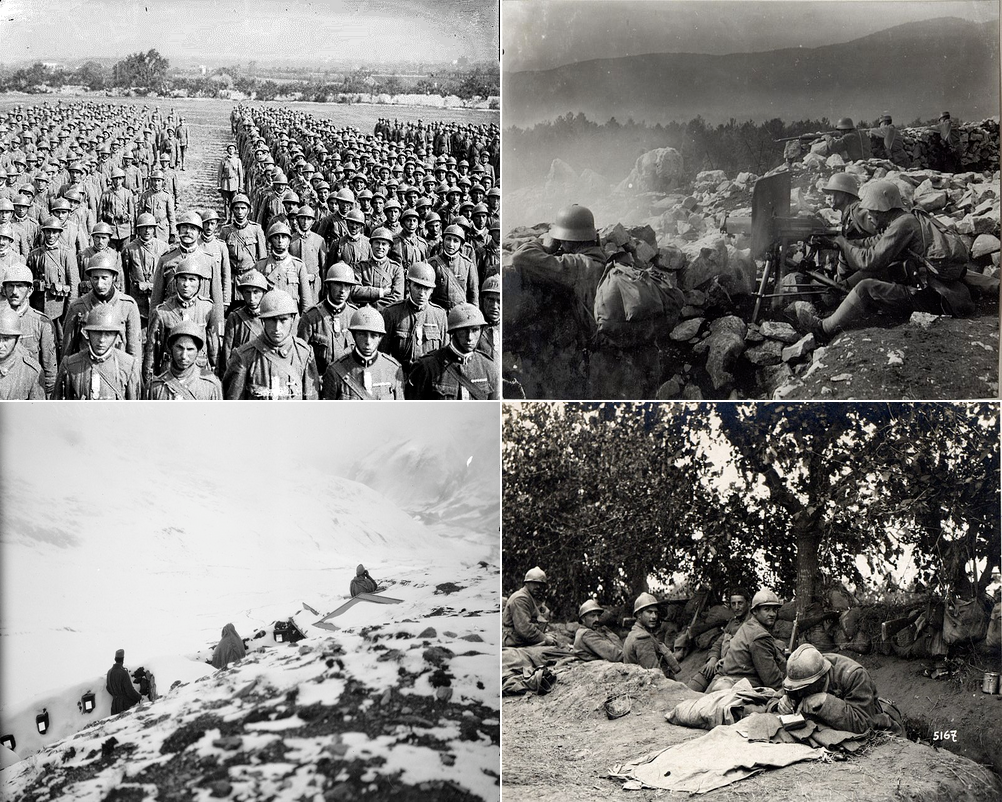
The Italian front (Italian: Fronte italiano; German: Südwestfront) was one of the main theatres of war of World War I. It involved a series of military engagements along the border between the Kingdom of Italy and Austria-Hungary from 1915 to 1918. Following secret promises made by the Entente in the 1915 Treaty of London, the Kingdom of Italy entered the war on the Entente side, aiming to annex the Austrian Littoral, northern Dalmatia and the territories of present-day Trentino and South Tyrol. The front soon bogged down into trench warfare, similar to that on the Western Front, but at high altitudes and with extremely cold winters. Fighting along the front displaced much of the local population, and several thousand civilians died from malnutrition and illness in Kingdom of Italy and Austro-Hungarian refugee camps.
Military operations came to an end in 1918 with Italian victory and the capture of Trento and Trieste by the Royal Italian Army. Austria-Hungary disintegrated due to military defeats and subsequent turmoils caused by pacifists and separatists. All military operations on the front came to an end with the entry into force of the armistice of Villa Giusti on 4 November 1918. Italy entered into World War I also with the aim of completing national unity with the annexation of Trentino-Alto Adige and the Julian March; for this reason, the Italian intervention in the World War I is also considered the Fourth Italian War of Independence, in a historiographical perspective that identifies in the latter the conclusion of the unification of Italy, whose military actions began during the revolutions of 1848 with the First Italian War of Independence.
" However, if, in the course of events, the maintenance of the status quo in the regions of the Balkans or of the Ottoman coasts and islands in the Adriatic and in the Aegean Sea should become impossible, and if, whether in consequence of the action of a third Power or otherwise, Austria-Hungary or Italy should find themselves under the necessity of modifying it by a temporary or permanent occupation on their part, this occupation shall take place only after a previous agreement between the two Powers, based upon the principle of reciprocal compensation for every advantage, territorial or other, which each of them might obtain beyond the present status quo, and giving satisfaction to the interests and well-founded claims of the two Parties. "
The Italian Front stretched from the Stelvio Pass (at the border triangle between Italy, Austria-Hungary and Switzerland) along the Tyrolean, Carinthian, and Littoral borders to the Isonzo. Its total length was around 600 kilometers, of which 450 kilometers ran in high alpine terrain. This information relates to measurements as the crow flies. Taking into account the natural terrain, the many yokes, peaks and ridges with the resulting differences in height, the effective length was several thousand kilometers.
The front touched very different geographical areas: in the first three sections - from the Stelvio Pass to the Julian Alps in the area of Tarvisio, it ran through mountainous territory, where the average ridge heights reached 2,700 to 3,200 meters. The higher mountainous regions have a highly rugged relief with little vegetation; Elevations over 2,500 meters are also covered by glaciers. The barren landscape and lack of sufficient arable land led to little development of these high elevations; settlement was largely limited to the lower-lying zones. From the Julian Alps to the Adriatic Sea, the mountains are constantly losing on height and only rarely reach 1,000 meters as in the area around Gorizia. This area is also sparsely populated and characterized by a harsh climate with cold winters and very hot and dry summers. A craggy karst landscape spreads out around the Isonzo valley, which adjoins the Italian foothills of the Alps in the southwest.
The topographical characteristics of the front area had a concrete impact on the conduct of the war. The rocky ground, for example, made it difficult to dig trenches and in addition, the karst rock in the Isonzo Valley turned out to be an additional danger for the soldiers. If grenades exploded on the porous surface fragments of the exploding rock acted as additional shrapnel.
Archduke Eugen, who was already in command of the Balkan forces, was promoted to Generaloberst on May 22, 1915 and was given supreme command of the new southwest front. Together with his chief of staff Alfred Krauß the 5th Army was reorganized and placed under the command of General d. Inf. Svetozar Boroević who on May 27 had arrived from the Eastern Front. The K. u. k. Landesverteidigungskommando in Tyrol (LVK) was handed to GdK Viktor Dankl to protect the Tyrolean borders. It included the German Alpenkorps which was suitable for operations in the high mountains, the first divisions arrived on May 26; a short time later, the Alpenkorps was already taking part in combat operations against Italian units, although the German Empire was not officially at war with Italy until August 28, 1916. The "Armeegruppe Rohr" stood under the command of Franz Rohr von Denta and was to secure the Carinthian front. The transfer of the 5th Army and additional troops from the east went smoothly; within a few weeks, Archduke Eugen had around 225,000 soldiers under his command. In June the 48. Division (FML Theodor Gabriel) and finally, in July, the four Kaiserjäger regiments and three k.k. Landesschützen regiments from Galicia were added. A major advantage of the Austro-Hungarian defense was its entrenchment on higher ground.
Italy ordered general mobilization on May 22, 1915 and by the end of June four armies had marched into the north-east border area. In the deployment plan of the Italian general staff (Commando Supremo) under the direction of FM Luigi Cadorna, three main points were set:
Hub AI
Italian front (World War I) AI simulator
(@Italian front (World War I)_simulator)
Italian front (World War I)
The Italian front (Italian: Fronte italiano; German: Südwestfront) was one of the main theatres of war of World War I. It involved a series of military engagements along the border between the Kingdom of Italy and Austria-Hungary from 1915 to 1918. Following secret promises made by the Entente in the 1915 Treaty of London, the Kingdom of Italy entered the war on the Entente side, aiming to annex the Austrian Littoral, northern Dalmatia and the territories of present-day Trentino and South Tyrol. The front soon bogged down into trench warfare, similar to that on the Western Front, but at high altitudes and with extremely cold winters. Fighting along the front displaced much of the local population, and several thousand civilians died from malnutrition and illness in Kingdom of Italy and Austro-Hungarian refugee camps.
Military operations came to an end in 1918 with Italian victory and the capture of Trento and Trieste by the Royal Italian Army. Austria-Hungary disintegrated due to military defeats and subsequent turmoils caused by pacifists and separatists. All military operations on the front came to an end with the entry into force of the armistice of Villa Giusti on 4 November 1918. Italy entered into World War I also with the aim of completing national unity with the annexation of Trentino-Alto Adige and the Julian March; for this reason, the Italian intervention in the World War I is also considered the Fourth Italian War of Independence, in a historiographical perspective that identifies in the latter the conclusion of the unification of Italy, whose military actions began during the revolutions of 1848 with the First Italian War of Independence.
" However, if, in the course of events, the maintenance of the status quo in the regions of the Balkans or of the Ottoman coasts and islands in the Adriatic and in the Aegean Sea should become impossible, and if, whether in consequence of the action of a third Power or otherwise, Austria-Hungary or Italy should find themselves under the necessity of modifying it by a temporary or permanent occupation on their part, this occupation shall take place only after a previous agreement between the two Powers, based upon the principle of reciprocal compensation for every advantage, territorial or other, which each of them might obtain beyond the present status quo, and giving satisfaction to the interests and well-founded claims of the two Parties. "
The Italian Front stretched from the Stelvio Pass (at the border triangle between Italy, Austria-Hungary and Switzerland) along the Tyrolean, Carinthian, and Littoral borders to the Isonzo. Its total length was around 600 kilometers, of which 450 kilometers ran in high alpine terrain. This information relates to measurements as the crow flies. Taking into account the natural terrain, the many yokes, peaks and ridges with the resulting differences in height, the effective length was several thousand kilometers.
The front touched very different geographical areas: in the first three sections - from the Stelvio Pass to the Julian Alps in the area of Tarvisio, it ran through mountainous territory, where the average ridge heights reached 2,700 to 3,200 meters. The higher mountainous regions have a highly rugged relief with little vegetation; Elevations over 2,500 meters are also covered by glaciers. The barren landscape and lack of sufficient arable land led to little development of these high elevations; settlement was largely limited to the lower-lying zones. From the Julian Alps to the Adriatic Sea, the mountains are constantly losing on height and only rarely reach 1,000 meters as in the area around Gorizia. This area is also sparsely populated and characterized by a harsh climate with cold winters and very hot and dry summers. A craggy karst landscape spreads out around the Isonzo valley, which adjoins the Italian foothills of the Alps in the southwest.
The topographical characteristics of the front area had a concrete impact on the conduct of the war. The rocky ground, for example, made it difficult to dig trenches and in addition, the karst rock in the Isonzo Valley turned out to be an additional danger for the soldiers. If grenades exploded on the porous surface fragments of the exploding rock acted as additional shrapnel.
Archduke Eugen, who was already in command of the Balkan forces, was promoted to Generaloberst on May 22, 1915 and was given supreme command of the new southwest front. Together with his chief of staff Alfred Krauß the 5th Army was reorganized and placed under the command of General d. Inf. Svetozar Boroević who on May 27 had arrived from the Eastern Front. The K. u. k. Landesverteidigungskommando in Tyrol (LVK) was handed to GdK Viktor Dankl to protect the Tyrolean borders. It included the German Alpenkorps which was suitable for operations in the high mountains, the first divisions arrived on May 26; a short time later, the Alpenkorps was already taking part in combat operations against Italian units, although the German Empire was not officially at war with Italy until August 28, 1916. The "Armeegruppe Rohr" stood under the command of Franz Rohr von Denta and was to secure the Carinthian front. The transfer of the 5th Army and additional troops from the east went smoothly; within a few weeks, Archduke Eugen had around 225,000 soldiers under his command. In June the 48. Division (FML Theodor Gabriel) and finally, in July, the four Kaiserjäger regiments and three k.k. Landesschützen regiments from Galicia were added. A major advantage of the Austro-Hungarian defense was its entrenchment on higher ground.
Italy ordered general mobilization on May 22, 1915 and by the end of June four armies had marched into the north-east border area. In the deployment plan of the Italian general staff (Commando Supremo) under the direction of FM Luigi Cadorna, three main points were set: