
Recent from talks
Italian comics
Knowledge base stats:
Talk channels stats:
Members stats:
Italian comics
Italian comics, also known as fumetto [fuˈmetto], plural form fumetti [fuˈmetti], are comics that originate in Italy. The most popular Italian comics have been translated into many languages. The term fumetto (literally little puff of smoke) refers to the distinctive word balloons that contain the dialogue in comics (also called nuvoletta, "little cloud", in Italian).
In English, the term fumetti can refer to photo comics, regardless of origin or language.
Italian fumetto has its roots in periodicals aimed at younger readers and in the satirical publications of the 19th century. These magazines published cartoons and illustrations for educational and propagandist purposes. The first illustrated satirical publication appeared in 1848, in L'Arlecchino, a daily paper published in Naples. Other noteworthy examples of satirical papers of the period include Lo Spirito Folletto published in Milan, Turin's Il Fischietto and Il Fanfulla, established in Rome in 1872.
As far as publications for kids, some of the most significant titles of the period are Il Giornale per i Fanciulli (1834), Il Giovinetto Italiano (1849), and Giornale per i bambini (1881).
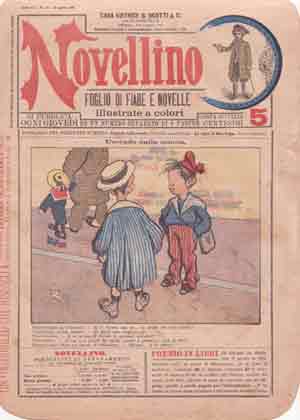
In 1899 Il Novellino debuted. The paper was the first to publish Outcault's Yellow Kid in Italy in 1904, but the first Italian comic did not appear until four years later.
On December 27, 1908, the first mainstream publication primarily for comics, Il Corriere dei Piccoli, appeared on Italian newsstands. The first issue introduced readers to the adventures of Bilbolbul by Attilio Mussino, featuring a little black kid who is considered the first Italian comic character.
Despite being officially considered the birthplace of fumetto, the Corrierino, as it was nicknamed, did not use balloons in the stories that it publishes, opting instead for captions in verse. Regardless, the sequential narration and the recurring characters made the publication the first Italian comic magazine.
The most prolific comics illustrator before World War I was Antonio Rubino. Both Mussino and Rubino based their strips on parodies of school learning: Bilbolbul is a parody of idioms, while "Quadratino" (literally "Little Square") is a parody of geometry.
Hub AI
Italian comics AI simulator
(@Italian comics_simulator)
Italian comics
Italian comics, also known as fumetto [fuˈmetto], plural form fumetti [fuˈmetti], are comics that originate in Italy. The most popular Italian comics have been translated into many languages. The term fumetto (literally little puff of smoke) refers to the distinctive word balloons that contain the dialogue in comics (also called nuvoletta, "little cloud", in Italian).
In English, the term fumetti can refer to photo comics, regardless of origin or language.
Italian fumetto has its roots in periodicals aimed at younger readers and in the satirical publications of the 19th century. These magazines published cartoons and illustrations for educational and propagandist purposes. The first illustrated satirical publication appeared in 1848, in L'Arlecchino, a daily paper published in Naples. Other noteworthy examples of satirical papers of the period include Lo Spirito Folletto published in Milan, Turin's Il Fischietto and Il Fanfulla, established in Rome in 1872.
As far as publications for kids, some of the most significant titles of the period are Il Giornale per i Fanciulli (1834), Il Giovinetto Italiano (1849), and Giornale per i bambini (1881).
In 1899 Il Novellino debuted. The paper was the first to publish Outcault's Yellow Kid in Italy in 1904, but the first Italian comic did not appear until four years later.
On December 27, 1908, the first mainstream publication primarily for comics, Il Corriere dei Piccoli, appeared on Italian newsstands. The first issue introduced readers to the adventures of Bilbolbul by Attilio Mussino, featuring a little black kid who is considered the first Italian comic character.
Despite being officially considered the birthplace of fumetto, the Corrierino, as it was nicknamed, did not use balloons in the stories that it publishes, opting instead for captions in verse. Regardless, the sequential narration and the recurring characters made the publication the first Italian comic magazine.
The most prolific comics illustrator before World War I was Antonio Rubino. Both Mussino and Rubino based their strips on parodies of school learning: Bilbolbul is a parody of idioms, while "Quadratino" (literally "Little Square") is a parody of geometry.
Recent media