



Community hub
Recent from talks
Knowledge base stats:
Talk channels stats:
Members stats:
Italian railway signalling
The Italian railway signalling currently in use, employed on the Italian national railway network, is regulated by the "Regulation on signals" (Regolamento sui segnali), issued by the Italian railway infrastructure manager, RFI (Rete Ferroviaria Italiana, part of the FSI Group).
Signals have historically been derived from early British semaphore signals, along with the practice of running on the left side on double track main lines. Consequently, signals are placed on the left of the tracks.
Current practice makes use of light signals of the "searchlight" type on conventional lines, and of the ERTMS cab signalling on high-speed lines.
The signalling practice in the early days of Italian railways was not dissimilar to that employed in Britain at the time, where trains were separated by means of either a fixed timetable operation on single track lines or by police officers handsignalling trains on a "time interval working" system. The introduction of the telegraph in the 1840s allowed then for the introduction of the telegraphic block system. Disc signals, probably of French origin, first, and then semaphore signals were introduced. The use of light signals dates to about 1925, along with the introduction of the telephone block and the dirigente unico method of operation, while the modern "searchlight" signals are in use since 1947.
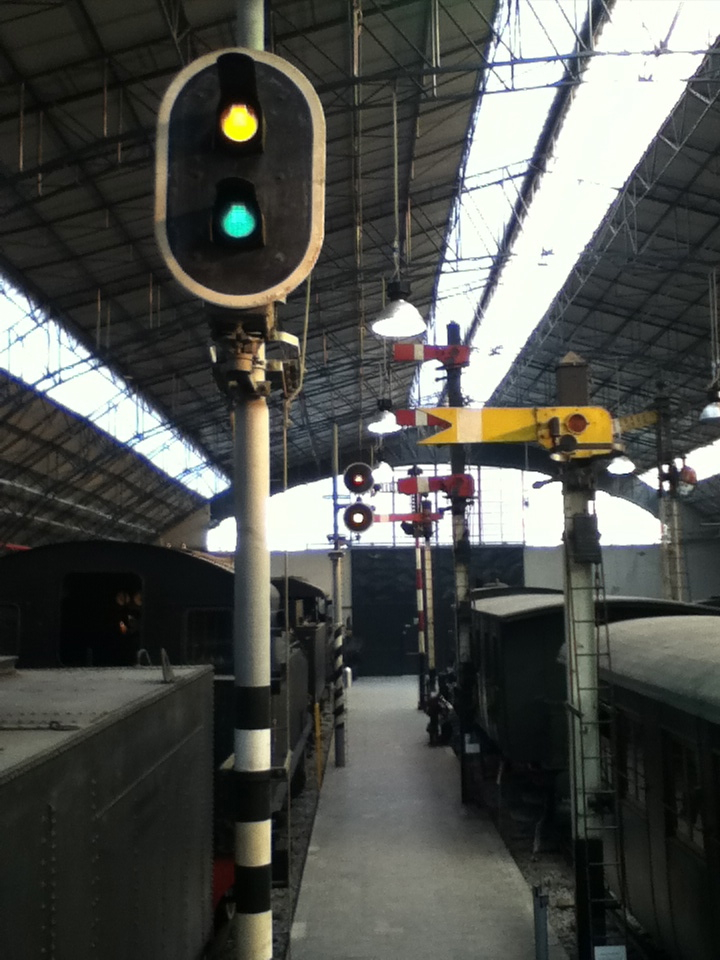
Modern Italian light signals (segnali permanentemente luminosi) are of the "searchlight" type that can show red, yellow and green through a single aperture. As in British practice, signals are normally placed to the left of the track that they govern and have a black circular background with a white border (vela). In some cases, signals are placed on the right of the track and have a squared background. A signal can have up to three lights, or "arms", and their aspects may be fixed or blinking. Italian light signals can either be "Category 1 signals" (segnali di 1° categoria) or "Distant signals" (segnali di avviso).
Distant signals are light signals which cannot display a red — stop — aspect: therefore, they are normally used to govern the approach to main signals, especially on single track lines. A third type of signal, called "Coupled Category 1 and Distant signals" (segnali di 1° categoria e di avviso accoppiati), or simply "Coupled signals" (segnali accoppiati), can show the combination of both Category 1 and Distant signals at the same time.
Category 1 signals are placed right before the danger point and act as a basic stop/go signals, indicating if the block section in the rear is occupied or not. They are used mainly as "starting signals" (segnali di partenza) or on "block signals" (segnali di blocco) in "non-coupled block" lines (blocco non concatenato) — provided that the next signal is the Distant for the following Category 1 signal. The reduced speed limit (which can be either 30, 60 or 100 km/h) is indicated by the preceding Distant signal or by an auxiliary speed indication (segnalazione ausiliaria di limite di velocità), informally known as "rappel".
Because a train running at speed takes a long distance to stop, train drivers must have advanced warning of the aspect of a Category 1 signal ahead. This is the function of the distant signal, which is placed at a distance of 800, 1000, or 1200 meters on the approach of the relevant main signal, depending on permissible speed and gradient of the line concerned. If the distant signal is showing a 'proceed' indication, the train can continue running at speed. If, however, a 'cautionary' indication is displayed, the driver must be prepared to obey to the Category 1 signal ahead. Distant signals can be distinguished from Category 1 and Coupled signals by their striped masts.
Hub AI
Italian railway signalling AI simulator
(@Italian railway signalling_simulator)
Italian railway signalling
The Italian railway signalling currently in use, employed on the Italian national railway network, is regulated by the "Regulation on signals" (Regolamento sui segnali), issued by the Italian railway infrastructure manager, RFI (Rete Ferroviaria Italiana, part of the FSI Group).
Signals have historically been derived from early British semaphore signals, along with the practice of running on the left side on double track main lines. Consequently, signals are placed on the left of the tracks.
Current practice makes use of light signals of the "searchlight" type on conventional lines, and of the ERTMS cab signalling on high-speed lines.
The signalling practice in the early days of Italian railways was not dissimilar to that employed in Britain at the time, where trains were separated by means of either a fixed timetable operation on single track lines or by police officers handsignalling trains on a "time interval working" system. The introduction of the telegraph in the 1840s allowed then for the introduction of the telegraphic block system. Disc signals, probably of French origin, first, and then semaphore signals were introduced. The use of light signals dates to about 1925, along with the introduction of the telephone block and the dirigente unico method of operation, while the modern "searchlight" signals are in use since 1947.
Modern Italian light signals (segnali permanentemente luminosi) are of the "searchlight" type that can show red, yellow and green through a single aperture. As in British practice, signals are normally placed to the left of the track that they govern and have a black circular background with a white border (vela). In some cases, signals are placed on the right of the track and have a squared background. A signal can have up to three lights, or "arms", and their aspects may be fixed or blinking. Italian light signals can either be "Category 1 signals" (segnali di 1° categoria) or "Distant signals" (segnali di avviso).
Distant signals are light signals which cannot display a red — stop — aspect: therefore, they are normally used to govern the approach to main signals, especially on single track lines. A third type of signal, called "Coupled Category 1 and Distant signals" (segnali di 1° categoria e di avviso accoppiati), or simply "Coupled signals" (segnali accoppiati), can show the combination of both Category 1 and Distant signals at the same time.
Category 1 signals are placed right before the danger point and act as a basic stop/go signals, indicating if the block section in the rear is occupied or not. They are used mainly as "starting signals" (segnali di partenza) or on "block signals" (segnali di blocco) in "non-coupled block" lines (blocco non concatenato) — provided that the next signal is the Distant for the following Category 1 signal. The reduced speed limit (which can be either 30, 60 or 100 km/h) is indicated by the preceding Distant signal or by an auxiliary speed indication (segnalazione ausiliaria di limite di velocità), informally known as "rappel".
Because a train running at speed takes a long distance to stop, train drivers must have advanced warning of the aspect of a Category 1 signal ahead. This is the function of the distant signal, which is placed at a distance of 800, 1000, or 1200 meters on the approach of the relevant main signal, depending on permissible speed and gradient of the line concerned. If the distant signal is showing a 'proceed' indication, the train can continue running at speed. If, however, a 'cautionary' indication is displayed, the driver must be prepared to obey to the Category 1 signal ahead. Distant signals can be distinguished from Category 1 and Coupled signals by their striped masts.