


Community hub
Recent from talks
Contribute something
Nothing was collected or created yet.
Ivan Dmitriev
View on Wikipedia
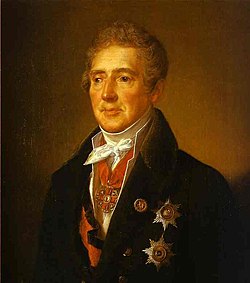
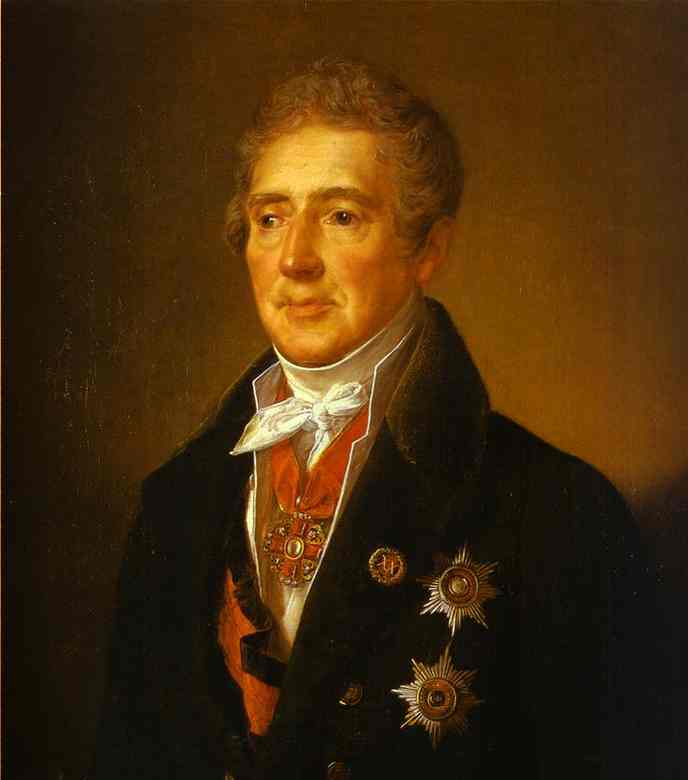
Ivan Ivanovich Dmitriev (Russian: Ива́н Ива́нович Дми́триев, IPA: [ɪˈvan ɨˈvanəvʲɪdʑ ˈdmʲitrʲɪjɪf] ⓘ; 21 September [O.S. 10 September] 1760 – 15 October [O.S. 3 October] 1837) was a Russian statesman. He was also a poet associated with the sentimentalist movement in Russian literature.
Dmitriev was born at his father's estate in the government of Simbirsk. In consequence of the revolt of Yemelyan Pugachev, the family had to flee to Saint Petersburg, and there Ivan was entered at the school of the Semenov Guards, and afterwards obtained a post in the military service. On the accession of Paul I to the imperial throne, he quit the army with the rank of colonel; and his appointment as procurator for the senate was soon after renounced for the position of privy councillor.[1]
During the four years from 1810 to 1814 he served as minister of justice under the Emperor Alexander I; but at the close of this period he retired into private life, and though he lived more than twenty years, he never again took office, but occupied himself with his literary labors and the collection of books and works of art.[1]
In the matter of language he sided with Karamsin, and did good service by his own pen against the Old Slavonic party. His poems include songs, odes, satires, tales, epistles, and others, as well as the fables—partly original and partly translated from La Fontaine, Florian and Arnault—on which his fame chiefly rests. Several of his lyrics have become thoroughly popular from the readiness with which they can be sung; and a short dramatico-epic poem on Yermak, the Cossack conqueror of Siberia, is well known.[1]
His writings occupy three volumes in the first five editions; in the 6th (Saint Petersburg, 1823) there are only two. His memoirs, to which he devoted the last years of his life, were published at Moscow in 1866.[1]
English translations of his poems
[edit]Translation of long poem "Liberation of Moscow" (1795) in Four Centuries 16[2]
...And you, our champion, will live for the ages,
As our honor, our glory, and a paragon to all!
There, where the mountains prop up the clouds,
A multitude of sonorous rivers will spring up,
And from the millstone a mighty forest emerge;
Verdant gardens will burgeon upon the plains
And cities will arise and vanish, with time;
An infinity of new marvels nature will create;
Be they revealed to our astonished gaze;
A new light will illuminate the cosmos,
And the warrior, heartened by your blood,
Remembering you, will become in his pride
Greater ingrained, and further, further confirmed
In his unshakable love for our fatherland!
References
[edit]- ^ a b c d One or more of the preceding sentences incorporates text from a publication now in the public domain: Chisholm, Hugh, ed. (1911). "Dmitriev, Ivan Ivanovich". Encyclopædia Britannica. Vol. 8 (11th ed.). Cambridge University Press. p. 348.
- ^ http://perelmuterverlag.de/FC162017.pdf [bare URL PDF]

| International | |
|---|---|
| National | |
| Academics | |
| Artists | |
| People | |
| Other | |

Ivan Dmitriev
View on GrokipediaEarly life and education
Ivan Ivanovich Dmitriev was born on 21 September 1760 (Old Style: 10 September 1760) on his father's estate in the village of Bogorodskoye near Syzran, in the Simbirsk Governorate of the Russian Empire.[2] He came from an old noble family tracing its origins to the princes of Smolensk, with his mother belonging to the influential Beketov family.[2] Dmitriev received his early education at home, followed by several years at a private boarding school (pansion) in Simbirsk (now Ulyanovsk). He continued his studies under his father's guidance, including self-study of French literature, notably reading Prévost’s Adventures of the Marquis G. with a dictionary to achieve fluency.[2] During the Pugachev Rebellion (1773–1775), the family fled their estate and moved to Moscow. Due to financial difficulties, his father placed his sons into military service. In 1772, Dmitriev was enrolled as a private in the elite Life Guards Semyonovsky Regiment. He later moved to Saint Petersburg, completed the regiment's school, and advanced to officer ranks.[2]Theater career
Ivan Dmitriev (1760–1837) did not have a career in theater. He was a poet, fabulist, and statesman with no documented involvement in acting, stage performance, or theatrical production. The previous content in this section described the career of a different individual, Ivan Petrovich Dmitriev (1915–2003), a Soviet and Russian actor. All citations and details (such as work at Leningrad theaters from 1936 onward) do not apply to the subject of this article.Film career
Ivan Dmitriev (1760–1837) lived in the 18th and 19th centuries and died before the invention of cinema. He had no film career.Awards and honors
Ivan Dmitriev received several orders from the Russian Empire in recognition of his government service, including as Minister of Justice.- Order of Saint Anna, 2nd class (29 May 1799)
- Order of Saint Anna, 1st class (18 November 1806)
- Order of Saint Alexander Nevsky (30 August 1809)
- Order of Saint Vladimir, 1st class (16 June 1819)