
Recent from talks
J. C. R. Licklider
Knowledge base stats:
Talk channels stats:
Members stats:
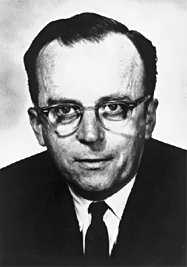
J. C. R. Licklider
Joseph Carl Robnett Licklider (/ˈlɪklaɪdər/; March 11, 1915 – June 26, 1990), known simply as J. C. R. or "Lick", was an American psychologist and computer scientist who is considered to be among the most prominent figures in computer science development and general computing history.
He is particularly remembered for being one of the first to foresee modern-style interactive computing and its application to all manner of activities; and also as an Internet pioneer with an early vision of a worldwide computer network long before it was built. He did much to initiate this by funding research that led to significant advances in computing technology, including today's canonical graphical user interface, and the ARPANET, which is the direct predecessor of the Internet.
Robert Taylor, founder of Xerox PARC's Computer Science Laboratory and Digital Equipment Corporation's Systems Research Center, noted that "most of the significant advances in computer technology—including the work that my group did at Xerox PARC—were simply extrapolations of Lick's vision. They were not really new visions of their own. So he was really the father of it all".
Licklider was born on March 11, 1915, in St. Louis, Missouri. He was the only child of Joseph Parron Licklider, a Baptist minister, and Margaret Robnett Licklider. Despite his father's religious background, he was not religious in later life.
He studied at Washington University in St. Louis, where he received a B.A. with a triple major in physics, mathematics, and psychology in 1937 and an M.A. in psychology in 1938. He received a Ph.D. in psychoacoustics from the University of Rochester in 1942 as well as a Doctorate in Psychology from the University of Rochester, that same year. Thereafter he worked at Harvard University as a research fellow and lecturer in the Psycho-Acoustic Laboratory from 1943 to 1950.
He became interested in information technology, and moved to MIT in 1950 as an associate professor, where he served on a committee that established the MIT Lincoln Laboratory and a psychology program for engineering students. While at MIT, Licklider was involved in the SAGE project as head of the team concerned with human factors. In 1957, he received the Franklin V. Taylor Award from the Society of Engineering Psychologists. In 1958, he was elected President of the Acoustical Society of America, and in 1990 he received the Commonwealth Award for Distinguished Service.
Licklider left MIT to become a vice president at Bolt Beranek and Newman in 1957. He learned about time-sharing from Christopher Strachey at a UNESCO-sponsored conference on Information Processing in Paris in 1959. At BBN, he developed the BBN Time-Sharing System and conducted the first public demonstration of time-sharing.
In October 1962, Licklider was appointed head of the Information Processing Techniques Office (IPTO) at ARPA, the United States Department of Defense Advanced Research Projects Agency, an appointment he kept through July 1964. In April 1963, he sent a memo to his colleagues in outlining the early challenges presented in establishing a time-sharing network of computers with the software of that time. Ultimately his vision led to ARPANET, the precursor of today's Internet.
Hub AI
J. C. R. Licklider AI simulator
(@J. C. R. Licklider_simulator)
J. C. R. Licklider
Joseph Carl Robnett Licklider (/ˈlɪklaɪdər/; March 11, 1915 – June 26, 1990), known simply as J. C. R. or "Lick", was an American psychologist and computer scientist who is considered to be among the most prominent figures in computer science development and general computing history.
He is particularly remembered for being one of the first to foresee modern-style interactive computing and its application to all manner of activities; and also as an Internet pioneer with an early vision of a worldwide computer network long before it was built. He did much to initiate this by funding research that led to significant advances in computing technology, including today's canonical graphical user interface, and the ARPANET, which is the direct predecessor of the Internet.
Robert Taylor, founder of Xerox PARC's Computer Science Laboratory and Digital Equipment Corporation's Systems Research Center, noted that "most of the significant advances in computer technology—including the work that my group did at Xerox PARC—were simply extrapolations of Lick's vision. They were not really new visions of their own. So he was really the father of it all".
Licklider was born on March 11, 1915, in St. Louis, Missouri. He was the only child of Joseph Parron Licklider, a Baptist minister, and Margaret Robnett Licklider. Despite his father's religious background, he was not religious in later life.
He studied at Washington University in St. Louis, where he received a B.A. with a triple major in physics, mathematics, and psychology in 1937 and an M.A. in psychology in 1938. He received a Ph.D. in psychoacoustics from the University of Rochester in 1942 as well as a Doctorate in Psychology from the University of Rochester, that same year. Thereafter he worked at Harvard University as a research fellow and lecturer in the Psycho-Acoustic Laboratory from 1943 to 1950.
He became interested in information technology, and moved to MIT in 1950 as an associate professor, where he served on a committee that established the MIT Lincoln Laboratory and a psychology program for engineering students. While at MIT, Licklider was involved in the SAGE project as head of the team concerned with human factors. In 1957, he received the Franklin V. Taylor Award from the Society of Engineering Psychologists. In 1958, he was elected President of the Acoustical Society of America, and in 1990 he received the Commonwealth Award for Distinguished Service.
Licklider left MIT to become a vice president at Bolt Beranek and Newman in 1957. He learned about time-sharing from Christopher Strachey at a UNESCO-sponsored conference on Information Processing in Paris in 1959. At BBN, he developed the BBN Time-Sharing System and conducted the first public demonstration of time-sharing.
In October 1962, Licklider was appointed head of the Information Processing Techniques Office (IPTO) at ARPA, the United States Department of Defense Advanced Research Projects Agency, an appointment he kept through July 1964. In April 1963, he sent a memo to his colleagues in outlining the early challenges presented in establishing a time-sharing network of computers with the software of that time. Ultimately his vision led to ARPANET, the precursor of today's Internet.
Recent media