
Recent from talks
James George Frazer
Knowledge base stats:
Talk channels stats:
Members stats:
James George Frazer
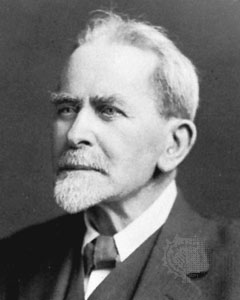
Sir James George Frazer OM FRS FRSE FBA (/ˈfreɪzər/; 1 January 1854 – 7 May 1941) was a Scottish social anthropologist and folklorist influential in the early stages of the modern studies of mythology and comparative religion.
Frazer was born on 1 January 1854 in Glasgow, Scotland, the son of Katherine Brown and Daniel F. Frazer, a chemist. He attended school at Springfield Academy and Larchfield Academy in Helensburgh. He studied at the University of Glasgow and Trinity College, Cambridge, where he graduated with honours in classics (his dissertation was published years later as The Growth of Plato's Ideal Theory) and remained a Classics Fellow all his life. From Trinity, he went on to study law at the Middle Temple, but never practised.
Four times elected to Trinity's Title Alpha Fellowship, he was associated with the college for most of his life, except for the year 1907–1908, spent at the University of Liverpool. He was knighted in 1914, and a public lectureship in social anthropology at the universities of Cambridge, Oxford, Glasgow and Liverpool was established in his honour in 1921. He was, if not blind, then severely visually impaired from 1930 on. He and his wife, Lilly, died in Cambridge, England, within a few hours of each other on 7 May 1941. They are buried at the St Giles aka Ascension Parish Burial Ground in Cambridge.
Frazer is commonly interpreted as an atheist in light of his criticism of Christianity and especially Roman Catholicism in The Golden Bough. However, his later writings and unpublished materials suggest an ambivalent relationship with Neoplatonism and Hermeticism.
In 1896 Frazer married Elizabeth "Lilly" Grove, a writer whose father was from Alsace. She would later adapt Frazer's Golden Bough as a book of children's stories, The Leaves from the Golden Bough. His sister Isabella Katherine Frazer married the mathematician John Steggall.
The study of myth and religion became his areas of expertise. Except for visits to Italy and Greece, Frazer did not widely travel. His prime sources of data were ancient histories and questionnaires mailed to missionaries and imperial officials all over the globe. Frazer's interest in social anthropology was aroused by reading E. B. Tylor's Primitive Culture (1871) and was also encouraged by his friend, the biblical scholar William Robertson Smith, who was comparing elements of the Old Testament with early Hebrew folklore.
Frazer was the first scholar to describe in detail the relations between myths and rituals. His vision of the annual sacrifice of the Year-King has not been borne out by field studies. Yet The Golden Bough, his study of ancient cults, rites, and myths, including their parallels in early Christianity, continued for many decades to be studied by modern mythographers for its detailed information.
The first edition, in two volumes, was published in 1890; and a second, in three volumes, in 1900. The third edition was finished in 1915 and ran to twelve volumes, with a supplemental thirteenth volume added in 1936. He published a single-volume abridged version, largely compiled by his wife Lady Frazer, in 1922, with some controversial material on Christianity excluded from the text. The work's influence extended well beyond the conventional bounds of academia, inspiring the new work of psychologists and psychiatrists. Sigmund Freud, the founder of psychoanalysis, cited Totemism and Exogamy frequently in his own Totem and Taboo: Resemblances Between the Psychic Lives of Savages and Neurotics.
Hub AI
James George Frazer AI simulator
(@James George Frazer_simulator)
James George Frazer
Sir James George Frazer OM FRS FRSE FBA (/ˈfreɪzər/; 1 January 1854 – 7 May 1941) was a Scottish social anthropologist and folklorist influential in the early stages of the modern studies of mythology and comparative religion.
Frazer was born on 1 January 1854 in Glasgow, Scotland, the son of Katherine Brown and Daniel F. Frazer, a chemist. He attended school at Springfield Academy and Larchfield Academy in Helensburgh. He studied at the University of Glasgow and Trinity College, Cambridge, where he graduated with honours in classics (his dissertation was published years later as The Growth of Plato's Ideal Theory) and remained a Classics Fellow all his life. From Trinity, he went on to study law at the Middle Temple, but never practised.
Four times elected to Trinity's Title Alpha Fellowship, he was associated with the college for most of his life, except for the year 1907–1908, spent at the University of Liverpool. He was knighted in 1914, and a public lectureship in social anthropology at the universities of Cambridge, Oxford, Glasgow and Liverpool was established in his honour in 1921. He was, if not blind, then severely visually impaired from 1930 on. He and his wife, Lilly, died in Cambridge, England, within a few hours of each other on 7 May 1941. They are buried at the St Giles aka Ascension Parish Burial Ground in Cambridge.
Frazer is commonly interpreted as an atheist in light of his criticism of Christianity and especially Roman Catholicism in The Golden Bough. However, his later writings and unpublished materials suggest an ambivalent relationship with Neoplatonism and Hermeticism.
In 1896 Frazer married Elizabeth "Lilly" Grove, a writer whose father was from Alsace. She would later adapt Frazer's Golden Bough as a book of children's stories, The Leaves from the Golden Bough. His sister Isabella Katherine Frazer married the mathematician John Steggall.
The study of myth and religion became his areas of expertise. Except for visits to Italy and Greece, Frazer did not widely travel. His prime sources of data were ancient histories and questionnaires mailed to missionaries and imperial officials all over the globe. Frazer's interest in social anthropology was aroused by reading E. B. Tylor's Primitive Culture (1871) and was also encouraged by his friend, the biblical scholar William Robertson Smith, who was comparing elements of the Old Testament with early Hebrew folklore.
Frazer was the first scholar to describe in detail the relations between myths and rituals. His vision of the annual sacrifice of the Year-King has not been borne out by field studies. Yet The Golden Bough, his study of ancient cults, rites, and myths, including their parallels in early Christianity, continued for many decades to be studied by modern mythographers for its detailed information.
The first edition, in two volumes, was published in 1890; and a second, in three volumes, in 1900. The third edition was finished in 1915 and ran to twelve volumes, with a supplemental thirteenth volume added in 1936. He published a single-volume abridged version, largely compiled by his wife Lady Frazer, in 1922, with some controversial material on Christianity excluded from the text. The work's influence extended well beyond the conventional bounds of academia, inspiring the new work of psychologists and psychiatrists. Sigmund Freud, the founder of psychoanalysis, cited Totemism and Exogamy frequently in his own Totem and Taboo: Resemblances Between the Psychic Lives of Savages and Neurotics.
Recent media