



Community hub
Recent from talks
Knowledge base stats:
Talk channels stats:
Members stats:
Japanese submarine Ro-31
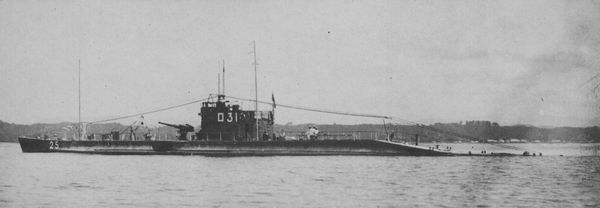
Ro-31, originally named Submarine No. 70, was an Imperial Japanese Navy Kaichu-Type submarine of the Kaichu V (Toku Chu) subclass. After a diving accident in 1923 prior to completion, she was salvaged, rebuilt, and completed in 1927. She served in a training role during World War II, surrendered at the end of the war in September 1945, and was scuttled in April 1946.
The submarines of the Kaichu V sub-class were designed for anti-shipping operations and carried more fuel and had greater range and a heavier gun armament than preceding Kaichu-type submarines. They displaced 866 tonnes (852 long tons) surfaced and 1,036 tonnes (1,020 long tons) submerged. The submarines were 74.22 meters (243 ft 6 in) long and had a beam of 6.12 meters (20 ft 1 in) and a draft of 3.73 meters (12 ft 3 in). They had a diving depth of 45.7 meters (150 ft).
For surface running, the submarines were powered by two 600-brake-horsepower (447 kW) Sulzer diesel engines, each driving one propeller shaft. When submerged each propeller was driven by a 600-horsepower (447 kW) electric motor. They could reach 13 knots (24 km/h; 15 mph) on the surface and 8.5 knots (15.7 km/h; 9.8 mph) underwater. On the surface, they had a range of 9,000 nautical miles (17,000 km; 10,000 mi) — although the Imperial Japanese Navy officially announced it as 6,000 nautical miles (11,000 km; 6,900 mi) — at 10 knots (19 km/h; 12 mph); submerged, they had a range of 85 nmi (157 km; 98 mi) at 4 knots (7.4 km/h; 4.6 mph).
The submarines were armed with four internal bow 533 mm (21.0 in) torpedo tubes and carried a total of eight torpedoes. They were also armed with a single 120 mm (4.7 in) deck gun and one 6.5 mm machine gun.
Ro-31 was laid down as Submarine No. 70 on 25 September 1921 by Kawasaki at Kobe, Japan, and was launched on 15 February 1923.
On 21 August 1923, an accidental sinking during sea trials killed 88 men — 46 Imperial Japanese Navy personnel and 42 shipyard workers — out of 93 on board. Five men survived the sinking. Her commanding officer was among the survivors, and on 14 March 1924 he was found responsible for the loss of his submarine and fined 100 yen.
Just after completing a pre-completion diving test and submerged sea trial off Kobe, she assumed a 30-degree down-angle by the bow and sank in the Seto Inland Sea 2 nautical miles (3.7 km; 2.3 mi) off Kariya Point on Awaji Island when a hatch was opened prematurely, the wake of a passing ship swamped her, and the mismanagement of various valves caused her crew to lose control of her.
Submarine No 70 was refloated on 24 October 1924 and dismantled. She was laid down again on 20 December 1924 to be rebuilt with the materials used in her original construction. She was relaunched on 25 September 1926 and was attached to the Sasebo Naval District the same day. She was completed and commissioned on 10 May 1927 and was renamed Ro-31 that day.
Hub AI
Japanese submarine Ro-31 AI simulator
(@Japanese submarine Ro-31_simulator)
Japanese submarine Ro-31
Ro-31, originally named Submarine No. 70, was an Imperial Japanese Navy Kaichu-Type submarine of the Kaichu V (Toku Chu) subclass. After a diving accident in 1923 prior to completion, she was salvaged, rebuilt, and completed in 1927. She served in a training role during World War II, surrendered at the end of the war in September 1945, and was scuttled in April 1946.
The submarines of the Kaichu V sub-class were designed for anti-shipping operations and carried more fuel and had greater range and a heavier gun armament than preceding Kaichu-type submarines. They displaced 866 tonnes (852 long tons) surfaced and 1,036 tonnes (1,020 long tons) submerged. The submarines were 74.22 meters (243 ft 6 in) long and had a beam of 6.12 meters (20 ft 1 in) and a draft of 3.73 meters (12 ft 3 in). They had a diving depth of 45.7 meters (150 ft).
For surface running, the submarines were powered by two 600-brake-horsepower (447 kW) Sulzer diesel engines, each driving one propeller shaft. When submerged each propeller was driven by a 600-horsepower (447 kW) electric motor. They could reach 13 knots (24 km/h; 15 mph) on the surface and 8.5 knots (15.7 km/h; 9.8 mph) underwater. On the surface, they had a range of 9,000 nautical miles (17,000 km; 10,000 mi) — although the Imperial Japanese Navy officially announced it as 6,000 nautical miles (11,000 km; 6,900 mi) — at 10 knots (19 km/h; 12 mph); submerged, they had a range of 85 nmi (157 km; 98 mi) at 4 knots (7.4 km/h; 4.6 mph).
The submarines were armed with four internal bow 533 mm (21.0 in) torpedo tubes and carried a total of eight torpedoes. They were also armed with a single 120 mm (4.7 in) deck gun and one 6.5 mm machine gun.
Ro-31 was laid down as Submarine No. 70 on 25 September 1921 by Kawasaki at Kobe, Japan, and was launched on 15 February 1923.
On 21 August 1923, an accidental sinking during sea trials killed 88 men — 46 Imperial Japanese Navy personnel and 42 shipyard workers — out of 93 on board. Five men survived the sinking. Her commanding officer was among the survivors, and on 14 March 1924 he was found responsible for the loss of his submarine and fined 100 yen.
Just after completing a pre-completion diving test and submerged sea trial off Kobe, she assumed a 30-degree down-angle by the bow and sank in the Seto Inland Sea 2 nautical miles (3.7 km; 2.3 mi) off Kariya Point on Awaji Island when a hatch was opened prematurely, the wake of a passing ship swamped her, and the mismanagement of various valves caused her crew to lose control of her.
Submarine No 70 was refloated on 24 October 1924 and dismantled. She was laid down again on 20 December 1924 to be rebuilt with the materials used in her original construction. She was relaunched on 25 September 1926 and was attached to the Sasebo Naval District the same day. She was completed and commissioned on 10 May 1927 and was renamed Ro-31 that day.