


Community hub
Recent from talks
Contribute something
Nothing was collected or created yet.
Jagdstaffel 2
View on Wikipedia| Jasta 2 | |
|---|---|
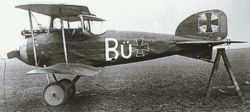
 Jasta 2 Albatross D 1 391/16 (w/n 2944) of Karl Heinrich Büttner downed 16 November 1916 by Cpt. Parker and Lt. Hervey in a B.E.2c | |
| Active | 1916–1918 |
| Country | German Empire |
| Branch | Luftstreitkräfte |
| Type | Fighter squadron |
| Engagements | World War I |
Jasta 2 (Jagdstaffel Zwei in full and also known as Jasta Boelcke) was one of the best-known German Luftstreitkräfte squadrons in World War I. Its first commanding officer was the great aerial tactician Oswald Boelcke, and it was the incubator of several notable aviation careers.
Formation
[edit]
As one of the first Jastas, Jasta 2 had no parent unit and there was therefore no mass transfer of personnel from existing Staffeln. Assigned to the German 1st Army, the unit was created with the intention that Hauptmann Oswald Boelcke would be its leader. Jasta 2 was formed on 10 August 1916 at Bertincourt, France. Boelcke was ordered to return from an inspection tour of south-eastern theatres of the War to take command and arrived back on the Western Front later that month.[citation needed]
After Max Immelmann's death, Kaiser Wilhelm II had ordered Boelcke grounded for a month to avoid losing him in combat soon after Immelmann. He had become such an important hero to the German public, as well as such an authority on aerial warfare, that he could not be risked.[1][2] Given a choice between a desk job and a tour of the Middle East, Boelcke downed a Nieuport over Douaumont on 27 June and reported to headquarters. Boelcke was detailed to share his expertise with the head of German military aviation. What had been known previously as the Deutsches Heer's Fliegertruppen des deutschen Kaiserreiches was being reorganized into the Luftstreitkräfte in mid-1916; this reorganization was inspired by Boelcke.[3] At this time, Boelcke codified his Dicta, promulgating axioms for individual pilot success, as well as a requirement for teamwork directed by a formation's leader. Boelcke also shared his views on creation of a fighter arm, and the organization of fighter squadrons.[2][4]
Boelcke was sent on a tour of the Balkans. He transited Austria to visit Turkey. Upon his return swing, he visited Bulgaria and the Russian Front. Boelcke would be visiting Wilhelm in Kovel when he received a telegram from the head of German aviation, Feldflugchef (Aviation Chief of Staff) Oberstleutnant Hermann von der Lieth-Thomsen, appointing him to raise, organize and command Royal Prussian Jagdstaffel 2.[5] He was given permission to choose his own pilots to form a fighter squadron.[2][3] Among his first selections upon his return were Manfred von Richthofen, Erwin Böhme and Hans Reimann.[3]
Principal Operational Activities
[edit]1916
[edit]Boelcke was appointed commander of Jasta 2 on 30 August 1916. The unit utilised the empty buildings vacated by FFA 32 in the Vélu Woods.
The first aircraft arrived on 1 September; two Fokker DIIIs and an Albatros D.I. By 8 September there were eight pilots on strength, including Manfred von Richthofen, Erwin Böhme and Otto Höhne. Three days later, Böhme noted he was pushing for permission to use his castoff Halberstadt, since Boelcke had a Fokker; there seemed to be four airplanes in the squadron by then.[6] On 16 September, Boelcke's new squadron received five new Albatros D.Is for the pilots, and an improved Albatros D.II for the Staffelführer.[7] Lt. Otto Höhne took his Albatros D.I out on a solo flight that same evening and became the first pilot to down an enemy aircraft with the new model, forcing down a British F.E.2b and capturing the pilot. Boelcke promptly put the new planes in the air on the first-ever fighter unit effort to gain local air superiority. At 1300 hours, 17 September, Boelcke and five of his pilots took off; they intercepted a British bombing raid on Marcoing Railway Station. While Boelcke held aside, his five younger pilots bounced a British formation of 14 planes, broke it up, and shot down two - one being Manfred von Richthofen's first victory, the other falling to Erwin Böhme. Boelcke himself added another.[8] That night, a German army tradition began and a new German air force custom was established when the enlisted men were invited into the Jasta's social center.[9]
Boelcke shot down ten Royal Flying Corps planes in his first month with Jasta 2, September 1916. He would fly a solo mission in the morning and return to his "cubs" for afternoon training.[10] However, in contrast to his freebooting style, his pilots always flew in disciplined formations in practice, and he repeatedly drilled them in his tactics. He not only preached this doctrine to his own "cubs"; he proselytized throughout the Luftstreitkräfte. He wrote upon his ideas, sketched them out, and delivered them in person to other aerodromes. Thus, Jasta 2 became the birthplace of fighter aviation tactics.[11]
Boelcke was killed on 28 October 1916 when his Albatros D.II crashed after colliding with the Albatros D.I of Lt. Erwin Böhme during a dogfight with British aircraft. Oblt. Stefan Kirmaier, who had ten victories of his own, was appointed leadership in his place. Kirmaier's command was to be short-lived; on 22 November, he lost his life after a fight with fliers from No. 24 Squadron. Hpt. Franz Walz arrived from Jasta 29 a week later.
1917
[edit]The unit's 100th claim was during February 1917, and the Jasta then moved to Eswars on 14 March, before arriving at Pronville soon after.
1918
[edit].jpg)
Jasta 2 became part of the new Royal Prussian Jagdgeschwader III in February 1918, under the command of Bruno Loerzer.[12]
Jagdstaffel 2 became the second-highest scoring fighter unit (behind Jasta 11); it ended the war with 23 aces among its ex- and current members, a total of 336 victories and a casualty list of only 44; 31 killed, 9 wounded, 2 prisoners of war, and 2 killed in accidents.[12]
Jasta 2 markings were usually black and white tailplanes and elevators (top and bottom)—one side black, one side white.[12]
Commanding officers (Staffelführer)
[edit]- Hauptmann Oswald Boelcke (27 August to 22 September 1916)
- Oberleutnant Günther Viehweger (acting) (22 September to 23 September 1916)
- Hauptmann Oswald Boelcke (23 September 1916 to 28 October 1916)
- Oberleutnant Stefan Kirmaier (30 October to 22 November 1916)
- Oberleutnant Karl Bodenschatz (acting) (22 November to 29 November 1916)
- Hauptmann Franz Walz (29 November 1916 to 9 June 1917)
- Oberleutnant Fritz Otto Bernert (9 June to 28 June 1917)
- Leutnant Otto Hunzinger (acting) (28 June to 29 June 1917)
- Oberleutnant Fritz Otto Bernert (29 June to 18 August 1917)
- Leutnant Erwin Böhme (18 August to 29 November 1917)
- Leutnant Eberhard Fr. von Gudenburg (acting) (29 November to 13 December 1917)
- Leutnant Walter von Bülow-Bothkamp (13 December 1917 to 6 January 1918)
- Leutnant Max Ritter von Müller (acting) (6 January to 9 January 1918)
- Leutnant Theodor Cammann (acting) (9 January to 26 January 1918)
- Leutnant Otto Höhne (26 January to 20 February 1918)
- Leutnant Carl Bolle (20 February to 4 September 1918)
- Leutnant Otto Löffler (acting) (4 September to 18 September 1918)
- Oberleutnant Karl Bolle (18 September 1918 to Disbandment)[citation needed]
Notable personnel
[edit]23 aces served with Jasta 2 at some time or other. Apart from the Staffelführern listed above, these include the following notables:
Notes
[edit]- ^ Duffy, Michael (22 August 2009). "Who's Who - Oswald Boelcke". firstworldwar.com. Retrieved 6 October 2010.
- ^ a b c Ro§bud. "Dicta Boelcke - Organization of Jagdstaffeln and the demise of Boelcke". Flying Aces. Archived from the original on May 10, 2008. Retrieved 5 October 2010. Via the Internet Archive Wayback Machine.
- ^ a b c "Boelcke, Oswald". www.cartage.org.lb. Archived from the original on 6 June 2011. Retrieved 5 October 2010.
- ^ VanWyngarden. Early German Aces of World War I. pp. 63, 69–70.
- ^ VanWyngarden. Early German Aces of World War I. p. 69.
- ^ VanWyngarden. Early German Aces of World War I. p. 75.
- ^ VanWyngarden. Early German Aces of World War I. p. 77.
- ^ Guttman. Pusher Aces of World War 1. p. 41.
- ^ Guttman. Pusher Aces of World War 1. p. 42.
- ^ VanWyngarden. Early German Aces of World War I. p. 76.
- ^ "Oswald Boelcke". AcePilots. Acepilots.com. Archived from the original on 28 September 2021. Retrieved 6 October 2010.
- ^ a b c Franks, Bailey & Guest 1993, p. 30
References
[edit]- Franks, Norman (2004). Jasta Boelcke: The History of Jasta 2, 1916–18. London: Grub Street. ISBN 1-904010-76-8.
- Franks, Norman L. R.; Bailey, Frank W.; Guest, Russell (1993). Above The Lines: The Aces and Fighter Units of the German Air Service, Naval Air Service and Flanders Marine Corps 1914-1918. Grub Street. ISBN 0-948817-73-9.
- Guttman, Jon (2009). Pusher Aces of World War 1. Aircraft of the Aces 88. Illustrated by Harry Dempsey. Oxford: Osprey Publishing Ltd. ISBN 1-84603-417-5.
- Hoeppner, E. W. von (1994) [1921]. Deutschlands Krieg in der Luft: Ein Rückblick auf die Entwicklung und die Leistungen unserer Heeres-Luftstreitkräfte im Weltkriege [Germany's War in the Air: A Review of the Development and the Achievements of our Army Air Force in the World War] (in German). trans. J. Hawley Larned (Battery Press ed.). Leipzig: K. F. Koehle. ISBN 0-89839-195-4.
- Neumann, G. P. (1920). Die deutschen Luftstreitkräfte im Weltkriege [The German Air Force in the Great War] (in German) (Hodder & Stoughton, London ed.). Berlin: Mittler. OCLC 39823845. Retrieved 18 April 2016.
- VanWyngarden, Greg (2006). Early German Aces of World War I. Aircraft of the Aces 73. Illustrated by Harry Dempsey. Oxford: Osprey Publishing Ltd. ISBN 1-84176-997-5.[permanent dead link]
| Prussian | |
|---|---|
| Bavarian | |
| Saxon | |
| Württembergian | |

Jagdstaffel 2
View on GrokipediaFormation
Establishment
Jagdstaffel 2 (Jasta 2), one of the earliest specialized fighter squadrons in the German Imperial Army Air Service (Luftstreitkräfte), was officially formed on 10 August 1916 at Bertincourt airfield in France, as part of a broader reorganization aimed at countering the growing Allied air superiority on the Western Front.[1] This initiative followed the success of ad hoc fighter detachments earlier in the year and was driven by the need for dedicated units equipped with single-seat fighters to protect reconnaissance aircraft and contest enemy airspace, as one of the first of 37 specialized Jagdstaffeln formed that autumn. The squadron's establishment reflected the Luftstreitkräfte's shift toward tactical air power, emphasizing concentrated fighter operations under experienced leadership.[4] On 30 August 1916, renowned ace Oswald Boelcke was appointed as the squadron's first commanding officer, having been recalled from an inspection tour in other theaters to lead the unit.[5] Boelcke, already credited with 20 aerial victories, hand-selected about 10 promising pilots, including future aces such as Manfred von Richthofen, Erwin Böhme, and Karl Allmenröder, to form the initial roster. The squadron relocated shortly after formation to an aerodrome near the Vélu woods, previously occupied by Feldflieger-Abteilung 32, where it received its first aircraft—a mix of early biplane fighters, including Fokker D.IIs/D.IIIs and Albatros D.Is, with Albatros D.IIs arriving shortly after—to prepare for combat operations.[1][5][6] Jasta 2 was fully mobilized on 1 September 1916, marking the beginning of its operational phase under Boelcke's strict discipline and tactical doctrines, including his famous Dicta Boelcke rules for aerial combat. The unit's establishment was pivotal in establishing local air superiority, as it quickly demonstrated the effectiveness of organized fighter tactics in intercepting Allied formations. Jasta 2 achieved its first victories on 17 September 1916, setting the stage for its reputation as an elite squadron later renamed Jasta Boelcke in honor of its founder following his death on 28 October 1916.[1][5][7]Initial Composition
Jagdstaffel 2, one of the first specialized fighter squadrons in the German Luftstreitkräfte, was officially established on 10 August 1916 at Bertincourt airfield in France, as part of a broader reorganization to counter Allied air superiority. Hauptmann Oswald Boelcke, already a celebrated ace with 20 victories, was appointed commander on 30 August 1916 and tasked with handpicking the unit's personnel from across the air service. Boelcke emphasized selecting experienced and promising aviators capable of executing coordinated tactics, drawing from his own experiences in earlier fighter units.[1][8] The squadron's core initially comprised a small group of pilots, with Boelcke personally recruiting Leutnant Manfred von Richthofen, a former cavalry officer transitioning to fighters, and Leutnant Erwin Böhme, a close friend and fellow ace. Other early members included Leutnant Stefan Kirmaier and Leutnant Hans Imelmann, bringing diverse backgrounds from observation and bombing roles. Reaching operational strength of about 10-12 pilots by early September 1916, the unit enabled its first patrols over the Somme front. This selective composition fostered a tight-knit group under Boelcke's mentorship, where he instituted the "Dicta Boelcke"—ten rules for aerial combat that became foundational for German fighter tactics.[8][9][10] In terms of equipment, Jasta 2 began operations on 1 September 1916 with a modest allocation of single-seat fighters, primarily twin-gun Albatros D.II scouts, which offered superior speed and firepower compared to earlier monoplanes. These aircraft, supplemented by a few Fokker D.II biplanes in the opening weeks, allowed the squadron to achieve local air dominance quickly, with Boelcke claiming several victories in his personally assigned Albatros. The initial logistics were supported by ground crews transferred from Feldflieger-Abteilung 32, ensuring rapid deployment near Vélu woods. This combination of elite personnel and reliable fighters positioned Jasta 2 for its pivotal role in the 1916 air battles.[3][9][6]Operational History
1916
Jagdstaffel 2, commonly known as Jasta 2, was officially formed on 10 August 1916 at Bertincourt airfield in France, as part of the German Luftstreitkräfte's expansion of specialized fighter units to counter Allied air superiority during the Battle of the Somme.[11] Under the command of Hauptmann Oswald Boelcke, appointed on 30 August, the squadron mobilized on 1 September and relocated to Vélu woods, inheriting facilities from Feldflieger-Abteilung 32.[8] Boelcke, already a renowned ace with 19 victories, emphasized tactical discipline through his "Dicta Boelcke" principles, training pilots in formation flying and cooperative combat to maximize effectiveness against numerically superior foes.[12] The squadron's operations commenced with its first patrol on 17 September, where it achieved an immediate impact by intercepting a British bombing raid, marking Jasta 2 as the first German unit to establish local air superiority over the Somme front.[8] Boelcke personally claimed the unit's inaugural victory on 2 September—his 20th overall—downing a Royal Flying Corps (RFC) aircraft, and by 14 September, he had secured five victories with the Jasta, pioneering the concept of squadron-based scoring.[13] Equipped initially with five Albatros D.I fighters and a prototype D.II arriving on 16 September, the squadron conducted aggressive patrols, focusing on escorting reconnaissance missions and ambushing Allied two-seaters. In its debut month of September, Boelcke alone downed ten RFC planes, while the unit as a whole contributed to disrupting British air operations.[14] By late September, Jasta 2 shifted bases to Lagnicourt on 22 September, continuing intensive sorties amid the escalating Somme offensive. The squadron amassed 85 confirmed victories between 2 September and 31 December, with Boelcke adding 21 more kills during September and October, solidifying his status as the leading ace.[12] However, operations incurred early losses; Leutnant Stefan Kirmaier, a pre-war pilot with ten personal victories, assumed temporary command after Boelcke's death but was himself killed in action on 22 November when his Albatros was shot down by RFC pilot James McCudden.[6] Tragedy struck on 28 October during a patrol against a mixed British and French formation, including Major Lanoe Hawker's No. 24 Squadron, when Boelcke's Albatros D.II collided mid-air with that of his protégé Leutnant Erwin Böhme, resulting in Boelcke's fatal crash near Bapaume.[15] This loss profoundly impacted morale, yet the squadron persisted, honoring Boelcke by renaming itself Jagdstaffel Boelcke on 17 December 1916, a designation that underscored its pioneering role in organized fighter tactics.[11] Throughout 1916, Jasta 2's disciplined approach shifted the aerial balance, claiming dozens of enemy aircraft and balloons while suffering initial casualties that highlighted the risks of frontline combat.[8]1917
In early 1917, Jagdstaffel 2, operating primarily from Pronville aerodrome, continued its patrols over the Western Front amid the ongoing Battle of Arras. The squadron achieved its 100th confirmed aerial victory in February, reflecting sustained effectiveness in intercepting Allied reconnaissance and bombing missions despite increasing enemy air activity. Under the command of Leutnant Franz Walz, who had led since late 1916, the unit focused on defensive operations supporting German ground forces, though internal tensions arose due to Walz's leadership style, culminating in his transfer on June 9 at the request of subordinate pilots.[3] Command passed to Oberleutnant Fritz Otto Bernert on June 9, a highly experienced pilot with prior victories who revitalized the squadron's morale and tactics. Bernert, who had joined Jasta 2 in February 1917, quickly added to his personal tally, scoring multiple victories while emphasizing coordinated formations inspired by Oswald Boelcke's doctrines. The unit remained at Pronville until late July, conducting offensive patrols that disrupted British Royal Flying Corps efforts during spring offensives. By mid-1917, Jasta 2 had contributed significantly to German air superiority in its sector, with pilots like Leutnant Werner Voss amassing notable successes—Voss alone claimed over 20 victories during his tenure from late 1916 through September 1917.[16] In August, following Bernert's wounding on August 18—which ended his flying career after 27 total victories—the squadron relocated northward to support operations in Flanders. Bases shifted rapidly: La Petrie (August 1–6), Bisseghem (August 7–11), Ghistelles (August 12–26), Varsenaere (August 27–September 30), and Rumbeke (October 1–November 12). Leutnant Erwin Böhme assumed command on August 18, bringing his 24 career victories and close association with Boelcke to the role; under his leadership, the unit engaged in intense combats during the Third Battle of Ypres, targeting Allied aircraft and balloons. Böhme's tenure ended tragically on November 29 when he was killed in action while pursuing a British two-seater, marking a significant loss amid the squadron's ongoing efforts to counter growing Allied numerical advantages.[17][18][1]1918
In early 1918, Jagdstaffel 2 was integrated into the newly formed Jagdgeschwader 3 (JG 3) on 2 February, operating under the overall command of Bruno Loerzer as part of the German Luftstreitkräfte's reorganization to counter Allied air superiority.[19] Known as Jasta Boelcke, the squadron relocated frequently to support ground operations during the German Spring Offensive (Operation Michael), beginning at Marcke airfield on 16 February before moving to Erchin on 15 March and Halluin on 15 April.[1] Command of Jasta 2 passed to Oberleutnant Karl Bolle on 20 February, who led the unit through much of the year while adding 22 personal victories, including four S.E.5a and Sopwith Snipe fighters on 4 November near Englefontaine and Tournai during the final Allied push.[20] During March and April, Jasta 2 pilots engaged in intense patrols over the Somme and Lys sectors, claiming multiple Allied aircraft amid the chaos of the offensive; for instance, Leutnant Otto Löffler downed a Bréguet 14 west of Champs on 21 August while flying a Fokker D.VII.[21] The squadron transitioned to defensive operations by summer, basing at Vivaise in late May and Chambry from 30 June, where it faced increasing pressure from British and French formations. Leutnant Paul Bäumer, who joined in late 1917, emerged as a standout ace, scoring 21 confirmed victories between September and October, including three D.H.9s on 21 September east of Bourlon Wood, Lagnicourt, and Morchies, often in Fokker D.VIIs marked with his distinctive "teeth" motif on the cowling.[22] Löffler, temporarily commanding from 4 to 18 September, added 13 victories that year, such as three Sopwith Camels on 2 September south of Pelves and Palluel.[21] As Allied counteroffensives intensified in the Hundred Days Offensive from August onward, Jasta 2 shifted bases rapidly— to Emerchicourt in late August, Lieu St. Armand and Spultier in September, and finally Aniche by 9 November—conducting low-level intercepts against superior numbers. Bolle resumed command on 18 September, leading until the armistice on 11 November.[1] The squadron suffered losses reflecting the escalating attrition. By war's end, Jasta 2's contributions helped JG 3 claim numerous successes, with the squadron's overall tally reaching 333 aerial victories against 44 losses, underscoring its elite status second only to Jagdgeschwader 1.[8]Personnel
Commanding Officers
Jagdstaffel 2, renowned as Jasta Boelcke after its inaugural commander, underwent multiple leadership changes during its service in World War I, reflecting the high attrition rates among German fighter pilots. The squadron's commanding officers, or Staffelführer, were typically experienced aces who shaped its tactical approach and combat effectiveness.[1] The following table lists the successive commanders, their tenures, and key details such as aerial victories where applicable:| Commander | Tenure | Notes |
|---|---|---|
| Oswald Boelcke | 30 August 1916 – 28 October 1916 | Founder and first commander; 40 victories; squadron renamed Jasta Boelcke in his honor on 17 December 1916 following his death in a mid-air collision.[1][23] |
| Stefan Kirmaier | 30 October 1916 – 22 November 1916 | Interim leader; 8 victories; killed in action.[1] |
| Karl Bodenschatz | 22 November 1916 – 29 November 1916 | Brief tenure as adjutant; later served as chief-of-staff to Manfred von Richthofen; no confirmed victories.[1] |
| Franz Walz | 29 November 1916 – 9 June 1917 | 7 victories; wounded multiple times.[1][24] |
| Otto Bernert | 9 June 1917 – 18 August 1917 | 27 victories (achieved across units); Pour le Mérite recipient; transferred due to illness.[1] |
| Erwin Böhme | 18 August 1917 – 29 November 1917 | 24 victories; close associate of Boelcke; killed in action.[1] |
| Eberhard von Gudenberg | 29 November 1917 – 13 December 1917 | No confirmed victories; short tenure.[1] |
| Walter von Bülow-Bothkamp | 13 December 1917 – 6 January 1918 | 28 victories; Pour le Mérite; killed in action shortly after leaving command.[1] |
| Max von Müller | 6 January 1918 – 9 January 1918 | 36 victories; brief acting role.[1][25] |
| Theodor Cammann | 11 January 1918 – 26 January 1918 | 12 victories; wounded in action.[1][26] |
| Otto Höhne | 26 January 1918 – 20 February 1918 | 6 victories; later commanded other units.[1] |
| Karl Bolle | 20 February 1918 – 4 September 1918 (returned 18 September 1918 – 11 November 1918) | 36 victories; longest-serving commander; Pour le Mérite.[1][20] |
| Otto Löffler | 4 September 1918 – 18 September 1918 | 15 victories; temporary replacement.[1] |
Notable Members
Jagdstaffel 2, later renamed Jasta Boelcke in honor of its founding commander, produced numerous distinguished pilots during World War I, with 25 aces credited to its ranks by war's end.[1] The squadron's early emphasis on disciplined tactics under Boelcke fostered an environment where several members achieved significant aerial successes and later commanded other units. Oswald Boelcke, the squadron's inaugural commander from 30 August 1916 until his death, was a pioneering fighter pilot with 40 confirmed victories.[23] Awarded the Pour le Mérite in January 1916 for his pre-Jasta exploits, Boelcke's "Dicta Boelcke"—a set of nine tactical principles—shaped German air combat doctrine and influenced all subsequent pilots in the unit. He was killed on 28 October 1916 in a mid-air collision with fellow Jasta 2 pilot Erwin Böhme during combat near Bapaume.[23] Manfred von Richthofen, who joined Jasta 2 on 1 October 1916, scored his first 16 victories with the squadron before transferring to command Jasta 11 in March 1917. As the "Red Baron," Richthofen amassed 80 total victories and became the highest-scoring ace of the war, crediting much of his early success to Boelcke's mentorship during his time in Jasta 2. Erwin Böhme, a close friend of Boelcke and his frequent wingman, achieved 24 victories while serving in Jasta 2 from October 1916 to July 1917, earning the Pour le Mérite in April 1917.[18] Transferred to command Jasta 29, Böhme was killed in action on 29 November 1917 near Westrozebeke.[18] Fritz Otto Bernert commanded Jasta 2 from June to August 1917, adding to his 27 victories (most scored earlier with Jasta 5) and receiving the Pour le Mérite in May 1917.[17] Severely wounded in August 1917, he ended his flying career but later influenced aviation through administrative roles.[17] Max Ritter von Müller, who flew with Jasta 2 in 1917, tallied 36 victories overall, including several with the squadron, and was awarded the Pour le Mérite in October 1917.[25] He went on to command Jasta 28 and contributed to the development of later German fighter tactics.[25] Other notable members included Werner Voss (48 victories), who served briefly in 1917 and became a leading ace; Paul Bäumer (43 victories), a high-scoring pilot in 1918; Ernst Bormann (23 victories); Otto Höhne (6 victories), an early pilot who survived the war and later flew in the 1930s; and Karl Bolle (36 victories), who commanded Jasta 2 from February 1918 until the armistice.[1][27] The squadron's legacy extended beyond individual scores, as many alumni, including Hans Imelmann (6 victories) and Erich König (6 victories), rose to lead other Jastas, perpetuating Boelcke's tactical innovations.[1]Equipment and Deployment
Aircraft Used
Jagdstaffel 2, formed in August 1916, began operations with a limited number of aircraft suited to the emerging role of specialized fighter squadrons in the German Luftstreitkräfte. The initial equipment included two Fokker D.IIIs and one Albatros D.I, which arrived on 1 September 1916, providing the squadron with its first single-seat fighters capable of offensive patrols over the Western Front.[28][29] The Fokker D.III, a biplane powered by an Oberursel U.III rotary engine of 160 horsepower, was armed with twin synchronized 7.92 mm LMG 08/15 machine guns and marked an early shift from tractor to pusher configurations in German fighters, though its handling was challenged by engine torque and limited visibility.[28] Notably, serial number 352/16, flown by squadron commander Oswald Boelcke, accounted for the unit's first seven victories between 2 and 17 September 1916.[28] By mid-September 1916, the squadron expanded to include Albatros D.IIs, which supplemented and gradually replaced the initial mix, offering improved pilot visibility through a modified upper wing design while retaining the Mercedes D.III inline engine and dual machine-gun armament of its D.I predecessor.[29] These sesquiplane biplanes, with a maximum speed of around 165 km/h and better climb rates, enabled Jasta 2 to conduct coordinated formation tactics that Boelcke pioneered, contributing to the squadron's rapid accumulation of aerial victories during the Battle of the Somme.[29] Halberstadt D.IIs may have also been employed briefly in the early months for familiarization, as they were common in the initial outfitting of new Jastas, though specific assignments to Jasta 2 remain less documented. In 1917, as German fighter technology advanced, Jasta 2 standardized on the Albatros D.III, a refined sesquiplane with enhanced streamlining and the same 160 hp Mercedes engine, achieving speeds up to 175 km/h and serving as the backbone of operations through much of the year.[3] This aircraft, often produced by Ostdeutsche Albatros-Werke (OAW) variants for better build quality, was flown by aces such as Werner Voss in June 1917 and supported the squadron's defensive patrols against superior Allied numbers.[30] Toward late 1917, the unit began incorporating Fokker Dr.I triplanes, known for their exceptional maneuverability in dogfights, though these were used selectively alongside Albatros types until structural issues prompted a shift.[3] By early 1918, under commanders like Karl Bolle, Jasta 2—then attached to Jagdgeschwader III—fully transitioned to the Fokker D.VII, Germany's most advanced production fighter of the war, featuring a 185 hp BMW IIIa engine, robust construction, and superior high-altitude performance that allowed it to outperform many Allied scouts.[3] Equipped with twin Spandau machine guns, the D.VII enabled the squadron to maintain offensive superiority during the Spring Offensive, with aircraft often personalized with victory tallies before surrender to the Allies in November 1918.[3] Throughout its service, Jasta 2's equipment evolution reflected broader Luftstreitkräfte priorities, prioritizing firepower, synchronization, and tactical flexibility over sheer numbers.Bases and Logistics
Jagdstaffel 2, also known as Jasta Boelcke, operated from a series of forward aerodromes on the Western Front throughout World War I, relocating frequently to align with the shifting lines of the German Army and maintain proximity to combat zones. These bases were typically improvised or repurposed airfields, often consisting of grass landing strips, tents, and rudimentary hangars, supported by the Luftstreitkräfte's broader infrastructure of repair shops, fuel depots, and meteorological stations. The squadron's initial base was at Bertincourt from 10 August to 26 August 1916, followed by Vélu from 27 August to 21 September 1916, where it took over facilities previously used by Feldflieger-Abteilung 32, including empty buildings in the Vélu Woods.[1][8] Subsequent relocations reflected the dynamic frontline, with Jasta 2 moving to Lagnicourt from 22 September 1916 to 4 December 1916, Pronville from 5 December 1916 to 13 March 1917 and again from 23 March to 31 July 1917, and a brief stint at Eswars from 14 March to 22 March 1917. In mid-1917, as operations intensified along the Flanders sector, the squadron shifted to La Petrie (1–6 August 1917), Bisseghem (7–11 August 1917), Ghistelles (12–26 August 1917), Varsenaere (27 August–30 September 1917), Rumbeke (1 October–12 November 1917), and Bavichove (13 November 1917–15 February 1918). By 1918, following integration into Jagdgeschwader 3, bases included further advances such as Marckebeke, Guizecourt, and ultimately Aniche from 9 to 11 November 1918, totaling 24 distinct locations over the war.[1]| Period | Base Location | Duration |
|---|---|---|
| August 1916 | Bertincourt | 10 Aug – 26 Aug |
| August–September 1916 | Vélu | 27 Aug – 21 Sep |
| September–December 1916 | Lagnicourt | 22 Sep – 4 Dec |
| December 1916–March 1917 | Pronville | 5 Dec – 13 Mar |
| March 1917 | Eswars | 14 Mar – 22 Mar |
| March–July 1917 | Pronville (return) | 23 Mar – 31 Jul |
| August 1917 | La Petrie | 1 Aug – 6 Aug |
| August 1917 | Bisseghem | 7 Aug – 11 Aug |
| August 1917 | Ghistelles | 12 Aug – 26 Aug |
| August–September 1917 | Varsenaere | 27 Aug – 30 Sep |
| October–November 1917 | Rumbeke | 1 Oct – 12 Nov |
| November 1917–February 1918 | Bavichove | 13 Nov – 15 Feb |
| 1918 (selected) | Various (e.g., Marckebeke, Aniche) | Up to 11 Nov |