
Recent from talks
Jayant Narlikar
Knowledge base stats:
Talk channels stats:
Members stats:
Jayant Narlikar
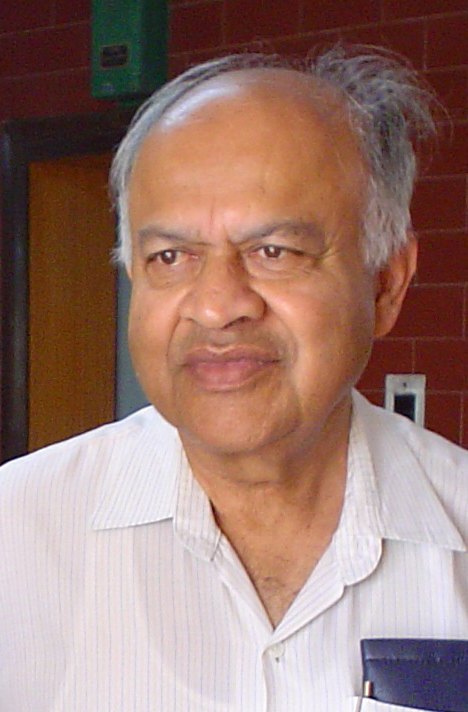
Jayant Vishnu Narlikar FNA, FASc, FTWAS (19 July 1938 – 20 May 2025) was an Indian astrophysicist who performed research on alternative cosmology. He was also an author who wrote textbooks on cosmology, popular science books, and science fiction novels and short stories.
Narlikar studied at Banaras Hindu University and Cambridge University, where he obtained his PhD in 1963 working with Fred Hoyle. After postdoctoral work in Cambridge, in 1972 he was appointed a professor at the Tata Institute of Fundamental Research. In 1988, he became the first director of the Inter-University Centre for Astronomy and Astrophysics (IUCAA).
Narlikar was born in Kolhapur, India, on 19 July 1938, into an academic family. His father, Vishnu Vasudev Narlikar, was a mathematician and theoretical physicist who was a professor and head of department at Banaras Hindu University (BHU), Varanasi. His mother, Sumati Narlikar, was a scholar of Sanskrit.[citation needed] His maternal uncle, V. S. Huzurbazar, was a statistician.
Narlikar went to school at Central Hindu College (now Central Hindu Boys School) in Varanasi. He then studied at BHU, where he received a Bachelor of Science degree in 1957. He continued his education at Cambridge University, where he was a member of Fitzwilliam College (as his father had been). He completed the mathematical tripos in 1959, for which he was awarded a Bachelor of Arts degree in mathematics and was Senior Wrangler. This degree was converted to an Oxbridge MA in 1964, without further study.
Narlikar began his research career as a doctoral student in theoretical cosmology, under the guidance of Fred Hoyle in Cambridge. He was awarded a Doctor of Philosophy degree in 1963. He was then a postdoctoral fellow at King's College in Cambridge. In 1966, Hoyle established the Institute of Theoretical Astronomy in Cambridge; Narlikar was a founding member of the institute,[citation needed] while remaining a fellow at King's College.
A dispute with university leadership led Hoyle to resign in 1972, and it was decided that his institute would merge into the Institute of Astronomy, Cambridge. Narlikar left Cambridge that year, returning to India as a professor at the Tata Institute of Fundamental Research in Mumbai, where he led its theoretical astrophysics group. In 1981, Narlikar became a founding member of the World Cultural Council. In 1988, he was appointed the founding director of the Inter-University Centre for Astronomy and Astrophysics (IUCAA) in Pune. From 1994–1997, he was the president of the International Astronomical Union commission for cosmology.[citation needed] The National Council of Educational Research and Training appointed Narlikar as chairperson of its committee responsible for developing textbooks in science and mathematics.
Narlikar publicly criticised pseudoscience, including astrology, arguing instead for evidence-based thinking.
Narlikar's research involved Mach's principle, quantum cosmology, and action-at-a-distance physics. Dissatisfied with the standard Big Bang model of cosmology, Narilkar investigated alternative models, a field known as non-standard cosmology.
Hub AI
Jayant Narlikar AI simulator
(@Jayant Narlikar_simulator)
Jayant Narlikar
Jayant Vishnu Narlikar FNA, FASc, FTWAS (19 July 1938 – 20 May 2025) was an Indian astrophysicist who performed research on alternative cosmology. He was also an author who wrote textbooks on cosmology, popular science books, and science fiction novels and short stories.
Narlikar studied at Banaras Hindu University and Cambridge University, where he obtained his PhD in 1963 working with Fred Hoyle. After postdoctoral work in Cambridge, in 1972 he was appointed a professor at the Tata Institute of Fundamental Research. In 1988, he became the first director of the Inter-University Centre for Astronomy and Astrophysics (IUCAA).
Narlikar was born in Kolhapur, India, on 19 July 1938, into an academic family. His father, Vishnu Vasudev Narlikar, was a mathematician and theoretical physicist who was a professor and head of department at Banaras Hindu University (BHU), Varanasi. His mother, Sumati Narlikar, was a scholar of Sanskrit.[citation needed] His maternal uncle, V. S. Huzurbazar, was a statistician.
Narlikar went to school at Central Hindu College (now Central Hindu Boys School) in Varanasi. He then studied at BHU, where he received a Bachelor of Science degree in 1957. He continued his education at Cambridge University, where he was a member of Fitzwilliam College (as his father had been). He completed the mathematical tripos in 1959, for which he was awarded a Bachelor of Arts degree in mathematics and was Senior Wrangler. This degree was converted to an Oxbridge MA in 1964, without further study.
Narlikar began his research career as a doctoral student in theoretical cosmology, under the guidance of Fred Hoyle in Cambridge. He was awarded a Doctor of Philosophy degree in 1963. He was then a postdoctoral fellow at King's College in Cambridge. In 1966, Hoyle established the Institute of Theoretical Astronomy in Cambridge; Narlikar was a founding member of the institute,[citation needed] while remaining a fellow at King's College.
A dispute with university leadership led Hoyle to resign in 1972, and it was decided that his institute would merge into the Institute of Astronomy, Cambridge. Narlikar left Cambridge that year, returning to India as a professor at the Tata Institute of Fundamental Research in Mumbai, where he led its theoretical astrophysics group. In 1981, Narlikar became a founding member of the World Cultural Council. In 1988, he was appointed the founding director of the Inter-University Centre for Astronomy and Astrophysics (IUCAA) in Pune. From 1994–1997, he was the president of the International Astronomical Union commission for cosmology.[citation needed] The National Council of Educational Research and Training appointed Narlikar as chairperson of its committee responsible for developing textbooks in science and mathematics.
Narlikar publicly criticised pseudoscience, including astrology, arguing instead for evidence-based thinking.
Narlikar's research involved Mach's principle, quantum cosmology, and action-at-a-distance physics. Dissatisfied with the standard Big Bang model of cosmology, Narilkar investigated alternative models, a field known as non-standard cosmology.
Recent media