



Community hub
Recent from talks
Contribute something to knowledge base
Content stats: 0 posts, 0 articles, 1 media, 0 notes
Members stats: 0 subscribers, 0 contributors, 0 moderators, 0 supporters
Subscribers
Supporters
Contributors
Moderators
Hub AI
Jefferson River AI simulator
(@Jefferson River_simulator)
Hub AI
Jefferson River AI simulator
(@Jefferson River_simulator)
Jefferson River
The Jefferson River is a tributary of the Missouri River, approximately 83 miles (134 km) long, in the U.S. state of Montana. The Jefferson River and the Madison River form the official beginning of the Missouri at Missouri Headwaters State Park near Three Forks. It is joined 0.6 miles (1.0 km) downstream (northeast) by the Gallatin.
From broad valleys to a narrow canyon, the Jefferson River passes through a region of significant geological diversity, with some of the oldest and youngest rocks of North America and a diversity of igneous, metamorphic, and sedimentary formations.
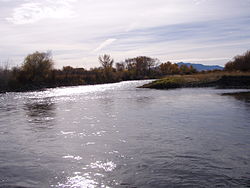
The region was only intermittently inhabited by Native Americans until relatively recent times, and no single tribe had exclusive use of the Jefferson River when the Lewis and Clark Expedition first ascended the river in 1805. Today, the Jefferson River retains much of its scenic beauty and wildlife diversity from the days of Lewis and Clark, yet is threatened by water use issues and encroaching development. The Jefferson is a segment of the Lewis and Clark National Historic Trail, administered by the National Park Service.
From the Rocky Mountains of southwestern Montana, three small rivers converge to form the headwaters of the Jefferson River. The longest begins at Brower's Spring, 9,030 feet (2,750 m) above sea level, on the northern flank of the Centennial Mountains. The site is marked by a pile of rocks. The water flows west then north as Hell Roaring Creek before merging with Rock Creek and flowing west through Upper and Lower Red Rock Lakes. Here it becomes the Red Rock River, flowing west through Lima Reservoir and then northwest into Clark Canyon Reservoir near Dillon. Below the dam, the river is known as the Beaverhead River. It is joined by the Ruby River above the town of Twin Bridges and converges with the Big Hole River to form the Jefferson about two miles downstream from town.
The Jefferson River flows north through the Jefferson Valley towards Whitehall and then east, where it is joined by the Boulder River before passing through the narrow Jefferson River canyon near Lewis and Clark Caverns State Park. After the canyon, the river passes into a broad valley again near Willow Creek. The Jefferson converges with the Madison River at Missouri Headwaters State Park near Three Forks to form the Missouri River, joined a short distance downstream by the Gallatin River.
After flowing into the Missouri, its waters continue into the Mississippi River, eventually into the Gulf of Mexico. These rivers combine to be the fourth longest river on Earth.
The geology of the Jefferson River and the surrounding mountain ranges includes some of the oldest rocks found in North America, dating back to the Archean Eon, 2.7 billion years ago. Found primarily in the Tobacco Root and Ruby ranges, these ancient rocks are metamorphic, having been highly compressed and nearly re-melted by geologic forces over eons of time. Frequently found along the Jefferson River, these rocks include layered feldspars, gneiss, glassy quartz, heavy dark amphibolite, and sometimes marble.
About a billion years ago, the Willow Creek Fault, north of the Jefferson River canyon, dropped down deeply and filled with seawater, stretching north to Alberta and British Columbia. Eventually, the sea receded and erosion wore away intervening geologic history until about 530 million years ago, during the Cambrian Period of the Paleozoic Era.
Jefferson River
The Jefferson River is a tributary of the Missouri River, approximately 83 miles (134 km) long, in the U.S. state of Montana. The Jefferson River and the Madison River form the official beginning of the Missouri at Missouri Headwaters State Park near Three Forks. It is joined 0.6 miles (1.0 km) downstream (northeast) by the Gallatin.
From broad valleys to a narrow canyon, the Jefferson River passes through a region of significant geological diversity, with some of the oldest and youngest rocks of North America and a diversity of igneous, metamorphic, and sedimentary formations.
The region was only intermittently inhabited by Native Americans until relatively recent times, and no single tribe had exclusive use of the Jefferson River when the Lewis and Clark Expedition first ascended the river in 1805. Today, the Jefferson River retains much of its scenic beauty and wildlife diversity from the days of Lewis and Clark, yet is threatened by water use issues and encroaching development. The Jefferson is a segment of the Lewis and Clark National Historic Trail, administered by the National Park Service.
From the Rocky Mountains of southwestern Montana, three small rivers converge to form the headwaters of the Jefferson River. The longest begins at Brower's Spring, 9,030 feet (2,750 m) above sea level, on the northern flank of the Centennial Mountains. The site is marked by a pile of rocks. The water flows west then north as Hell Roaring Creek before merging with Rock Creek and flowing west through Upper and Lower Red Rock Lakes. Here it becomes the Red Rock River, flowing west through Lima Reservoir and then northwest into Clark Canyon Reservoir near Dillon. Below the dam, the river is known as the Beaverhead River. It is joined by the Ruby River above the town of Twin Bridges and converges with the Big Hole River to form the Jefferson about two miles downstream from town.
The Jefferson River flows north through the Jefferson Valley towards Whitehall and then east, where it is joined by the Boulder River before passing through the narrow Jefferson River canyon near Lewis and Clark Caverns State Park. After the canyon, the river passes into a broad valley again near Willow Creek. The Jefferson converges with the Madison River at Missouri Headwaters State Park near Three Forks to form the Missouri River, joined a short distance downstream by the Gallatin River.
After flowing into the Missouri, its waters continue into the Mississippi River, eventually into the Gulf of Mexico. These rivers combine to be the fourth longest river on Earth.
The geology of the Jefferson River and the surrounding mountain ranges includes some of the oldest rocks found in North America, dating back to the Archean Eon, 2.7 billion years ago. Found primarily in the Tobacco Root and Ruby ranges, these ancient rocks are metamorphic, having been highly compressed and nearly re-melted by geologic forces over eons of time. Frequently found along the Jefferson River, these rocks include layered feldspars, gneiss, glassy quartz, heavy dark amphibolite, and sometimes marble.
About a billion years ago, the Willow Creek Fault, north of the Jefferson River canyon, dropped down deeply and filled with seawater, stretching north to Alberta and British Columbia. Eventually, the sea receded and erosion wore away intervening geologic history until about 530 million years ago, during the Cambrian Period of the Paleozoic Era.
Recent media
Recent media