
Recent from talks
Jerry Nadeau
Knowledge base stats:
Talk channels stats:
Members stats:
Jerry Nadeau
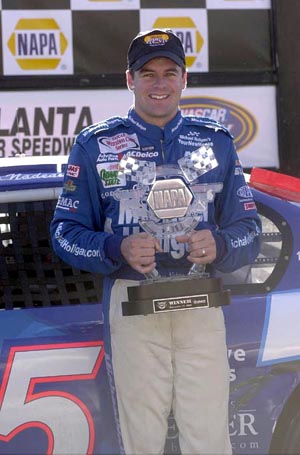
Jerry Anthony Nadeau (born September 9, 1969) is an American former stock car racer. He competed in the NASCAR Winston Cup Series. He started racing go-karts before moving up to car racing, driving in the 12 Hours of Sebring, the European Formula Ford Festival, and the Barber Dodge Pro Series. Nadeau arrived in NASCAR, the highest and most expensive level of stock car racing in the United States, with a limited budget. He started racing part-time in NASCAR and finished sixth in the 1996 Formula Opel Euro Series.
He started full-time racing in 1998 and came third in that year's NASCAR Rookie of the Year award standings. After Nadeau took his first top-ten finish at Talladega Superspeedway in 1999, he won his first NASCAR sanctioned race in the Winston West Series at Las Vegas Motor Speedway. He earned his first Winston Cup victory at Atlanta Motor Speedway the following year. Nadeau achieved his top NASCAR season in 2001 when he finished seventeenth in points, but his racing career ended in 2003 after he suffered serious injuries in a practice crash. He attempted a comeback before moving on to mentor drivers.
Nadeau was born on September 9, 1969, and grew up in Danbury, Connecticut. His parents were Gerald Joseph, a roofer, and veteran in the United States Army during the Vietnam War (1944–2007) and Pauline Cyr Nadeau. Nadeau's ancestors originate from St. John's Valley, Maine. He has one sister, Debbie. Nadeau was educated at Henry Abbott Technical High School and studied automotive technology. His family had connections to auto racing; Gerald raced modifieds at the Danbury Race Arena. Nadeau was given a go-kart by his father when he was four and one-half years old. He also worked with his father in the construction industry to support his career. Speaking about his father's role in his career, Nadeau said, "I learned a lot from my dad, Gerry, while I was growing up. He wasn't afraid to yell and get on my toes to do my job because he hated to lose and I hated to lose. He made me the hungriest guy on the race track."
At the age of seven, he came in first in the eight- to twelve-year-old karting championship held in Bethany, Connecticut. In 1988, aged eighteen, Nadeau won his first World Karting Association (WKA) Gold Cup championship. Motorsports Talent Scout, Dicken Wear, had seen Jerry race for a number of years in Karting and asked if he would like to drive his SCCA SS/C Toyota Celica at an EMRA open track event at Lime Rock Park. Jerry caught the eye of Skip Barber and a few other driving instructors that day. Afterward, he was introduced to Bruce MacInnes and fellow graduates Walter Bladstrom, Tom Cotter, Bill Fisher, Bob Kullas, Frank Martinelli, and Art Regan who gave Nadeau financial support. He defended his karting title for the next two years. In 1991, he took the WKA Grand National Championship. In the same year, Nadeau moved into car racing, driving in the Skip Barber Eastern Series. He took eight victories and became the Rookie of the Year. At the end of 1991, Nadeau won the $100,000 Barber Pro Series shoot-out, allowing him to race in the Barber Dodge Pro Series.
Nadeau drove alongside sports car driver Gene Felton for the Jill Prewitt team which entered the 1992 12 Hours of Sebring, but retired after forty-eight laps because of a differential problem. He also took part in karting events in St. Petersburg, Russia, competing on an ice track, winning two out of eight races. Nadeau later stated the experience helped him to develop the skill of not using his car's brakes on slippery surfaces. In 1993, he raced in the Barber Pro Series, where he finished with one win and took fifth in the points standings. Nadeau also drove in the European Formula Ford Festival winning the qualifying race and coming second in the semi-finals behind Formula Ford champion Peter Duke. Nadeau secured fourth in the final heat. He also took five, top-four finishes in the Firestone Firehawk Series. Nadeau improved in the Barber Pro Series in 1994 by finishing fifth in the championship with two victories. In 1995, he took two victories but fell to thirteenth overall in the standings.
Nadeau entered eight NASCAR Busch Grand National Series races for T&G Racing in 1995. At that time, the Busch Grand National Series was considered NASCAR's feeder circuit, a proving ground for drivers who wished to step up to the organization's premiere circuit, the Winston Cup. It is comparable to Formula One's relationship with Formula 2/Formula 3000/GP2 Series. He originally signed to run fourteen season races. Nadeau moved to North Carolina that year on the advice of public relations worker Tom Cotter, and was on a budget of $200. He often went to Hendrick Motorsports to receive tips. Nadeau failed to qualify for his first career NASCAR race, which took place at Richmond International Raceway. Later that year, he finished 21st at Hickory, 29th at New Hampshire, 19th at the Myrtle Beach Speedway, 20th at the Milwaukee Mile, 31st at Lucas Oil Raceway, and did not qualify for the races at North Carolina Speedway or Homestead-Miami Speedway.
The following year, Nadeau moved to M.P.H. Racing and planned to run ten races in the Busch Series in 1996, in combination with a full season in the Formula Opel European Union Series Championship. He ran only two races in the Busch Series, finishing 39th in both races and did not qualify at Darlington. In Formula Opel, he drove a partial season, running in thirteen out of seventeen races for six teams and finished sixth overall, the highest for an American driver. He later declined a move into the Formula 3000 series, opting for a return to NASCAR. In November 1996, Nadeau and Barber Dodge Pro Series driver Tony Renna represented the United States in the EDFA Nations Cup held at Donington Park and won the silver medal, finishing behind Germany.
After returning from racing in Europe in 1997, Nadeau moved to the Winston Cup Series and signed a five-race contract with Precision Products Racing to replace Morgan Shepherd in the No. 1 Pontiac Grand Prix. During the first races, Nadeau was Shepherd's spotter, and worked on maintaining Shepherd's car before the races. Nadeau also built his own cars for Automobile Racing Club of America (ARCA) and Busch Series events. Nadeau made all five races, including a ninth place qualification at New Hampshire International Speedway, but failed to finish higher than thirtieth and was let go at the end of his contract when the team's sponsor expressed no interest in retaining him. In five races, he had zero top-ten finishes and two DNF's, and finished 54th in season points. He also took part in one race in the Busch Series at Talladega Superspeedway but failed to qualify. He made his first appearance in an ARCA Bondo/Mar-Hyde Series car and finished fourth and second in the races he entered. Nadeau's performances during the season caught the interest of 1988 Champion Bill Elliott and quarterback Dan Marino, and they offered him the chance to become their second driver.
Hub AI
Jerry Nadeau AI simulator
(@Jerry Nadeau_simulator)
Jerry Nadeau
Jerry Anthony Nadeau (born September 9, 1969) is an American former stock car racer. He competed in the NASCAR Winston Cup Series. He started racing go-karts before moving up to car racing, driving in the 12 Hours of Sebring, the European Formula Ford Festival, and the Barber Dodge Pro Series. Nadeau arrived in NASCAR, the highest and most expensive level of stock car racing in the United States, with a limited budget. He started racing part-time in NASCAR and finished sixth in the 1996 Formula Opel Euro Series.
He started full-time racing in 1998 and came third in that year's NASCAR Rookie of the Year award standings. After Nadeau took his first top-ten finish at Talladega Superspeedway in 1999, he won his first NASCAR sanctioned race in the Winston West Series at Las Vegas Motor Speedway. He earned his first Winston Cup victory at Atlanta Motor Speedway the following year. Nadeau achieved his top NASCAR season in 2001 when he finished seventeenth in points, but his racing career ended in 2003 after he suffered serious injuries in a practice crash. He attempted a comeback before moving on to mentor drivers.
Nadeau was born on September 9, 1969, and grew up in Danbury, Connecticut. His parents were Gerald Joseph, a roofer, and veteran in the United States Army during the Vietnam War (1944–2007) and Pauline Cyr Nadeau. Nadeau's ancestors originate from St. John's Valley, Maine. He has one sister, Debbie. Nadeau was educated at Henry Abbott Technical High School and studied automotive technology. His family had connections to auto racing; Gerald raced modifieds at the Danbury Race Arena. Nadeau was given a go-kart by his father when he was four and one-half years old. He also worked with his father in the construction industry to support his career. Speaking about his father's role in his career, Nadeau said, "I learned a lot from my dad, Gerry, while I was growing up. He wasn't afraid to yell and get on my toes to do my job because he hated to lose and I hated to lose. He made me the hungriest guy on the race track."
At the age of seven, he came in first in the eight- to twelve-year-old karting championship held in Bethany, Connecticut. In 1988, aged eighteen, Nadeau won his first World Karting Association (WKA) Gold Cup championship. Motorsports Talent Scout, Dicken Wear, had seen Jerry race for a number of years in Karting and asked if he would like to drive his SCCA SS/C Toyota Celica at an EMRA open track event at Lime Rock Park. Jerry caught the eye of Skip Barber and a few other driving instructors that day. Afterward, he was introduced to Bruce MacInnes and fellow graduates Walter Bladstrom, Tom Cotter, Bill Fisher, Bob Kullas, Frank Martinelli, and Art Regan who gave Nadeau financial support. He defended his karting title for the next two years. In 1991, he took the WKA Grand National Championship. In the same year, Nadeau moved into car racing, driving in the Skip Barber Eastern Series. He took eight victories and became the Rookie of the Year. At the end of 1991, Nadeau won the $100,000 Barber Pro Series shoot-out, allowing him to race in the Barber Dodge Pro Series.
Nadeau drove alongside sports car driver Gene Felton for the Jill Prewitt team which entered the 1992 12 Hours of Sebring, but retired after forty-eight laps because of a differential problem. He also took part in karting events in St. Petersburg, Russia, competing on an ice track, winning two out of eight races. Nadeau later stated the experience helped him to develop the skill of not using his car's brakes on slippery surfaces. In 1993, he raced in the Barber Pro Series, where he finished with one win and took fifth in the points standings. Nadeau also drove in the European Formula Ford Festival winning the qualifying race and coming second in the semi-finals behind Formula Ford champion Peter Duke. Nadeau secured fourth in the final heat. He also took five, top-four finishes in the Firestone Firehawk Series. Nadeau improved in the Barber Pro Series in 1994 by finishing fifth in the championship with two victories. In 1995, he took two victories but fell to thirteenth overall in the standings.
Nadeau entered eight NASCAR Busch Grand National Series races for T&G Racing in 1995. At that time, the Busch Grand National Series was considered NASCAR's feeder circuit, a proving ground for drivers who wished to step up to the organization's premiere circuit, the Winston Cup. It is comparable to Formula One's relationship with Formula 2/Formula 3000/GP2 Series. He originally signed to run fourteen season races. Nadeau moved to North Carolina that year on the advice of public relations worker Tom Cotter, and was on a budget of $200. He often went to Hendrick Motorsports to receive tips. Nadeau failed to qualify for his first career NASCAR race, which took place at Richmond International Raceway. Later that year, he finished 21st at Hickory, 29th at New Hampshire, 19th at the Myrtle Beach Speedway, 20th at the Milwaukee Mile, 31st at Lucas Oil Raceway, and did not qualify for the races at North Carolina Speedway or Homestead-Miami Speedway.
The following year, Nadeau moved to M.P.H. Racing and planned to run ten races in the Busch Series in 1996, in combination with a full season in the Formula Opel European Union Series Championship. He ran only two races in the Busch Series, finishing 39th in both races and did not qualify at Darlington. In Formula Opel, he drove a partial season, running in thirteen out of seventeen races for six teams and finished sixth overall, the highest for an American driver. He later declined a move into the Formula 3000 series, opting for a return to NASCAR. In November 1996, Nadeau and Barber Dodge Pro Series driver Tony Renna represented the United States in the EDFA Nations Cup held at Donington Park and won the silver medal, finishing behind Germany.
After returning from racing in Europe in 1997, Nadeau moved to the Winston Cup Series and signed a five-race contract with Precision Products Racing to replace Morgan Shepherd in the No. 1 Pontiac Grand Prix. During the first races, Nadeau was Shepherd's spotter, and worked on maintaining Shepherd's car before the races. Nadeau also built his own cars for Automobile Racing Club of America (ARCA) and Busch Series events. Nadeau made all five races, including a ninth place qualification at New Hampshire International Speedway, but failed to finish higher than thirtieth and was let go at the end of his contract when the team's sponsor expressed no interest in retaining him. In five races, he had zero top-ten finishes and two DNF's, and finished 54th in season points. He also took part in one race in the Busch Series at Talladega Superspeedway but failed to qualify. He made his first appearance in an ARCA Bondo/Mar-Hyde Series car and finished fourth and second in the races he entered. Nadeau's performances during the season caught the interest of 1988 Champion Bill Elliott and quarterback Dan Marino, and they offered him the chance to become their second driver.
Recent media